Samaúma: The Queen of the Forest Tree (A Rainha da Floresta)
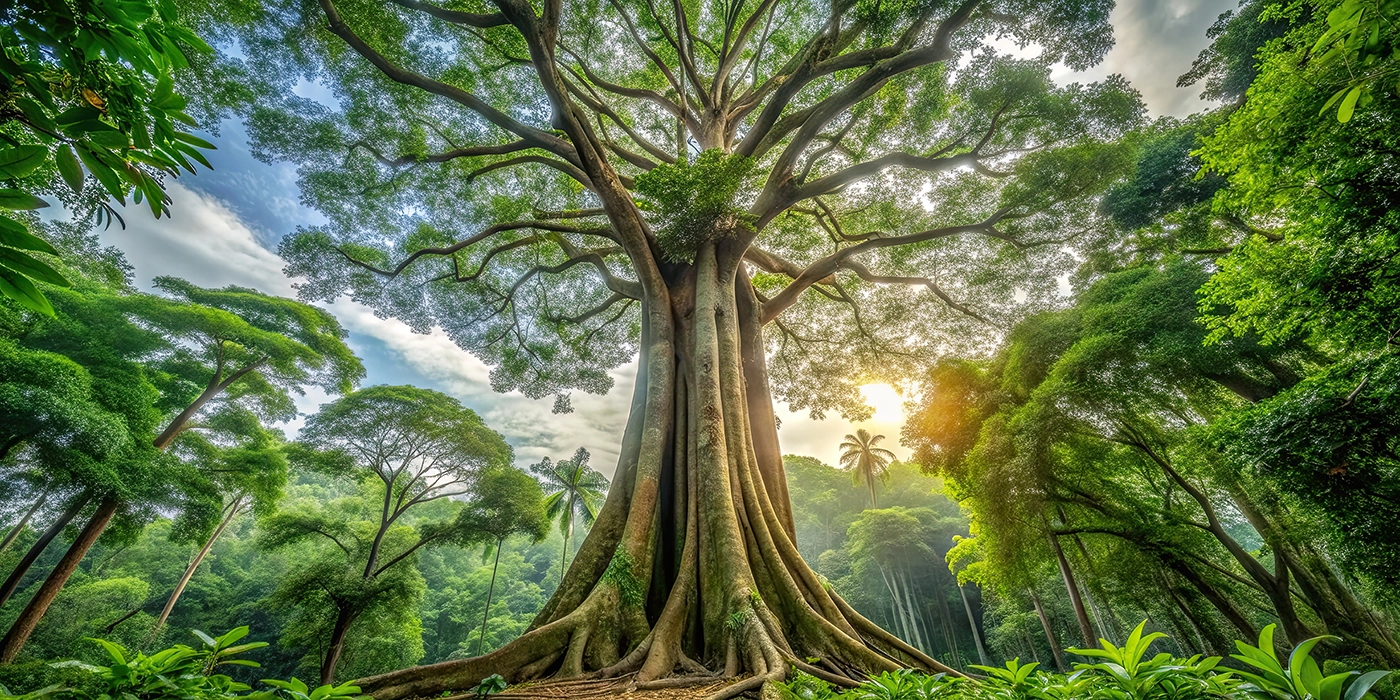
The Samaúma (Ceiba pentandra) is the tree that Brazilians call a Rainha da Floresta — the Queen of the Forest. She is the tallest tree of the Amazon, rising above the canopy to as much as 70 meters, and for the peoples of the forest she is not simply a tree. She is the Mother Tree, the axis, the one under whose crown everything else grows.
This is the tree our house is named for.
What is the Samaúma tree?
Samaúma — also written sumaúma, and known in English as the kapok or silk-cotton tree — is a giant of the Neotropics, native to the Amazon basin and found from southern Mexico through Central America and into northern South America.
She can reach 70 meters (230 feet) in height and 3 to 4 meters across the trunk. Her seed pods hold a fine, floating white fiber — kapok — traditionally used for pillows, mattresses, and insulation. She is deciduous, dropping her leaves in the dry season, and she stands above the other trees of the canopy, alone against the sky.
Why is the Samaúma called the Queen of the Forest?
The name is old and it is not decorative. Across Brazil she is called a Rainha da Floresta, and also Árvore Mãe — the Mother Tree — and Árvore da Vida, the Tree of Life.
She earns these names by what she does. Her crown breaks through the canopy and shelters what lives beneath it: birds, bats, monkeys, bromeliads, orchids, and uncountable insects make their lives in a single samaúma. She was sacred to the ancient Maya, who saw her as the tree joining the underworld, the earth, and the heavens. She is sacred still to many Indigenous peoples of the Amazon, and to fell one without cause is understood, in many places, as a serious wrong.
It is often said of her that her roots draw water from deep in the soil and give it to the trees around her — that she waters her neighbors. Hydraulic redistribution of this kind has been observed in some Amazonian trees, though it has not been specifically established for Ceiba pentandra. We repeat it here as what the forest says of her, because the saying itself tells you what she is understood to be: not a competitor, but a mother.
The sapopemas — the telephone of the forest
The samaúma stands on sapopemas: enormous buttress roots that flare from her trunk like walls, running as much as 15 meters up the tree and 20 meters outward before continuing underground.
They hold her upright in the thin, wet soils where nothing that tall should be able to stand. And they carry sound. Struck with a branch, a sapopema booms, and the sound travels far through the trees. The forest peoples used her this way — a message beaten out against the root of a tree and heard kilometers away. She was the telephone of the forest long before there were telephones.
If you have ever wondered how the trees speak, this is one of the plainer answers.
The Queen of the Forest in the Santo Daime
Here the name deepens, and here it is worth being precise, because two things are often confused.
In the Santo Daime, a Rainha da Floresta — the Queen of the Forest — is a being. Tradition holds that Raimundo Irineu Serra, working the rubber trails in the early twentieth century, was visited in vision by a woman who first named herself Clara. She instructed him to keep an eight-day diet in the forest. When he drank again, she returned and gave her name as the Queen of the Forest, whom Mestre Irineu understood as Nossa Senhora da Conceição, Our Lady of the Conception. She gave him the gift of healing and the mission that became the Doctrine.
Distinct from her is a Rainha — the Queen — the name given in the Daime to the chacruna leaf (Psychotria viridis), the feminine, the Light, married to the Jagube vine, the masculine, the Force. Chacruna is a Rainha. She is not a Rainha da Floresta. The distinction matters, and it is regularly lost by people selling things.
The samaúma, the chacruna, and the Queen who appeared to Mestre Irineu are three presences that the same reverence reaches toward. Our house carries the name in that spirit. You can read more of this lineage in our interview with CristalMar on the building of Céu do Mapiá, and in the Prayer to Mother Ayahuasca.
Samaúma in the medicine of the forest
Among several Amazonian peoples, the ash of sacred trees is prepared and blended with mapacho tobacco to make rapéh. The Kuntanawa work with samaúma in this way, and the resulting blend is grounding, expansive, quiet — many describe it as being held.
Understanding why a tree becomes ash, and what that ash carries, is its own study. We have written about why so many rapéh blends contain tree ash, and if you are new to this medicine entirely, begin with what rapéh is before anything else. Each tree gives a different character; our guide to rapéh blends walks through more than thirty of them.
She is disappearing
The samaúma is threatened by logging and by the clearing of forest for cattle and soy. She grows slowly and lives long — among the oldest living things in the Amazon — and a tree that takes a century to rise is felled in an afternoon.
To understand what is lost with her, read on the importance of the Amazon rainforest. To sit with her as story rather than science, read the legend of the Samaúma, the tree that listens to the dreams of the Earth.
Common questions
What is the Queen of the Forest tree?
The Queen of the Forest is the Samaúma (Ceiba pentandra), called a Rainha da Floresta in Portuguese. It is the tallest tree of the Amazon rainforest and is regarded as the Mother Tree by many Indigenous peoples.
Is samaúma the same as the kapok tree?
Yes. Ceiba pentandra is called samaúma or sumaúma in Brazil and the kapok or silk-cotton tree in English, after the fiber in its seed pods.
Is the Queen of the Forest the same as chacruna?
No. In the Santo Daime, chacruna (Psychotria viridis) is called a Rainha, the Queen. A Rainha da Floresta refers to the samaúma tree, and in the Daime also to the being who appeared to Mestre Irineu, understood as Nossa Senhora da Conceição.
How tall does a samaúma grow?
Up to about 70 meters (230 feet), with buttress roots — sapopemas — extending up to 15 meters up the trunk and 20 meters outward.
Why is samaúma used in rapéh?
The ash of the samaúma is blended with sacred tobacco by peoples such as the Kuntanawa. Different tree ashes give different character; samaúma is associated with grounding and spaciousness.
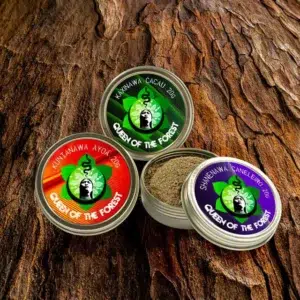
The Kuntanawa prepare a rapéh from the ash of this tree. If it calls you, it is here: Kuntanawa Samaúma and Kuntanawa Sumaúma. We buy it directly from the community that makes it.
Continue exploring
All stories
The medicines of the forest