The Trees That Speak: Master Plants and Dreams with the Forest
Stories of vision, silence, and spiritual messages from the sacred trees of the Earth
When the Forest Speaks Through Dreams
In the deep stillness of the rainforest, where the hum of insects and rustling leaves form a living symphony, something ancient stirs. The trees, vast and silent, do not move in haste—yet they are far from still. To many Indigenous and spiritually attuned people, these towering beings are not background scenery. They are watchers. Teachers. Whisperers of an older truth.
Across cultures, there are those who speak of dreams with trees—vivid, symbolic, or deeply emotional visions in which certain trees or plants communicate something essential. These are not hallucinations, nor simple metaphors. They are considered messages from the spirits of the forest—especially from what some call “master plants”: those with powerful energetic, medicinal, or spiritual properties.
This article explores these sacred relationships between people and trees. Through stories, traditions, and insights, we explore how the forest teaches us—not through books or words, but through silence, presence, and dreams.
The Spirit of the Tree: More Than Biology
In Western science, a tree is a biological organism: trunk, roots, leaves, photosynthesis. In Indigenous knowledge systems, a tree is a multidimensional being. It has a physical body, yes—but also an energy field, a spirit, and a consciousness that interacts with humans, animals, and the Earth itself.
Sacred trees are often seen as living temples, guardians of ancestral knowledge. Many communities believe that trees remember, dream, and communicate. Not with spoken language—but through vibration, resonance, and dreams.
This view is not limited to one region. From the Amazon to Africa, from Celtic oaks to Buddhist Bodhi trees, forests have always been revered as places of spiritual learning.
Master Plants and Tree Teachers
While all trees are considered sacred, certain species are revered as master plants—trees that are believed to hold deep spiritual intelligence and healing power. These are not chosen at random. People may spend years in dietas (periods of deep retreat and fasting) to build a relationship with the spirit of a specific plant.
Examples of such trees include:
- Chullachaki-caspi – believed to connect the dreamer with forest spirits.
- Lupuna – a giant Amazonian tree known as a protector and powerful guide.
- Ayauma – a visionary tree often associated with ancestral communication.
- Ceibo / Kapok tree – linked to cosmic consciousness in many traditions.
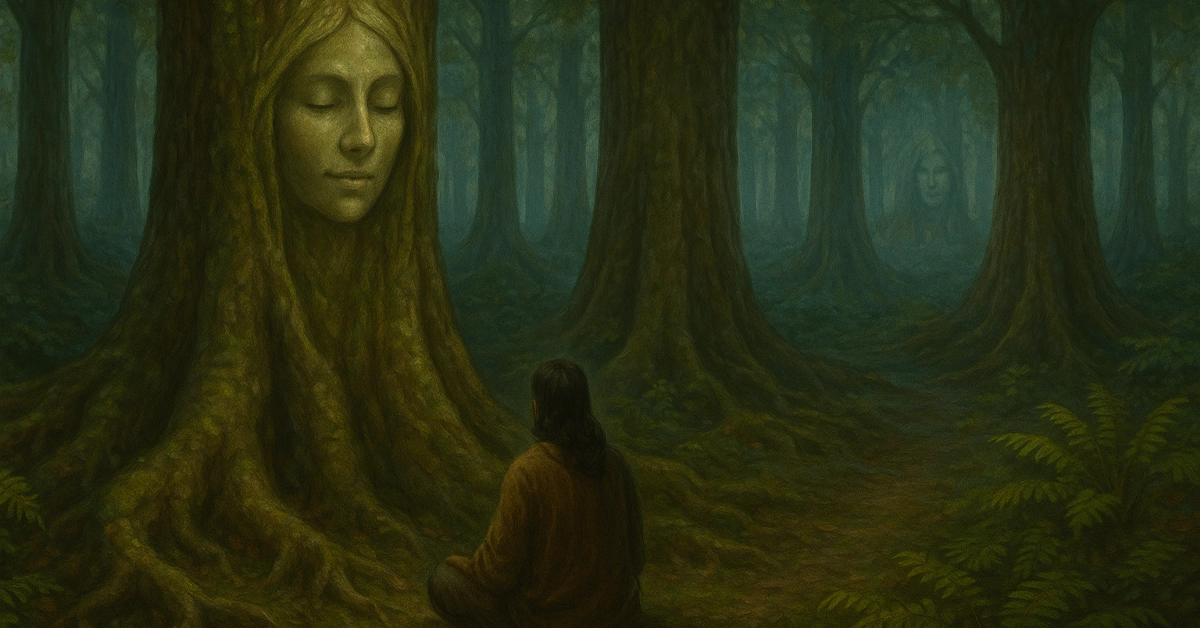
In dreams, these trees may appear not just in their physical form, but as beings—sometimes as human-like figures made of bark and leaves, other times as glowing presences or voices heard within the dreamscape.
Dreams as a Gateway
The dream world is often seen as a place of revelation. In Indigenous cosmovision, dreams are not “just subconscious thoughts”—they are realms of learning and communication.
When someone dreams of a tree or a plant, elders or healers may help interpret the message. Did the tree call your name? Did it offer fruit, sap, or a leaf? Was it uprooted, blooming, on fire, or ancient and still?
Each symbol carries meaning:
- Climbing a tree may represent spiritual ascent or readiness for higher teachings.
- Drinking sap in a dream could signify healing or being nourished by the Earth.
- Being embraced by a tree is often interpreted as a sign of protection or acceptance into the forest’s inner circle.
These dreams are treated with reverence. They may even guide the person’s next steps—whether to seek a plant dieta, begin healing work, or offer something back to the forest.
Stories of Dreaming with Trees
The Tree That Whispered a Name
Ana, a woman living near the forest in Acre, Brazil, once shared that during a time of great confusion in her life, she had a recurring dream of a tall, golden tree glowing in moonlight. Each time, the tree whispered a word in a language she didn’t know.
After several dreams, she brought the sound to a local elder. He recognized it as the name of a little-known plant used for emotional healing and clarity. Following his guidance, Ana began a dieta with that plant. Within weeks, the fog she had felt in her mind began to lift. She later said: “It was not the elder who healed me. It was the tree. The dream came first.”
The Grandfather Tree in the Vision
In another account, Mateo, a young man undergoing spiritual initiation, fasted in isolation near a massive Lupuna tree. On the third night, he dreamed of a giant man with skin like bark and eyes like sap.
This being offered him a seed and said, “Plant this in your heart.” Upon waking, Mateo felt changed. He later discovered that in his family lineage, his great-grandfather had also made offerings to that same tree. The spirit of the tree had become part of his ancestral story, passed through dreams across generations.
The Tree That Cried
An elder in the Upper Amazon once told of dreaming with a sacred ceibo tree that appeared to be weeping sap like tears. In the dream, the elder felt the sorrow of the forest—trees being cut down, rivers polluted, animals fleeing.
He awoke with a heavy heart and called a gathering in his village. That dream led to a new local effort to protect a nearby section of the forest from illegal logging. “The tree cried, so we could act,” he said.
The Role of Silence and Intuition
Trees do not shout. They do not demand. Their teachings are subtle, and they require the listener to be still—within and without.
Spiritual seekers often report that they began hearing or dreaming with trees only after spending time in solitude in the forest. The more they slowed down—turning off the mental chatter—the more they could sense a presence in the trees around them.
This type of communication is not like reading a text or hearing a voice. It’s more like feeling an impression, receiving a knowing, or being gently moved from within.
The silence of the tree is not emptiness. It is fullness without words. In this sense, learning to communicate with trees is learning to listen with the heart.
Offerings and Relationships
In Indigenous traditions, one does not receive without giving. Before approaching a sacred tree, a person may offer tobacco smoke, a song, a strand of hair, or simply a heartfelt intention.
Some healers sleep near specific trees, asking permission before doing so. Others prepare plant-based baths or apply resins to the body before entering a dream journey. This is not superstition—it is relationship.
These offerings are not “gifts” in a transactional sense—they are gestures of respect. To receive wisdom from a tree is a sacred exchange. The forest does not speak to those who do not listen.
Tree Symbols Across Cultures
The idea of sacred trees appears in nearly every spiritual tradition:
- The Yggdrasil of Norse mythology is a world tree connecting the heavens, Earth, and underworld.
- The Bodhi Tree is where the Buddha attained enlightenment.
- The Tree of Life appears in African, Celtic, and Sufi traditions as a symbol of divine order and growth.
In many Indigenous Amazonian traditions, large trees like Lupuna or Samaúma are considered axes mundi—central pillars that connect the spiritual and physical worlds.
These cross-cultural parallels suggest a universal truth: that trees are more than flora—they are bridges between realms.
What the Trees Teach in Dreams
From the many stories and symbols, we can distill some key teachings that sacred trees often offer through dreams:
Rooting Down
Trees teach us to be rooted. In dreams, they may appear to someone who feels ungrounded or lost, reminding them to return to their essence.
Letting Go
Like leaves falling in autumn, trees remind us that shedding is necessary for growth. A tree in a dream may invite us to release old identities or pain.
Becoming Still
The presence of a tree often calls for stillness. If you dream of sitting under a tree, it may be a call to meditate, pause, or listen more deeply.
Rising Without Hurry
Trees grow slowly, over years or centuries. Dreams of trees may encourage patience, reminding us that deep growth takes time.
Modern Reflections and Reconnection
Even outside the forest, many people today are reconnecting with trees as spiritual allies. Urban dwellers report feeling drawn to a specific tree in their neighborhood, sitting under it during times of distress or speaking to it quietly when no one is watching.
Some even receive dreams with trees they’ve never seen before—only to later discover that these species hold spiritual significance in ancestral traditions.
You don’t need to be Indigenous to build a relationship with the trees—but you must come with humility, patience, and sincerity.
Listening to the Whisper of the Leaves
In a world saturated with noise, distraction, and disconnection, the trees offer a different kind of medicine: slow, steady, symbolic, and alive. They do not rush us. They do not push. They simply invite us to be—to sit, to breathe, to listen.
Dreams with trees are not fantasy. They are invitations. They remind us that we are part of a larger ecosystem of spirit, that the forest remembers, and that wisdom does not always come in human language.
When we quiet our minds, open our hearts, and lay our heads down near the roots of the Earth, the trees may speak. And what they offer—through dream, silence, or symbol—can change our lives.
Continue exploring
All stories
The medicines of the forest