Indigenous Fire Management: When Burning Protects the Land
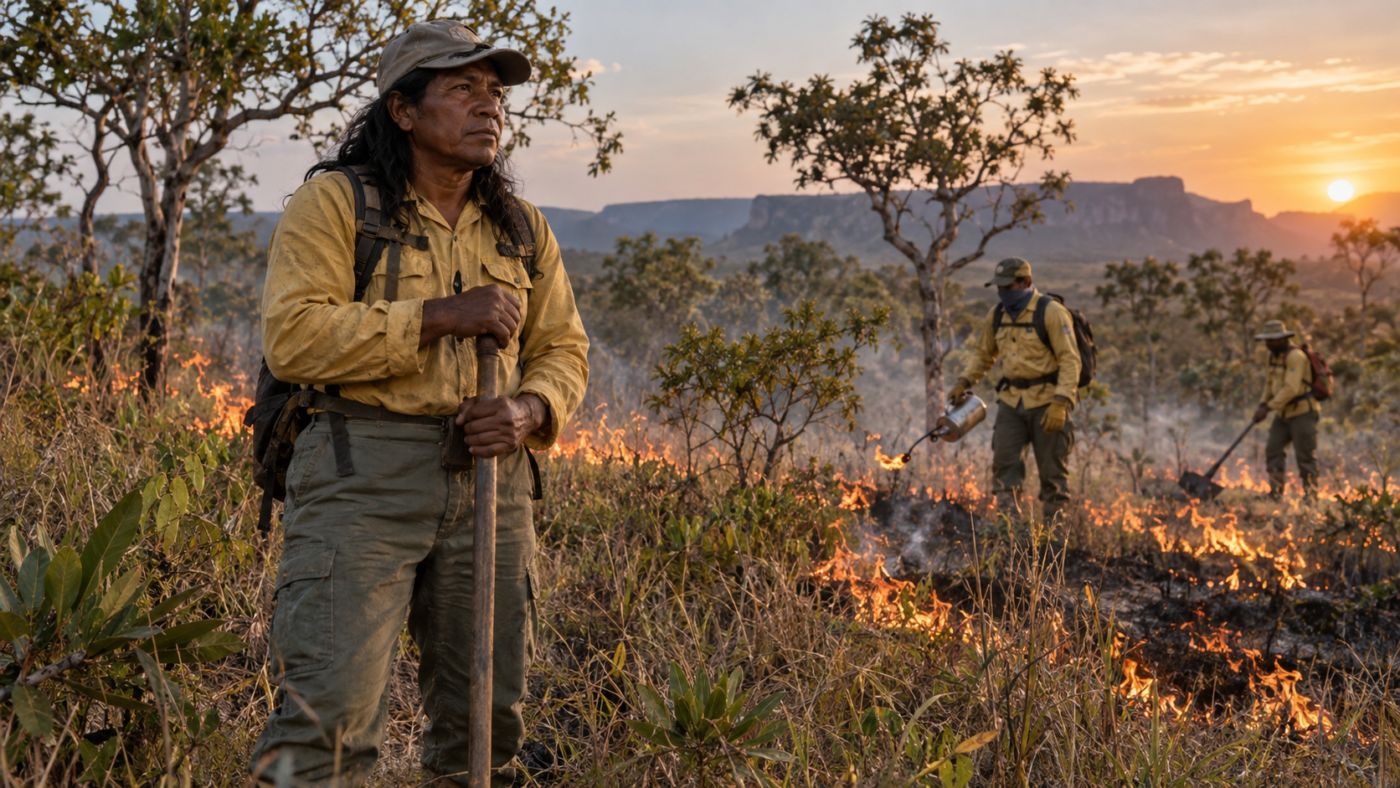
Fire in the Forest: When Is Burning Destruction—and When Is It Knowledge?
Fire is one of the most emotionally charged words in environmental conservation.
We see flames and think of destruction.
Smoke.
Dead animals.
Burned homes.
Blackened forests.
And often, that association is completely justified.
Uncontrolled wildfire can devastate ecosystems, threaten communities, release enormous amounts of carbon and push already vulnerable forests toward collapse.
But there is another story about fire.
A much older one.
In some landscapes, people have used carefully timed, low-intensity fire as a tool for generations.
To manage vegetation.
Protect food resources.
Maintain open habitats.
Reduce accumulated fuel.
Create mosaics across the landscape.
And in some cases, reduce the conditions that allow much larger fires to become catastrophic.
This is where Indigenous fire management enters the conversation.
The challenge is understanding an essential distinction:
Fire is not one thing.
Its ecological effects depend on where it burns, when it burns, how intensely it burns, how frequently it returns and who is making the decision to use it.
A low flame moving slowly through dry Cerrado grasses in a planned burn is not the same event as an uncontrolled fire entering drought-stressed Amazon rainforest.
Treating them as equivalent can be as misleading as treating rain and flood as the same phenomenon.
Fire Is an Ecological Process, Not Just a Disaster
Fire existed long before humans.
Lightning ignited landscapes.
Dry vegetation burned.
Some ecosystems evolved alongside recurring fire.
Others did not.
This distinction is fundamental.
Certain savannas and grasslands contain species adapted to periodic burning.
Some plants resprout quickly.
Some protect living tissues underground.
Some seeds respond to heat or the conditions created after fire.
Other ecosystems—particularly humid tropical forests—can be much more sensitive.
A severe fire entering a forest that rarely burns naturally can cause enormous mortality.
So the question:
“Is fire good or bad?”
is too simple.
The useful question is:
What kind of fire, in what ecosystem, under what conditions?
What Is Indigenous Fire Management?
Indigenous fire management refers broadly to place-based systems through which Indigenous peoples intentionally use, limit, time or respond to fire according to knowledge developed in particular territories.
There is no single universal Indigenous fire practice.
Different peoples use fire for different reasons.
Different landscapes require different approaches.
Practices may involve:
- Managing vegetation;
- Supporting food production;
- Maintaining pathways;
- Encouraging particular plant species;
- Protecting settlements;
- Reducing fuel accumulation;
- Creating habitat mosaics;
- Supporting hunting or gathering;
- Preparing land for agriculture;
- Protecting areas from larger late-season fires.
The knowledge is not simply:
“Set fire to the land.”
It may involve detailed judgments about:
- Humidity;
- Wind;
- Vegetation condition;
- Soil;
- Previous burns;
- Season;
- Topography;
- Time of day;
- Fire direction;
- Desired ecological outcome.
That complexity is what turns burning from a random act into management.
Cultural Burning Is Not the Same as Wildfire
The term cultural burning is often used internationally to describe intentional burning embedded within Indigenous land-management systems.
A cultural burn may be:
Small.
Slow.
Low intensity.
Strategically located.
Repeated according to local ecological conditions.
A wildfire may be:
Unplanned.
Driven by extreme heat and drought.
Difficult to control.
High intensity.
Capable of spreading rapidly across large areas.
One of the most important misunderstandings in modern fire debates is assuming that all burning increases wildfire risk.
In some fire-adapted landscapes, carefully managed early burns can do the opposite.
They can remove part of the dry fuel before the hottest and driest period arrives.
Fire Needs Fuel
A fire needs three basic ingredients:
Heat.
Oxygen.
Fuel.
Land managers cannot remove oxygen from a landscape.
And during hot dry seasons, controlling heat becomes increasingly difficult.
But fuel can sometimes be managed.
Dry grasses.
Dead leaves.
Branches.
Dense understory.
When large amounts of combustible vegetation accumulate continuously across a landscape, fire can move farther and burn more intensely.
Carefully planned fire can create breaks in that continuity.
This is one reason some Indigenous management systems create a mosaic:
Burned areas.
Unburned areas.
Recently regenerated areas.
Older vegetation.
Instead of one continuous mass of dry fuel, the landscape contains patches with different flammability.
The Difference Between Early Fire and Late Fire
Timing can radically alter fire behavior.
In some fire-adapted savanna environments, vegetation early in the dry season may still contain moisture.
Temperatures may be lower.
Humidity may be higher.
Fires can remain relatively mild.
Later in the dry season, the same landscape may be much more combustible.
Grasses are drier.
Humidity falls.
Wind can increase.
Fuel has cured.
Fire may move faster and generate much greater heat.
This is why experienced fire practitioners often care deeply about when something burns.
A calendar date alone is not enough.
Conditions matter.
Brazil’s Cerrado Has a Long Relationship With Fire
The Cerrado is one of the clearest Brazilian examples of a fire-adapted biome.
It contains grasslands, savannas, woodlands and forest formations.
Fire has influenced parts of this landscape for very long periods.
Many Cerrado plants possess characteristics associated with recurrent fire, including:
- Thick bark;
- Underground structures;
- Strong resprouting ability;
- Protected buds.
But acknowledging fire’s ecological role does not mean every Cerrado fire is beneficial.
Very frequent fire can damage ecosystems.
Extremely intense fire can kill vegetation.
Poorly timed fire can threaten wildlife.
The ecological effect depends on the fire regime.
What Is a Fire Regime?
A fire regime describes the characteristic pattern of fire in a landscape.
It can include:
- Frequency;
- Intensity;
- Season;
- Size;
- Duration;
- Type of vegetation burned.
Two landscapes can both experience fire yet have completely different fire regimes.
This concept helps explain why “fire suppression” and “more fire” are both oversimplified solutions.
The goal is often not to eliminate fire completely.
It is to maintain or restore an appropriate fire regime for that particular ecosystem.
Indigenous People Can Shape Fire Regimes
A major 2026 study examining the history of Brazil’s Araucaria Forests gives us a fascinating example.
Researchers reconstructed interactions among climate, vegetation, fire and human activity during the Late Holocene.
They concluded that climatic changes played an important role in Araucaria Forest expansion.
But in locations with stronger evidence of human occupation, Indigenous populations also had major effects.
People cultivated plants, modified fire dynamics and influenced vegetation structure and composition.
The lesson is not that Indigenous people simply “burned the forest.”
The lesson is that human management became part of landscape ecology.
Long before modern conservation agencies existed, people were already interacting with vegetation through fire and cultivation.
The Araucaria Forest Was Not Simply Untouched Wilderness
This challenges a familiar environmental myth.
We often imagine precolonial landscapes as ecosystems existing completely independently of human influence.
But many Indigenous societies actively managed landscapes.
The 2026 Araucaria research adds to growing evidence that climate and human land management interacted in shaping vegetation.
That does not mean every forest was intensively managed.
Nor does it mean human influence was always beneficial.
It means the history was more complex than:
Nature existed.
Then humans arrived and disturbed it.
People were already ecological participants.
But Araucaria Forest Is Not the Same as the Amazon
This distinction is crucial.
The study concerns Brazil’s southern Araucaria Forest landscape.
Its conclusions should not be casually transferred to humid Amazon rainforest.
Different ecosystems have different fire histories.
The Cerrado is not the Amazon.
Araucaria Forest is not identical to either.
A practice appropriate in one landscape can be dangerous in another.
This is exactly why Indigenous fire management cannot be reduced to a universal technique.
It is place-based knowledge.
Humid Amazon Forests Can Be Highly Fire-Sensitive
Most intact Amazon rainforest is not naturally adapted to frequent ground fire in the same way many savanna systems are.
Under normal humid conditions, dense forest can resist fire surprisingly well.
Moisture limits flame spread.
But drought changes this protection.
Leaves dry.
Branches accumulate.
Humidity falls.
Deforestation creates hotter forest edges.
Once fire enters, trees that evolved without frequent burning can suffer severe damage.
And after a forest burns, it may become more vulnerable to burning again.
This creates a dangerous feedback loop.
Therefore:
Using fire in one Brazilian ecosystem successfully does not mean fire should be introduced indiscriminately into another.
Climate Change Is Changing the Rules
Traditional fire management developed under particular environmental conditions.
But those conditions are shifting.
Heat is increasing.
Dry seasons are changing.
Droughts can become more intense.
Vegetation may dry earlier.
Practices that were historically safe may therefore require adaptation.
This is one of the most important realities facing Indigenous fire practitioners today.
Traditional knowledge is not a frozen rulebook.
It must respond to a changing environment.
When Old Timing Becomes Dangerous
Imagine that a community traditionally burns during a season when vegetation remains relatively moist.
For generations, the timing works.
Then climate conditions change.
Rain ends earlier.
Humidity drops faster.
Wind patterns shift.
A burn performed according to the old calendar may now behave differently.
This does not mean the knowledge was wrong.
The environment has changed.
Living knowledge responds by observing those changes and adjusting practice.
That is one of the fundamental differences between living traditional knowledge and nostalgia.
The Xerente Are Showing What This Can Look Like Today
In 2026, attention turned toward Indigenous fire management in the Xerente territory in Tocantins.
There, Indigenous practitioners have worked with environmental agencies to conduct controlled burns in the Cerrado before the most dangerous part of the dry season.
The process combines different forms of knowledge.
Indigenous experience with local vegetation and fire behavior.
Weather forecasts.
Satellite monitoring.
Government fire-management infrastructure.
Trained brigades.
This is not traditional knowledge being replaced by technology.
Nor is it technology merely “validating” traditional knowledge.
It is a practical example of collaboration.
Integrated Fire Management
Brazil increasingly uses the concept of Integrated Fire Management.
The principle recognizes that fire management may require several strategies rather than total suppression.
These can include:
- Fire prevention;
- Prescribed burning;
- Cultural burning;
- Fuel management;
- Firebreaks;
- Monitoring;
- Firefighting;
- Community brigades;
- Scientific research;
- Traditional ecological knowledge.
The goal is to manage the entire fire regime.
Not merely extinguish every flame after it begins.
Brazil Has Learned From the Limits of Zero-Fire Thinking
For many years, environmental policy frequently treated fire almost exclusively as an enemy.
In certain ecosystems, suppressing every burn can allow fuel to accumulate.
Then, when fire eventually arrives under extreme conditions, it may become far more difficult to control.
This has pushed fire science toward more nuanced approaches.
But nuance does not mean abandoning prevention.
It means distinguishing:
Fire that belongs in a management plan.
Fire that must be prevented.
Fire that must be suppressed immediately.
Indigenous Brigades Can Reduce Wildfire Risk
Research published in 2026 examining Indigenous Lands in Brazil found meaningful differences associated with federal Indigenous fire brigades.
Indigenous Lands covered by these brigades showed a substantial reduction in active fires after implementation, while areas without equivalent coverage showed increases.
This is important because it undermines another stereotype:
That Indigenous fire use means Indigenous communities cause more wildfire.
In reality, trained local brigades can be part of the solution.
Knowledge combined with infrastructure matters.
Fire Management Is Also Governance
Effective fire management depends on more than ecological knowledge.
Someone must decide:
Where burning is allowed.
Who authorizes it.
Who participates.
Who receives equipment.
Who gets paid.
Who is blamed when something goes wrong.
This makes fire political.
Indigenous people have historically faced criminalization or stigma for burning practices while large-scale destructive fires caused by land clearing, speculation or uncontrolled agricultural burning may involve entirely different dynamics.
A fair fire policy must distinguish among causes and contexts.
The Same Flame Can Have Different Purposes
Consider three fires.
Fire One: Land Clearing
Large vegetation areas are intentionally burned after clearing to convert land.
Fire Two: Wildfire
Fire escapes control during extreme drought and spreads through forest.
Fire Three: Cultural or Prescribed Burn
A trained group intentionally applies low-intensity fire to a limited area under selected environmental conditions.
All three involve combustion.
Ecologically and socially, they are not the same event.
Calling them all simply “forest fire” hides critical differences.
Purpose Is Important—but Purpose Is Not Enough
A fire can have a good intention and still become dangerous.
This must be stated clearly.
Traditional purpose does not make fire automatically safe.
Safety depends on:
- Weather;
- Training;
- Vegetation;
- Fuel;
- Equipment;
- Experience;
- Coordination;
- Emergency planning.
Respecting Indigenous fire knowledge does not mean romanticizing risk.
It means recognizing expertise while taking changing environmental conditions seriously.
Knowledge Can Be Highly Local
An experienced practitioner may know how one valley behaves under fire.
Where wind changes.
Where moisture remains.
Which grasses burn quickly.
Which areas act as natural barriers.
Such knowledge can be extraordinarily detailed.
But it may not transfer perfectly even to a neighboring territory.
This is why standardized fire policy can sometimes clash with local ecological reality.
A national rule can provide safety standards.
It cannot contain every landscape.
Fire Can Create Mosaics
One important feature of some traditional burning systems is heterogeneity.
Instead of burning an entire landscape uniformly, small burns at different times create patches.
Some vegetation is recently burned.
Some is regenerating.
Some has remained untouched for years.
These mosaics can reduce continuous fuel and create varied habitats.
The landscape becomes less uniform.
Ecological heterogeneity can support different species and reduce the path available to a single large fire.
Fire Can Also Destroy Habitat
Again, nuance requires the opposite side.
Too much burning can simplify landscapes.
Repeated fire may prevent tree regeneration.
High-intensity burns can kill animals.
Smoke affects health.
Fire can damage soils.
Sensitive ecosystems can degrade rapidly.
There is no ecological rule that says:
“More burning equals more biodiversity.”
The question remains the fire regime.
Smoke Is Also a Public-Health Issue
Fire management discussions sometimes focus so strongly on biodiversity that smoke is overlooked.
Smoke contains fine particles that can harm human health.
Even planned burns produce emissions.
This means responsible fire planning may also consider:
- Wind direction;
- Nearby villages;
- Schools;
- People with respiratory conditions;
- Timing;
- Amount of material burned.
A good ecological intervention should not ignore human health.
Children, Elders and Knowledge Transmission
Like plant knowledge or bee knowledge, fire knowledge can move between generations.
Young people may learn by observing experienced practitioners.
They learn not only how to light fire.
More importantly, they learn when not to light it.
What weather feels unsafe.
How wind changes flame direction.
Which vegetation burns differently.
Where animals may escape.
How to extinguish edges.
What signals require stopping.
The deepest knowledge may be restraint.
Knowing When Not to Burn Is Fire Knowledge
This deserves emphasis.
Fire knowledge is not measured by how often someone burns.
A knowledgeable decision may be:
Not today.
Too dry.
Too windy.
Wrong vegetation.
Wrong season.
Too much accumulated fuel.
A fire-management culture built around judgment rather than routine is better able to adapt to changing conditions.
Technology Can Strengthen Cultural Burning
Modern fire programs can combine traditional expertise with tools such as:
- Satellite fire detection;
- GPS;
- Drones;
- Weather stations;
- Humidity measurements;
- Fire-behavior models;
- Radio communication.
Technology can extend observation.
It does not erase place-based experience.
The practitioner on the ground may understand something a satellite does not.
The satellite may detect something no person can see from one location.
Together, they can improve decisions.
Science and Indigenous Knowledge Ask Different Questions
Fire ecology may ask:
How frequently does this vegetation burn?
What mortality follows fire?
How much carbon is released?
How does biodiversity respond?
Indigenous fire knowledge may also ask:
When does this area need fire?
Which plants return afterward?
Where should fire stop?
What food resources depend on this landscape?
Who is responsible for burning?
These questions overlap but are not identical.
That is a strength.
Science Should Not Extract Fire Knowledge
As cultural burning becomes fashionable in conservation circles, there is a risk.
Institutions may want the techniques without supporting the people.
They may ask Indigenous practitioners:
Tell us when to burn.
Show us how.
Map your knowledge.
Then outside agencies retain control.
That is extraction.
Indigenous fire stewardship involves governance, cultural authority and territorial rights—not simply a technical recipe that can be copied.
Indigenous Fire Management Depends on Territory
Knowledge of fire is inseparable from access to land.
A community displaced from its territory cannot practice long-term landscape management in the same way.
Without territorial security, generations of observation can be interrupted.
This is why Indigenous fire stewardship cannot be separated from Indigenous rights.
You cannot ask people to manage landscapes while denying them authority over those landscapes.
The Myth of the Untouched Landscape
Fire history also challenges the idea that conservation should always restore landscapes to a state without human influence.
In many places, there was no such recent state.
Humans have shaped ecosystems for thousands of years.
Through:
- Fire;
- Cultivation;
- Hunting;
- Plant dispersal;
- Harvesting;
- Pathways.
Removing people from these systems can also produce ecological change.
Sometimes conservation is not about removing human relationships.
It is about restoring responsible ones.
This Does Not Justify Deforestation
Recognition of historical Indigenous land management is sometimes misused.
If humans shaped forests in the past, someone may argue:
“Then modern deforestation is just another form of management.”
That conclusion is false.
Scale matters.
Intensity matters.
Technology matters.
Purpose matters.
Ecological outcome matters.
Small-scale landscape management over generations is not equivalent to clearing thousands of hectares for industrial land conversion.
Historical human influence does not erase the concept of environmental destruction.
Cultural Fire Is Not a License for Commercial Burning
The same caution applies to businesses and landowners.
Companies cannot describe large-scale clearing fires as “traditional fire management” merely because controlled burning exists in Indigenous cultures.
Cultural burning belongs to specific knowledge systems and management objectives.
Appropriation of that language can become greenwashing.
What Can Conservation Learn From Indigenous Fire Management?
Several principles emerge.
1. Fire Must Be Contextual
No universal fire prescription works everywhere.
2. Timing Matters
The same landscape can respond differently depending on season and conditions.
3. Smaller Fires Can Influence Larger Fire Risk
Strategic burns may reduce fuel continuity in appropriate ecosystems.
4. Long-Term Observation Matters
Experienced communities can recognize subtle landscape patterns.
5. Knowledge Must Adapt
Climate change means historical practices may need adjustment.
6. Governance Matters
The people holding knowledge must have authority in management decisions.
7. Fire Is Only One Tool
Healthy landscapes also require habitat protection, territorial rights, monitoring and prevention.
What Readers Should Understand About Fire Headlines
When you see:
“Fires rise in Brazil”
or:
“Indigenous people use fire”
those statements need context.
Ask:
Where?
Which biome?
What caused the fire?
Was it intentional?
Was it planned?
What was the intensity?
What season?
What vegetation?
Did it escape?
Was it connected to land clearing?
Was it part of an authorized management program?
Without these questions, fire statistics can obscure more than they reveal.
When Burning Is Destruction
Burning becomes destructive when it:
- Escapes control;
- Enters fire-sensitive ecosystems;
- Occurs under extreme dry conditions;
- Repeatedly burns areas unable to recover;
- Is used for illegal deforestation;
- Threatens communities;
- Produces severe ecological degradation.
The consequences can include:
- Tree mortality;
- Wildlife death;
- Smoke exposure;
- Carbon emissions;
- Soil damage;
- Forest degradation;
- Increased future fire vulnerability.
There should be no romanticism about those outcomes.
When Fire Can Become Knowledge
Fire becomes knowledgeable management when it is embedded in:
- Purpose;
- Ecological understanding;
- Timing;
- Restraint;
- Experience;
- Monitoring;
- Community authority;
- Safety;
- Adaptation.
Even then, results must be observed.
Knowledge is not demonstrated simply because a practice is old.
It remains knowledge because people continue paying attention to consequences.
Fire Is a Relationship With Risk
Perhaps the most useful way to understand Indigenous fire management is not as a technique.
It is a relationship with risk.
People know that fire can create.
And destroy.
They work with something that cannot be treated casually.
That demands attention.
Humility.
Timing.
Responsibility.
This relationship may offer an important lesson for a modern world increasingly confronted by wildfire.
Climate Change Makes That Lesson More Urgent
The 21st century is producing fire conditions unlike those experienced during much of recent human history.
Hotter temperatures.
Long droughts.
Drier fuels.
Changing vegetation.
Extreme weather.
This makes simplistic fire policy increasingly dangerous.
“Always suppress fire” may fail in some fire-adapted landscapes.
“Let it burn” may be disastrous elsewhere.
“Traditional burning always works” is equally simplistic.
We need adaptive management.
And adaptation requires both history and measurement.
The Future May Be Co-Management
One of the most promising directions is genuine co-management.
Indigenous practitioners.
Fire ecologists.
Government agencies.
Local communities.
Meteorologists.
Working together.
Not with Indigenous knowledge added as cultural decoration.
But with decision-making shared.
The 2026 Xerente example in Brazil shows what this direction can look like.
Traditional understanding of landscape.
Modern monitoring.
Trained brigades.
Institutional support.
Each contributes something different.
Conclusion: Fire Is Neither Enemy Nor Medicine by Itself
Fire does not carry morality.
It is not automatically destruction.
It is not automatically renewal.
It is a process.
Its meaning depends on relationship.
The study of Indigenous fire management challenges us to move beyond one of environmentalism’s simplest equations:
Fire = bad.
Sometimes that equation is correct.
An uncontrolled fire entering drought-stressed rainforest can be catastrophic.
But a carefully planned low-intensity burn in a fire-adapted landscape can belong to a completely different ecological process.
Research into Brazil’s Araucaria Forest history shows that Indigenous peoples were not simply passive inhabitants of landscapes. In areas of stronger human activity, they influenced fire regimes, cultivated plants and shaped vegetation over long periods.
Contemporary programs in the Cerrado show that this knowledge is not only archaeological.
It remains alive.
Indigenous fire practitioners today are working with satellites, weather data, trained brigades and public agencies to reduce the risks of catastrophic fire.
That does not make fire harmless.
It makes the question more intelligent.
Not:
Should humans use fire?
But:
Who?
Where?
When?
Why?
How?
Under what conditions?
And with what consequences?
The difference between destruction and knowledge may be found in those questions.
A wildfire runs because conditions allow it.
A knowledgeable burn stops because someone knows where it should end.
And perhaps the deepest form of fire knowledge is not knowing how to light a flame.
It is knowing when not to.
FAQ
What is Indigenous fire management?
Indigenous fire management refers to diverse place-based systems through which Indigenous peoples intentionally use, control, avoid or time fire according to ecological knowledge developed within particular territories.
Is Indigenous fire management the same as wildfire?
No. Indigenous or cultural burning is generally intentional and planned, whereas wildfire is uncontrolled. The ecological effects depend on intensity, season, vegetation and landscape.
What is cultural burning?
Cultural burning refers to intentional fire use embedded within Indigenous land-management systems. Practices vary greatly among peoples and ecosystems.
Can controlled burning prevent wildfires?
In some fire-adapted landscapes, carefully planned burns can reduce continuous dry fuel and help limit the extent or intensity of later fires. This does not apply universally to every ecosystem.
Is the Amazon rainforest adapted to fire?
Most intact humid Amazon rainforest is relatively fire-sensitive compared with savanna ecosystems such as the Cerrado. Drought and degradation can make Amazon forests increasingly vulnerable to fire.
What did the 2026 Araucaria Forest study find?
The study found that climate contributed significantly to Araucaria Forest dynamics over several thousand years, while areas with stronger Indigenous occupation showed evidence of crop cultivation, altered fire dynamics and major effects on vegetation structure and composition.
What is Integrated Fire Management?
Integrated Fire Management combines prevention, monitoring, prescribed burning where appropriate, firefighting, community participation, scientific knowledge and traditional ecological knowledge to manage fire across landscapes.
Are Indigenous communities involved in fire management in Brazil today?
Yes. Contemporary programs involve Indigenous brigades and practitioners working with environmental agencies, including initiatives in the Cerrado where traditional knowledge is combined with weather forecasts and satellite monitoring.
Does Indigenous fire management mean fire is always beneficial?
No. Fire can be extremely destructive. Outcomes depend on ecosystem, frequency, intensity, timing, weather, vegetation and management. Respecting traditional knowledge does not mean assuming every fire is safe.
Why is climate change making fire management more difficult?
Hotter temperatures, longer droughts and drier vegetation can make fire more intense and unpredictable. Practices historically considered safe may need to be adapted to new conditions.
Continue exploring
All stories
The medicines of the forest