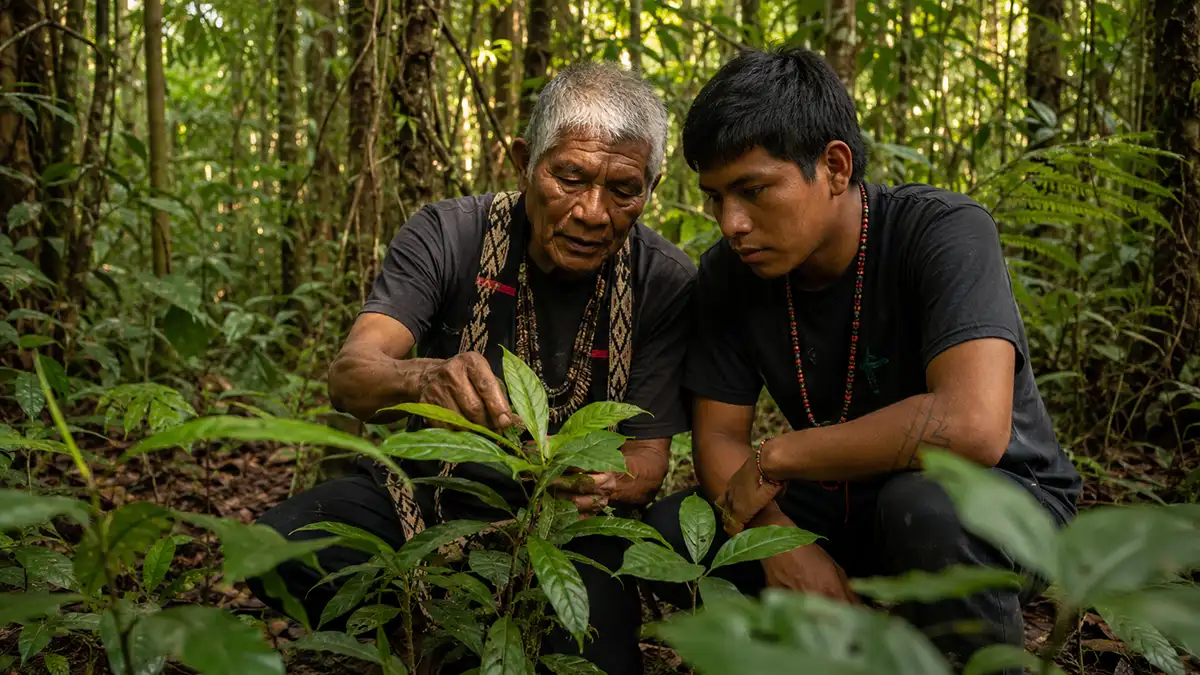
A plant can be photographed. Its scientific name can be written in a database. Its leaves can be collected and its chemical compounds analyzed. But none of these things, by themselves, preserve the entire knowledge surrounding that plant.
To understand traditional Amazonian medicine, we have to look beyond ingredients.
Knowledge lives in people, conversations, languages, places, repeated observations and the relationships connecting one generation with another.
It can live in the difference between two leaves that appear almost identical to an outsider. It can live in knowing when not to collect something. It can live in a story about who first taught a preparation.
And it can live in the forest itself.
A 2026 scientific review focusing on the Tenetehara Tembé of the Alto Rio Guamá Indigenous Territory in Pará highlights this inseparable relationship among traditional health practices, medicinal plants, biodiversity and territory.
Traditional knowledge is not simply a recipe book waiting to be translated.
It is a living process.
Traditional Amazonian Medicine Is More Than a List of Plants
Online discussions of Amazonian medicine often reduce knowledge to lists: one plant for one purpose, another plant for another.
That can create the impression that traditional knowledge is simply a catalog.
Knowing a plant may actually involve knowing:
- Where it grows;
- Which habitat it prefers;
- What it looks like at different stages;
- Which similar species must not be confused with it;
- Who traditionally works with it;
- Which preparation belongs to which context;
- What restrictions accompany its use;
- Which language describes it;
- How harvesting affects the plant;
- How environmental change affects its availability.
The journey from plant to knowledge is far more complex than attaching a benefit to a botanical name.
Knowledge Begins With Attention
Imagine walking through a forest with someone who has spent decades observing it.
You see green.
They see differences.
Bark, leaf shape, smell, soil, water and neighboring species can all carry information.
Traditional ecological knowledge develops through observations repeated across time.
Knowledge is remembered, compared with experience and adapted as environmental conditions change.
Learning Happens in the Territory
One of the central themes in research on the Tenetehara Tembé is the relationship between health and territory.
Forest integrity matters because traditional healthcare practices depend partly upon continued access to biodiversity.
Territory therefore becomes more than the location where knowledge happens.
It can be part of the knowledge system itself.
A photograph can show a plant.
The territory teaches context.
The Forest Becomes a Classroom
Ecological learning can happen while:
- Walking;
- Gathering food;
- Fishing;
- Planting;
- Preparing materials;
- Identifying trees;
- Listening to stories;
- Watching animals;
- Observing seasonal change;
- Participating in community life.
Knowledge becomes embedded in experience.
This helps explain why ecological knowledge can become harder to maintain when communities lose access to their territories.
The Role of Elders and Experienced Knowledge Holders
Older and experienced community members may play important roles in knowledge transmission, but not every Indigenous culture organizes expertise in the same way.
Different people may hold knowledge concerning plants, childbirth, food, agriculture, crafts, songs, healing or other areas.
Traditional Amazonian medicine may therefore involve networks of expertise rather than one person who knows everything.
This is why the stereotype of a single universal “shaman” representing all Indigenous knowledge is misleading.
Young People Are Not Empty Containers
Intergenerational learning is not simply a one-way transfer.
Young people question, compare, reinterpret and adapt knowledge.
They may move through community life, universities, biomedical healthcare, smartphones and digital media simultaneously.
An Indigenous student using GPS technology to document plants has not automatically abandoned traditional knowledge.
Cultures survive partly because they adapt.
Language Carries Knowledge Between Generations
Language is one of the most important bridges through which knowledge travels.
A plant name may contain information about habitat, appearance, relationships or cultural meaning.
When languages become endangered, translation can preserve some information, but it may not preserve every ecological and cultural distinction.
Protecting Indigenous languages can therefore contribute to protecting traditional ecological knowledge.
Observation Comes Before Explanation
Traditional ecological expertise often develops through repeated encounters.
A person may observe a plant when young, mature, flowering, fruiting, during floods and during drought.
Eventually recognition becomes immediate.
That form of expertise is difficult to reproduce through occasional exposure.
Memory Is Part of the System
Traditional knowledge can also contain environmental memory.
A community may remember where plants once grew, how rivers changed or how fire altered a landscape.
These memories can become ecological records even when they were never written down.
Traditional Knowledge Changes Over Time
The word “traditional” should not imply that knowledge remains frozen.
Indigenous communities can incorporate new practices and technologies while maintaining cultural continuity.
Traditional medicine and biomedical healthcare may coexist, creating relationships sometimes described as intermedicality.
What Is Intermedicality?
Intermedicality describes the interaction among different systems of health knowledge and practice.
An Indigenous patient or family may move between community care, medicinal plant knowledge, Indigenous health professionals and biomedical services.
The challenge is to create dialogue without assuming only one system deserves respect.
Medicinal Plants Are Part of Biocultural Identity
A medicinal plant is biological.
Knowing it is cultural.
Its habitat is ecological.
Its name is linguistic.
Its use may relate to health, family and history.
These dimensions overlap.
This is what makes traditional plant knowledge biocultural.
What Happens When the Forest Changes?
Knowledge transmission depends on opportunities to encounter the things being taught.
When a species becomes rare locally, younger generations may still learn its name but have fewer opportunities to develop direct familiarity.
Environmental degradation can therefore affect not only biodiversity but opportunities for learning.
Territory Loss Can Become Knowledge Loss
Deforestation destroys more than trees.
It can destroy classrooms.
When forest paths, rivers and plant populations change, some of the everyday contexts through which knowledge is transmitted can disappear.
Culture and biodiversity may therefore erode together.
Traditional Medicine Depends on Biodiversity
Plant-based healthcare systems require access to plants and ecosystems.
Protecting traditional medicine therefore also means protecting habitats.
A functioning forest includes pollinators, soils, water, shade and countless ecological relationships that cannot be recreated by cultivating only a few commercially popular species.
Teaching Also Includes What Not to Do
Knowledge may include boundaries:
- Do not confuse these species;
- Do not collect at this time;
- Do not remove too much;
- This requires specialist knowledge;
- This is not appropriate in this situation.
Restrictions and caution are part of knowledge too.
Not Everyone Has the Same Knowledge
Knowledge can vary according to experience, family, specialist responsibility, territory and opportunities for learning.
Some information may be widely shared.
Other knowledge may belong to specialists or remain culturally restricted.
One person’s account should therefore not automatically be generalized as the belief of an entire Indigenous people.
Storytelling Can Carry Knowledge
Stories can preserve environmental memory, ethical lessons, relationships with animals, seasonal observations and place-based knowledge.
Teaching does not always look like formal instruction.
Sometimes knowledge travels through narrative.
Learning Through the Body
Hands learn texture.
Eyes learn subtle differences.
Noses learn aromas.
Feet learn landscapes.
A written description can preserve information, but repeated experience creates another kind of familiarity.
Traditional Knowledge Is Not Folklore
Traditional Amazonian medicine involves observation, classification, experimentation, memory and adaptation.
It may also include cultural and spiritual dimensions that differ from biomedical frameworks.
Recognizing traditional knowledge as legitimate does not mean claiming every traditional treatment has been clinically proven.
Respect and scientific caution can coexist.
Traditional Knowledge Is Not Automatically Public Knowledge
When communities share knowledge with researchers, that information does not automatically become free commercial material.
Ethical approaches emphasize:
- Free, prior and informed consent;
- Collective rights;
- Fair benefit sharing;
- Indigenous authorship;
- Community authority over what can be shared.
Research Can Preserve Knowledge—or Extract It
Ethnobotanical research can support education, language preservation, environmental monitoring and community archives.
But research becomes extractive when outsiders collect information, receive professional or commercial value and return little to the communities that shared it.
Ethics must therefore extend beyond the initial interview.
Indigenous Youth Can Become the Researchers
Participatory ethnobotany offers another model.
Indigenous researchers can help determine:
- Which questions matter;
- What can be documented;
- What should remain private;
- How information should be interpreted;
- Who controls the data;
- How benefits return to the community.
The next generation can become not only recipients of knowledge but researchers, archivists and defenders of it.
Technology Can Strengthen Transmission
Community-controlled technologies may include:
- Digital herbariums;
- Audio archives;
- Indigenous-language dictionaries;
- GPS mapping;
- Documentary film;
- Photography;
- Community databases;
- Digital storytelling.
Technology can support continuity when communities determine how it is used.
The Most Important Archive May Still Be the Living Community
Books matter.
Databases matter.
Recordings matter.
But none fully replaces a living community.
Knowledge remains strongest when a language is spoken, plants remain accessible, specialists have opportunities to teach and young people can continue participating in community life.
An archive can preserve the past.
A living community carries knowledge into the future.
Traditional Amazonian Medicine and the Future
The future of traditional Amazonian medicine does not need to reproduce the past exactly.
Indigenous communities are contemporary societies.
Young people can study medicine and ethnobotany. Traditional specialists can collaborate with health teams. Digital technology can support oral traditions.
The important question is not whether tradition changes.
Who controls the change?
From Knowledge Holders to Knowledge Partners
Indigenous participation should mean more than being consulted after outside institutions have already made decisions.
Communities can participate in:
- Defining research questions;
- Designing healthcare programs;
- Interpreting results;
- Deciding what can be shared;
- Writing publications;
- Receiving economic benefits;
- Setting conservation priorities.
This is shared authority rather than symbolic inclusion.
What Businesses Working With Forest Traditions Can Learn
- Ask who taught the knowledge being shared.
- Identify specific peoples and communities when appropriate.
- Obtain permission before using Indigenous names.
- Describe traditional use accurately.
- Do not convert traditional knowledge into unsupported medical claims.
- Compensate producers fairly.
- Respect culturally restricted knowledge.
- Support long-term relationships.
- Represent Indigenous people as contemporary knowledge holders.
- Help strengthen the conditions in which knowledge can survive.
What Readers Can Learn From This
When you encounter the phrase “traditionally used in the Amazon,” ask:
- Which people?
- Which territory?
- Which language?
- Who documented the knowledge?
- Is it specialist or widely shared knowledge?
- Is traditional use being confused with clinical evidence?
- Who benefits from commercialization?
Better questions lead toward more respectful relationships.
Conclusion: Traditional Amazonian Medicine Survives Through Relationship
Traditional knowledge does not move between generations like a computer file.
It travels through relationships.
Someone teaches.
Someone listens.
Someone observes.
Someone asks questions.
Someone notices the forest changing.
Someone adapts.
Someone teaches again.
This is why traditional Amazonian medicine cannot be preserved simply by creating lists of plants.
Plants matter, but so do:
- Languages;
- Specialists;
- Families;
- Young people;
- Stories;
- Territory;
- Biodiversity;
- Community autonomy;
- Opportunities to practice knowledge.
Research concerning the Tenetehara Tembé reinforces the close relationship among health knowledge, medicinal plants, biodiversity and territorial integrity.
Environmental degradation therefore threatens more than natural resources.
It can weaken the conditions through which knowledge is practiced and transmitted.
The deeper goal is not simply preserving information.
It is preserving the conditions in which knowledge can continue living.
An experienced person teaching.
A young person questioning.
A plant growing.
A language being spoken.
A community remaining on its territory.
That is how knowledge travels forward.
Not simply from plant to product.
But from plant to observation.
From observation to language.
From language to memory.
From memory to another person.
And from one generation to the next.
Frequently Asked Questions About Traditional Amazonian Medicine
What is traditional Amazonian medicine?
Traditional Amazonian medicine refers to diverse systems of health knowledge and care developed by different Indigenous and local communities in Amazonia. These systems may involve medicinal plants, food, territory, specialist knowledge, spiritual practices and community relationships.
How is traditional Amazonian medicine passed between generations?
Knowledge can be transmitted through language, observation, storytelling, practical experience in the forest, community participation and teaching by experienced family members or specialists.
Do all Indigenous peoples in the Amazon share the same medicinal knowledge?
No. Amazonia contains many distinct peoples, languages and knowledge systems. Plant uses and traditional health practices can differ significantly between communities.
Why is territory important for traditional medicine?
Territory provides access to plants, ecosystems and places where knowledge can be practiced and taught. Environmental degradation may therefore affect both biodiversity and knowledge transmission.
What did the 2026 Tenetehara Tembé study find?
The June 2026 scoping review found that available evidence connects Tenetehara Tembé health knowledge with medicinal plants, biodiversity and territorial stewardship. It also called for more Indigenous-led research, participatory ethnobotany and protection of territorial and knowledge rights.
Did the Tenetehara Tembé study directly observe elders teaching young people?
No. The 2026 paper was a scoping review rather than an ethnographic study directly observing intergenerational teaching. The authors identified knowledge transmission under social and environmental pressures as an area requiring further research.
What is intermedicality?
Intermedicality describes interactions among different medical systems, such as Indigenous traditional healthcare and biomedical services.
Does traditional plant use prove that a plant is medically effective?
No. Traditional use and clinical evidence are different forms of knowledge. Documented traditional use does not automatically establish safety or effectiveness for treating a medical condition.
Why are Indigenous languages important to traditional medicine?
Languages can carry plant names, classifications, ecological observations, cultural meanings and knowledge about traditional preparations and restrictions.
Can technology help preserve traditional knowledge?
Yes. Community-controlled digital archives, mapping, recordings and educational tools can support knowledge transmission, although they do not replace living communities, territories and active language use.
Sources and Further Reading
- Santos, J. L. B. & de Araújo, J. A. C. Indigenous traditional knowledge in health and biodiversity stewardship of the Tenetehara Tembé in the Brazilian Amazon. Discover Public Health 23, 870 (2026).
- Research and documentary literature synthesized in the review concerning traditional health practices, medicinal plants, intermedicality, territorial stewardship and Indigenous knowledge rights.
Continue Exploring the Living Knowledge of the Forest
Explore more stories about traditional Amazonian medicine, Indigenous languages, medicinal plants, biodiversity and the relationships that allow forest knowledge to move from one generation to the next.
At Queen of the Forest, we believe knowledge should never be separated from the people, territories and relationships that keep it alive.