New Highway Through Protected Amazon Land Sparks Controversy
When the Road to Climate Negotiation Threatens the Forest It Should Protect
In the lush green belly of the world — the Amazon Rainforest — a scar is being carved. Not by illegal loggers, not by wildfires, not even by industrial ranchers. This time, the gash in the forest comes in the name of progress. And more paradoxically still, it comes in the name of climate action.
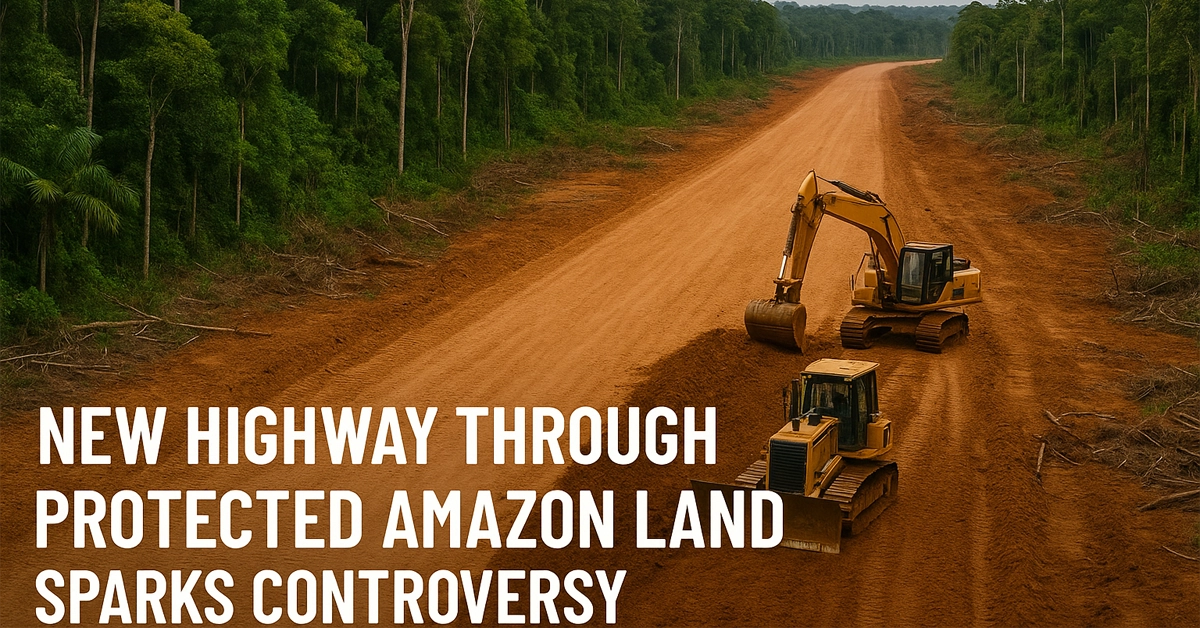
As Brazil prepares to host the COP30 United Nations Climate Summit in 2025 — a historic opportunity to place the Amazon and its people at the center of global climate discussions — construction has begun on a controversial infrastructure project: a four-lane highway slicing through tens of thousands of acres of protected Amazon rainforest.
Satellite imagery confirms what many environmental groups feared: the development is already underway, raising alarm about the ecological and moral cost of building such infrastructure in the heart of the world’s most biodiverse biome. In the very place where world leaders will soon gather to discuss how to save the planet, the planet is quietly being wounded.
The Paradox of COP30
Hosting COP30 in Brazil — especially in the Amazonian state of Pará — was supposed to be a symbolic victory. A chance to show the world that the country is serious about environmental protection. That it honors the forest not only as a natural treasure, but as a global ally in the fight against climate change.
Instead, what we’re witnessing is a bitter paradox: to welcome climate delegates, journalists, and policymakers, roads are being built through protected lands, thereby contributing to the very climate crisis the summit seeks to address.
The Brazilian government argues that the highway is necessary to improve access to Belém, the host city of COP30. Officials have framed the project as a logistical requirement for accommodating thousands of attendees and ensuring that the summit runs smoothly. But critics — including Indigenous leaders, scientists, and environmental NGOs — are asking: At what cost?
A Highway Through the Heart of Biodiversity
The proposed highway cuts through areas that are not only legally protected, but ecologically irreplaceable. These lands harbor endangered species, act as critical carbon sinks, and serve as the ancestral territories of Indigenous and traditional communities.
Many of these areas are part of the so-called “Terra do Meio” — a mosaic of conservation units and Indigenous territories in Pará that was designed precisely to resist such incursions. For decades, environmental defenders and Indigenous peoples have fought to keep these lands intact.
Now, with bulldozers rolling in under the banner of global climate dialogue, the line between progress and hypocrisy becomes painfully thin.
Forest Fragmentation: A Death by a Thousand Cuts
One of the most insidious effects of roads in the rainforest is fragmentation.
Roads not only lead to deforestation — they multiply it. By breaking continuous forest into isolated patches, roads make ecosystems more vulnerable to edge effects, invasive species, hunting, fires, and illegal extraction.
Fragmented forests are less resilient. They store less carbon. They support fewer species. They lose the intricate web of life that allows the rainforest to regenerate and regulate itself.
Studies have shown that over 95% of deforestation in the Amazon occurs within 5 kilometers of a road. In other words: wherever roads go, destruction follows.
To build a four-lane highway is not just to open a path — it is to open a Pandora’s box.
Whose Progress?
The debate about the highway reflects a deeper question that has haunted Amazonian development for decades: Whose progress is this? And who pays the price?
For centuries, governments and corporations have portrayed the Amazon as an obstacle to development — a wild, empty frontier waiting to be tamed. Roads have always been the first step in that process. First the road, then the chain saw, then the cattle.
But for the people who live in the forest — the guardians of the green — the forest is not a barrier. It is home. It is medicine. It is teacher, ancestor, spirit.
Indigenous leaders across Pará and the broader Amazon have denounced the highway as a violation of their rights. Many report that they were not properly consulted, in direct contravention of international agreements such as the ILO Convention 169, which guarantees free, prior, and informed consent.
If the climate summit is to be truly inclusive, it must begin by respecting those who have protected the forest long before the world began to measure carbon.
Climate Cost vs. Climate Optics
While the highway may make logistical sense on paper, it poses enormous contradictions in practice.
Infrastructure projects like this are carbon bombs. They release CO₂ from cleared vegetation and disturbed soil. They increase the risk of fire. They facilitate extractive industries. And they send a dangerous signal that economic expediency trumps ecological integrity — even at a climate summit.
The optics are troubling: world leaders flying in to discuss emissions reductions, while a sacred biome is sacrificed to ease their travel.
Imagine building a road through a cathedral so that more people can attend a prayer meeting. That’s what this feels like to many forest defenders.
Alternatives Ignored
What makes the controversy even more painful is that alternatives exist.
Brazil already has underutilized air routes, waterways, and rail systems that could be expanded or upgraded to accommodate COP30’s logistical needs without cutting into protected lands.
Moreover, climate summits like COP increasingly emphasize the need for low-carbon travel and virtual participation. With technology more advanced than ever, why not invest in greener, decentralized infrastructure instead of highways that contribute to the very problem being addressed?
Critics argue that the highway project reveals not a lack of options — but a lack of political will.
The Sacred Voice of the Forest
In many Indigenous cosmologies, roads are not merely physical intrusions. They are spiritual wounds. They sever the energetic and ancestral lines between sacred sites. They disrupt the movements of animals and the messages of spirits. They desecrate what is living and breathing.
In this sense, the construction of the highway is not just a political misstep — it is a ceremonial offense. One that ignores the worldview of those who have coexisted with the rainforest for millennia.
As one elder from the Kayapó people put it:
“They are opening the body of the forest. And when you cut the body of the forest, you cut the life of everything.”
These are not romanticized words. They are the truth of people who see the Earth not as a resource, but as a relative.
What Can Be Done?
While much of the highway construction is already in motion, resistance is growing.
Environmental organizations are launching legal challenges. Indigenous leaders are organizing public statements and community actions. Satellite monitoring groups are documenting every tree lost, every trail cleared.
But this is not their fight alone. It belongs to all of us.
Here’s how we can support:
-
Raise awareness by sharing verified information on social media.
-
Support Indigenous rights organizations that are directly impacted by the highway.
-
Pressure global climate leaders to address this contradiction at COP30.
-
Call for transparency and accountability in infrastructure development in protected areas.
-
Encourage sustainable travel solutions for international events.
-
Refuse greenwashing. Demand consistency between rhetoric and reality.
The Road Ahead
As the bulldozers advance, we are forced to ask ourselves: is this truly the best we can do? In an age where climate tipping points loom and the Amazon faces unprecedented threats, can we really afford to pave over the lungs of the Earth — even for a climate conference?
The world is watching. Not just the climate activists and scientists, but the forest itself. And it remembers.
It remembers who came in peace.
It remembers who came with chains.
And it remembers the prayers spoken — and the ones broken.
Let us not betray the very being we claim to protect. Let us honor the forest not with speeches — but with integrity.
Continue exploring
All stories
The medicines of the forest