Weaving Wisdom: The Power of Forest Women in Protecting the Earth
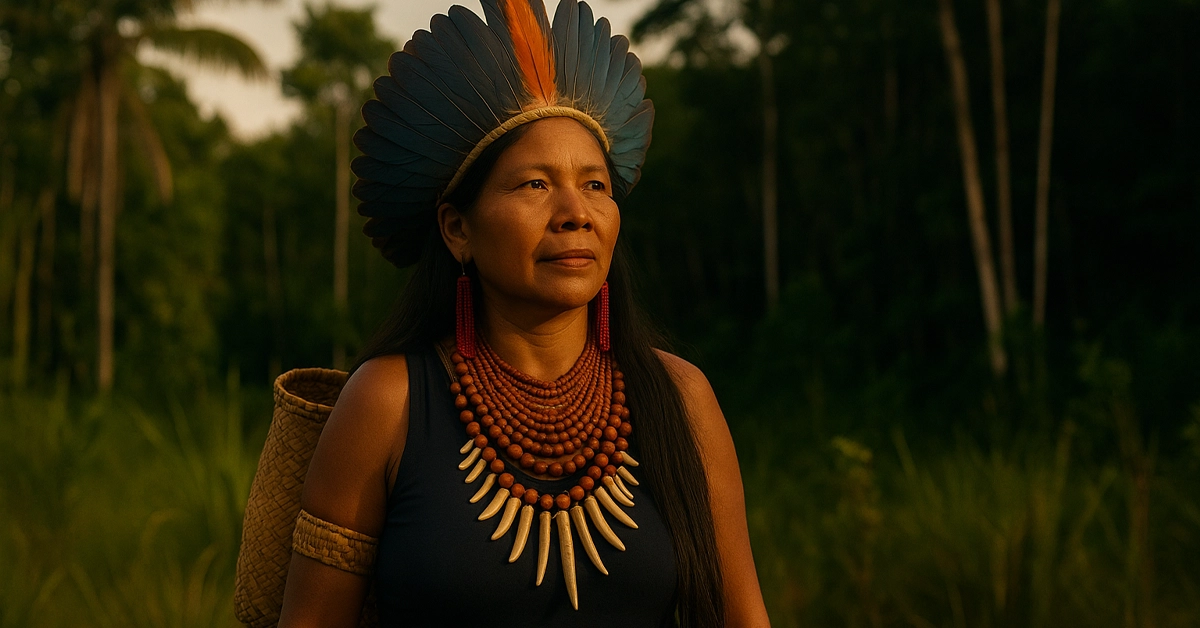
Stories of Indigenous female leaders and how they uphold the spiritual and ecological balance of the planet, woven into the archetype of Mother Earth and the feminine force within sacred forest medicines.
In the heart of the rainforest, where time moves not in hours but in seasons, where the wind whispers stories and the rivers carry songs, there lives a force as ancient as the Earth itself. It is not loud or boastful. It does not demand attention. And yet, it sustains life in ways modern systems have long forgotten.
This force has a name and a face.
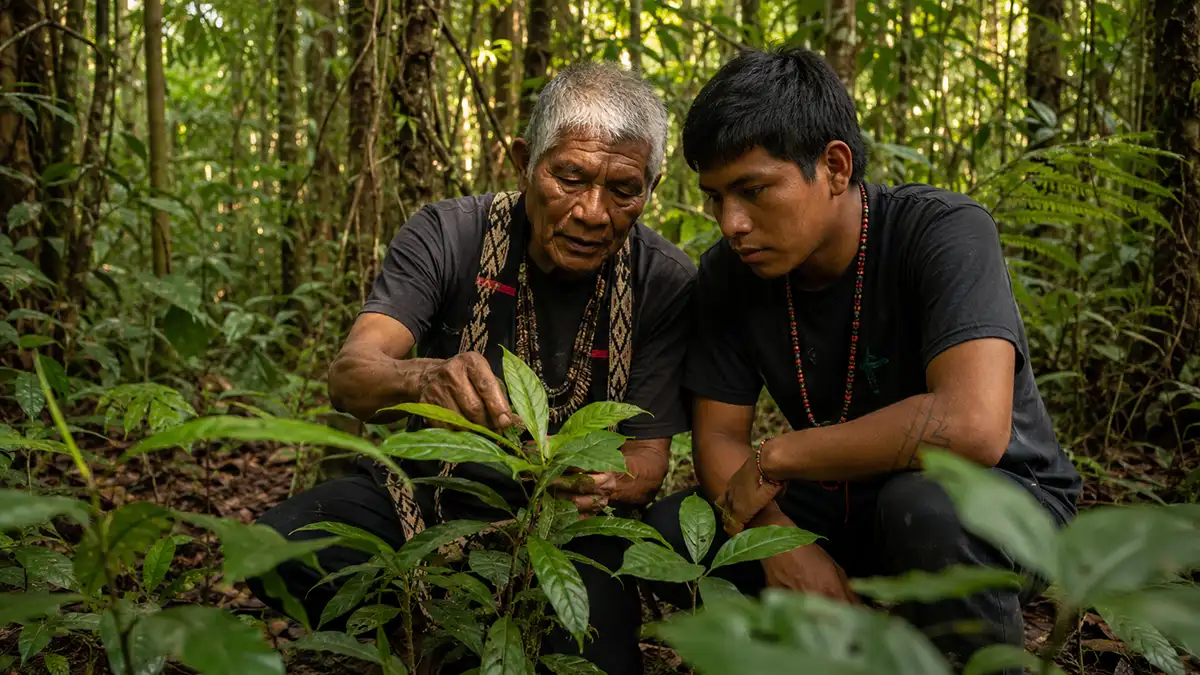
She is the grandmother with hands stained from pounding bark into medicine.
She is the young woman walking barefoot to the river, singing to the spirits.
She is the midwife of visions, the keeper of the fire, the voice of the Earth.
She is the Forest Woman — and she is the Earth herself.
Beyond Symbolism: The Living Archetype of Mother Earth
Across Indigenous cultures of the Amazon, the feminine is more than an energy. It is the fertile riverbed of existence. The forest is not viewed as a resource, but as a living mother — nurturing, wild, cyclical, and wise.
To speak of the feminine in the forest is to invoke the archetype of Pachamama, Nukë Mãey, Yuxibu in his female form — the divine intelligence that births and sustains all beings. Within this cosmology, women are not only caretakers of life — they are bridges between the spirit and the soil.
They are the translators of the invisible, the stewards of balance. And in today’s world, their role has never been more urgent.
The Rise of Indigenous Female Leadership
While traditional leadership in many Indigenous cultures has been patriarchal, recent decades have seen a powerful rise of female voices, reclaiming ancestral roles and forging new paths of visibility, influence, and resistance.
Women like Nara Baré, a leader of the Union of Indigenous Women of the Brazilian Amazon, have stepped into national and international platforms to demand land rights, climate justice, and recognition of Indigenous wisdom.
Others, like Sônia Guajajara, now Brazil’s first Minister for Indigenous Peoples, bring the forest into the political sphere, reminding the nation — and the world — that protecting nature begins by listening to those who live in communion with her.
But there are also those who lead without microphones or headlines: the pajés, herbalists, midwives, teachers, and storytellers who preserve knowledge passed down through generations, holding it like sacred fire.
Their power lies not in domination, but in weaving. In connecting the visible and the invisible, the body and the spirit, the community and the cosmos.
Forest Medicines and the Feminine Path
Many sacred plants of the forest — like Ayahuasca, Rapéh, and Sananga — are directly connected to feminine archetypes in Indigenous cosmologies.
Ayahuasca, known as “La Madre,” is a spirit-teacher often experienced as feminine. In ceremonies, her visions can be fierce or gentle, but always rooted in love, truth, and healing. It is said she reveals what needs to be seen, not what the ego wants.
Traditionally, women have played varied roles in these ceremonial spaces — as curanderas, singers, holders of the space, and sometimes, as the very lineage carriers of the medicine.
Huni Kuin, Yawanawá, Shipibo, and Kaxinawá communities — each in their own way — recognize the role of women not just in preparing the medicines, but in transmitting the songs, stories, and spiritual maps that guide their use.
And in the world beyond the forest, women are becoming ambassadors of this ancient knowledge, helping to translate its meaning into urban contexts, often with greater integrity and humility than many of their male counterparts.
Why? Because the feminine knows how to listen.
Because she births rather than conquers.
Because she remembers that healing is not about fixing — it is about returning.
Feminine Leadership Is Regenerative Leadership
In the language of the forest, the feminine is circular.
It does not move in straight lines, toward growth at all costs.
It breathes. It rests. It cycles.
In times of ecological collapse and spiritual fragmentation, this kind of leadership is not only relevant — it is essential.
Women like Valéria Paye Tapajós, a prominent Indigenous educator and activist, have emphasized that regeneration must begin with healing historical wounds — especially those inflicted on the bodies and territories of women.
Indeed, many Indigenous women see the forest as an extension of their own body. When the Earth is poisoned, they feel it in their wombs. When rivers are dammed, it is as if the lifeblood of their people is blocked. Thus, to protect the Earth is to protect themselves — and vice versa.
Regenerative leadership, as embodied by these women, does not separate ecology from spirituality, or activism from ceremony. It moves from a place of deep interconnectedness, intuition, and care.
Stories from the Forest: Silent Yet Sovereign Voices
Among the Ashaninka people, the grandmother is the one who teaches the children the songs of the plants.
In a Yawanawá village, a young woman named Putanny became one of the first female leaders to be recognized by her tribe. Today, she not only leads ceremonies but travels the world sharing the feminine strength of her people, breaking taboos, and empowering others to reclaim their roots.
In Acre, Brazil, you might find a woman weaving a bracelet that is not merely an ornament, but a coded prayer, a map of dreams, and a memory of the stars.
These stories are not exceptions. They are threads of a much larger tapestry — one that stretches from the heart of the Amazon to urban kitchens where mothers pray over their children, to healing circles where feminine voices tremble and rise.
These are the stories that need to be told. Not because they are exotic or romantic — but because they carry the wisdom the world has forgotten.
From Resistance to Remembrance
The feminine spirit in the forest is not merely fighting to survive — it is here to remind us.
Remind us that the Earth is not a machine, but a living being.
That progress is meaningless if it devours its own source.
That strength does not always roar — sometimes it hums like a lullaby at dusk.
And that wisdom is not always loud — sometimes it is whispered through leaves, braided into hair, poured into a clay pot, or offered in a bowl of medicine prepared with quiet devotion.
These women — whether holding political office or cradling newborns under starlight — are the memory-keepers of balance.
Their resistance is not only against deforestation, but against forgetfulness.
Their leadership is not a demand for power, but a restoration of harmony.
Honoring the Feminine is Healing the Earth
To truly protect the forest, we must listen to its women. Not just invite them to panels, but center their voices. Not just photograph them, but walk beside them.
This also means examining how patriarchal patterns — even within well-meaning spiritual and environmental movements — continue to silence or minimize feminine wisdom.
It means embracing a new form of leadership: one that weaves, nourishes, and includes.
At Queen of the Forest, we are guided by this spirit.
Every sacred medicine offered, every beadwork crafted by women, every plant gathered with prayer — is a tribute to this feminine lineage. A call to remember what it means to walk gently, live ceremonially, and act from the heart.
We don’t just honor the forest — we honor the mothers of the forest.
We don’t just sell sacred tools — we carry the intention of healing, beauty, and protection that these women have carried since time immemorial.
The Invitation
This is not a romanticization. It is a reckoning.
A remembering.
A return.
A return to the Earth as mother, not as marketplace.
A return to women as leaders, not as assistants.
A return to life as ceremony, not as consumption.
May we hear their songs.
May we support their work.
May we become protectors, not just admirers.
And may we, in our own way, learn again to weave wisdom — thread by thread, prayer by prayer, until the world becomes whole.
Continue exploring
All stories
The medicines of the forest