Invisible Bridges: How Forest Medicines Unite Peoples and Cultures
A Reflection on the Role of Rapéh and Sananga in the Dialogue Between Ancestral Traditions and Modern Seekers
When the Forest Speaks Beyond Borders
There are forces in the world that travel without passports, without language barriers, without frontiers. The medicines of the forest are among them. They arrive quietly—carried in seeds, in stories, in songs, in powders and drops prepared by ancestral hands. And yet their reach extends far beyond the rivers and villages of their origin.
Today, many seekers across the world encounter these sacred tools not as exotic artifacts but as bridges of connection. Rapéh, the sacred snuff of the Amazon, and Sananga, the eye drops made from forest roots, are not merely substances. They are carriers of relationships: between body and spirit, between humans and nature, between ancient traditions and the questions of modern life.
This article explores how these medicines have become invisible bridges, uniting cultures, offering healing, and reminding us that the forest’s wisdom belongs not to one people but to all of humanity.
Rapéh: The Breath of the Earth
Rapéh (often spelled rapé or hapé) is a finely ground preparation of sacred plants and ashes, applied through the nose with a kuripe or tepi applicator. For Indigenous peoples, rapéh is far more than a substance—it is a breath of the Earth itself, a cleansing wind that clears the mind, grounds the spirit, and opens pathways of communication with the invisible.
- In ceremonies, rapéh is used to sharpen concentration, dispel negative energies, and align the individual with nature’s order.
- Its preparation is considered a sacred art, with each plant blend carrying specific intentions—whether for grounding, opening the heart, or enhancing visions.
- The act of receiving rapéh is both physical and symbolic: a forceful breath that enters the body as if the forest itself were blowing its spirit into you.
As rapéh travels from villages to cities, from forest to faraway homes, it carries with it the ethics of reciprocity. It reminds seekers that healing is not consumption but relationship—to the plants, to the people who guard them, and to the Earth itself.
Sananga: Drops of Inner Vision
Sananga, the eye medicine prepared from the roots of Amazonian plants, is known for its intense sting upon application. But its strength lies not in discomfort, rather in the clarity it brings.
- Traditionally, Sananga is used for sharpening physical vision in hunters, helping them perceive the subtle movements of the forest.
- On a spiritual level, it is said to open the inner vision, dissolving blockages in perception and allowing individuals to see with greater truth.
- The burning sensation is considered part of the medicine—an energetic cleansing that clears both eyes and spirit.
For many modern seekers, Sananga becomes a teacher of resilience. To receive its fire is to practice surrender, trust, and patience. It is a reminder that clarity often requires passing through intensity—that vision comes after purification.
The Language of the Forest Without Words
What makes rapéh and Sananga so unique is not only their effect but their capacity to communicate without words. One does not need to understand the songs of a tribe or speak the language of the Amazon to feel their impact.
- Rapéh speaks through the breath.
- Sananga speaks through the eyes.
Both bypass the intellect and reach directly into the body and spirit, creating a universal experience that can be shared by people of all cultures.
In this sense, they are languages of the forest—codes carried in plant form, intelligible to anyone willing to listen with humility and presence.
Invisible Bridges Between Peoples
The spread of these medicines has created encounters that would have been unthinkable just decades ago:
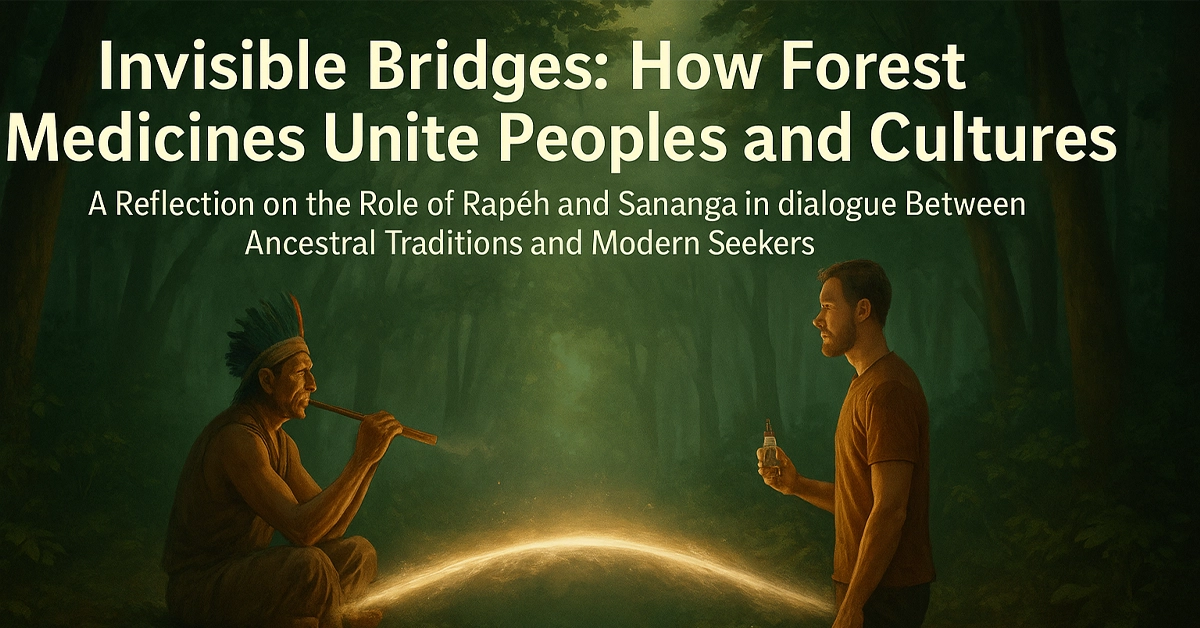
- An elder from the forest sharing rapéh in a circle with seekers in Europe.
- A healer applying Sananga to a group in an urban setting, thousands of miles from its birthplace.
- People who have never set foot in the Amazon receiving guidance, clarity, or healing through these drops and powders.
These are not mere acts of “globalization.” They are exchanges of spirit. When done respectfully, they allow ancestral traditions to dialogue with modern lives, creating bridges of solidarity, reciprocity, and shared humanity.
Challenges of Crossing Worlds
Of course, building bridges is never simple. There are challenges in the meeting of traditions and modern seekers:
- Respect vs. Appropriation: Medicines risk being taken out of context, stripped of their sacredness, and turned into commodities.
- Depth vs. Superficiality: Without guidance, some may seek quick experiences without embracing the responsibility that comes with them.
- Balance vs. Exploitation: The growing global interest can put pressure on Indigenous communities and the ecosystems that sustain these medicines.
And yet, these challenges also reveal the importance of responsibility. The medicines invite not only personal healing but also ethical choices: supporting fair trade, respecting Indigenous sovereignty, and remembering that every seed and root is part of a living world that demands care.
Medicines as Mirrors of Humanity
Rapéh and Sananga are not just tools of healing—they are mirrors.
- Rapéh reflects how we relate to our own breath, discipline, and presence.
- Sananga reflects how we face pain, clarity, and vision.
Through them, people are confronted not with something foreign, but with their own capacity for grounding, resilience, and transformation.
In this sense, the medicines become bridges inward, reconnecting modern individuals with forgotten parts of themselves.
A Shared Table of Humanity
Imagine a great table where peoples of the forest and seekers of the cities sit together. The medicines are placed in the center—not as possessions but as gifts of the Earth. Around them, stories are shared, songs are sung, silences are held.
In these moments, there is no “ancient” or “modern,” no “native” or “foreign.” There are simply humans in dialogue, remembering that what unites us is greater than what divides us.
Rapéh and Sananga, like invisible threads, weave these gatherings into a larger fabric of humanity.
Walking the Invisible Bridges
The medicines of the forest are not bridges of wood or stone, but of spirit and intention. They remind us that true connection happens in silence, in breath, in vision, in the shared act of sitting together with respect.
Rapéh and Sananga continue to cross oceans and borders, not to erase cultural differences but to honor diversity through connection. They show us that healing is not only individual but collective, and that the forest, in its generosity, has given us tools to remember our belonging to one another.
The bridges may be invisible, but once crossed, they change everything.
Continue exploring
All stories
The medicines of the forest