The Guardians of the Wind: The Invisible Wisdom of Air
How Indigenous Peoples See the Wind as Messenger, Breath of Life, and Spirit Communication
When the Forest Breathes
In the rainforest, silence is never truly silent. Even in stillness, there is movement—the leaves shiver, branches sway, the air carries a subtle vibration. The wind, often overlooked in modern life, is alive in Indigenous traditions as one of the most powerful carriers of wisdom.
For the peoples of the forest, wind is not just a meteorological phenomenon but a living being, an invisible ally, a messenger between realms. It carries voices of ancestors, whispers of the spirits, and the breath of life itself. To feel the wind brushing against the skin is to be reminded of presence—an eternal dialogue between human beings, nature, and the invisible.
This article explores the spiritual significance of wind in Indigenous cosmologies, its connection to breath and life force, and the rituals through which shamans and elders engage with this subtle yet powerful element.
The Wind as a Sacred Messenger
Across many Indigenous traditions, wind is the first language—a communication that predates words. It is the way the Earth speaks to those who are listening.
- Among some Amazonian tribes, the wind is seen as the breath of the forest itself, circulating energy and spirit across rivers, mountains, and villages.
- The Huni Kuin, for example, interpret sudden gusts as signals of invisible presences: spirits arriving, ancestors watching, or energies shifting.
- In North and South American traditions alike, wind carries the songs of the birds and trees, considered messages to guide hunters, healers, and dreamers.
In this way, wind becomes a sacred courier, not only moving seeds and clouds but also carrying intentions, prayers, and voices across the seen and unseen worlds.
Breath and the Spirit of Life
Breath and wind are inseparable. In many languages, the word for “breath” and “spirit” are one and the same.
- In Latin, spiritus means both breath and spirit.
- In Hebrew, ruach carries the dual meaning of wind and divine spirit.
- In Amazonian cosmologies, the act of breathing deeply in the forest is an act of receiving its living essence.
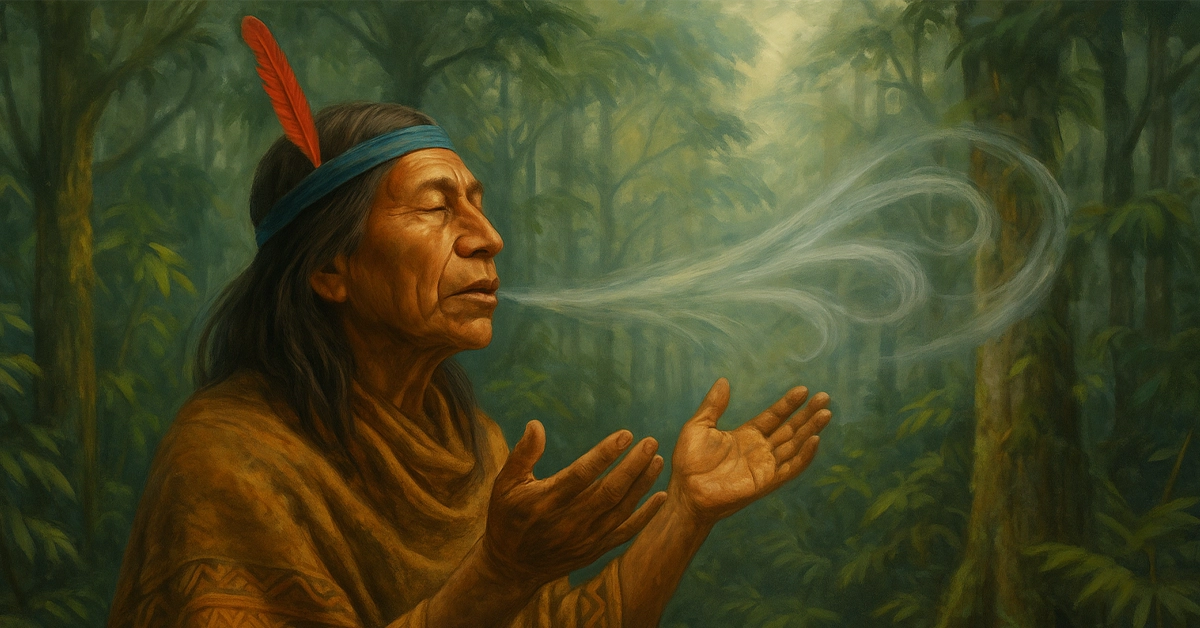
For shamans, breath is medicine. The controlled exhalations during chants and the blowing of tobacco smoke or rapéh (sacred snuff) are ways of channeling energy. The air that leaves the body is never neutral; it is infused with intention.
This is why many rituals emphasize breathing in alignment with nature’s rhythm—to inhale the strength of the forest, exhale what no longer serves, and let the wind carry prayers beyond human reach.
The Shaman and the Wind
Shamans, medicine men and women, and spiritual leaders often cultivate a deep relationship with the wind.
Whistles, Songs, and Wind Instruments
Flutes and whistles, common in Amazonian and Andean traditions, are not just musical tools but imitations of the wind’s voice. When a shaman plays, they are not producing a melody for entertainment but calling the spirit of the air into presence.
Healing with Breath
The act of blowing (soplada in Spanish-speaking shamanic traditions) is central to Amazonian healing. Shamans blow over the crown, chest, or hands of participants to infuse them with protective or cleansing energy. The belief is simple yet profound: the wind released from sacred breath is charged with spirit.
Reading the Wind
In ceremonies, sudden shifts in air currents may be interpreted as responses from the spirit world. A gust may indicate approval, while a swirl or change in direction can signal a warning. Shamans train their awareness to read these movements as carefully as a text.
Winds of the Four Directions
Many Indigenous cosmologies align wind with the Four Directions, each carrying a spiritual essence.
- East Wind: Birth, new beginnings, illumination. The first light carried by the morning breeze.
- South Wind: Warmth, growth, youth, and the fire of transformation.
- West Wind: Introspection, dreams, and the descent into the inner world, associated with sunset.
- North Wind: Wisdom, ancestors, discipline, and the clarity of cold air.
Ceremonies that invoke the Four Directions often call upon their winds as guardians, each entering the circle from a specific point, creating a sacred wheel of protection and balance.
Wind in Myth and Story
Indigenous myths often describe wind as a being with personality, intention, and power.
- In some Amazonian stories, the wind is the son of the jaguar and the sky, a spirit of force and unpredictability.
- In North American Lakota tradition, Tate, the wind god, governs the four directions and carries the voices of all spirits.
- The Shipibo of Peru speak of the wind as a hidden singer, weaving invisible patterns that later manifest as visions in ceremony.
These myths remind us that wind is never accidental. Its arrival, strength, and direction are embedded with meaning.
Daily Rituals with the Wind
While ceremonies are powerful, daily life in the forest also revolves around the wind.
- Cleansing: Families may turn their faces to the breeze to let it carry away heaviness or sadness.
- Guidance: Hunters watch how leaves sway to determine where animals might be moving.
- Protection: Mothers may ask the wind to “cover” their children during sleep, believing the moving air shields them from harmful spirits.
Even simple acts—like hanging a hammock where the breeze circulates—become ways of aligning life with the intelligence of the air.
The Silence Between the Winds
Equally important is the absence of wind. In Indigenous wisdom, when the forest becomes completely still, it is not emptiness but a pregnant silence, a signal that something important is about to happen. Shamans may pause their chants in these moments, listening more deeply.
The calm before a storm, or the pause before a new cycle, teaches that stillness is also part of the wind’s wisdom—that the invisible speaks not only in movement but also in rest.
Wind, Modern Life, and Forgotten Wisdom
In cities, we often lose touch with the wind. Air becomes conditioned, filtered, and controlled, stripped of its sacredness. But reconnecting is simple: stepping outside, feeling the breeze on the skin, remembering that every breath is shared with trees, rivers, mountains, and ancestors.
Indigenous wisdom reminds us that we are never separate from the wind. The same air that moved through the lungs of our great-grandparents now circulates within us. Each breath is a participation in eternity.
Becoming Listeners of the Wind
To walk through the forest is to walk among Guardians of the Wind. They are not statues or visible beings but forces, presences, and companions. The wind teaches us to listen, to surrender, to breathe consciously, and to respect the unseen connections that sustain life.
When we begin to see wind not as an accident of weather but as a sacred intelligence, we open ourselves to a deeper relationship with nature and with spirit.
The guardians are still here, whispering through the trees, calling us to remember that the breath of the Earth and the breath of our own bodies are one and the same.
Continue exploring
All stories
The medicines of the forest