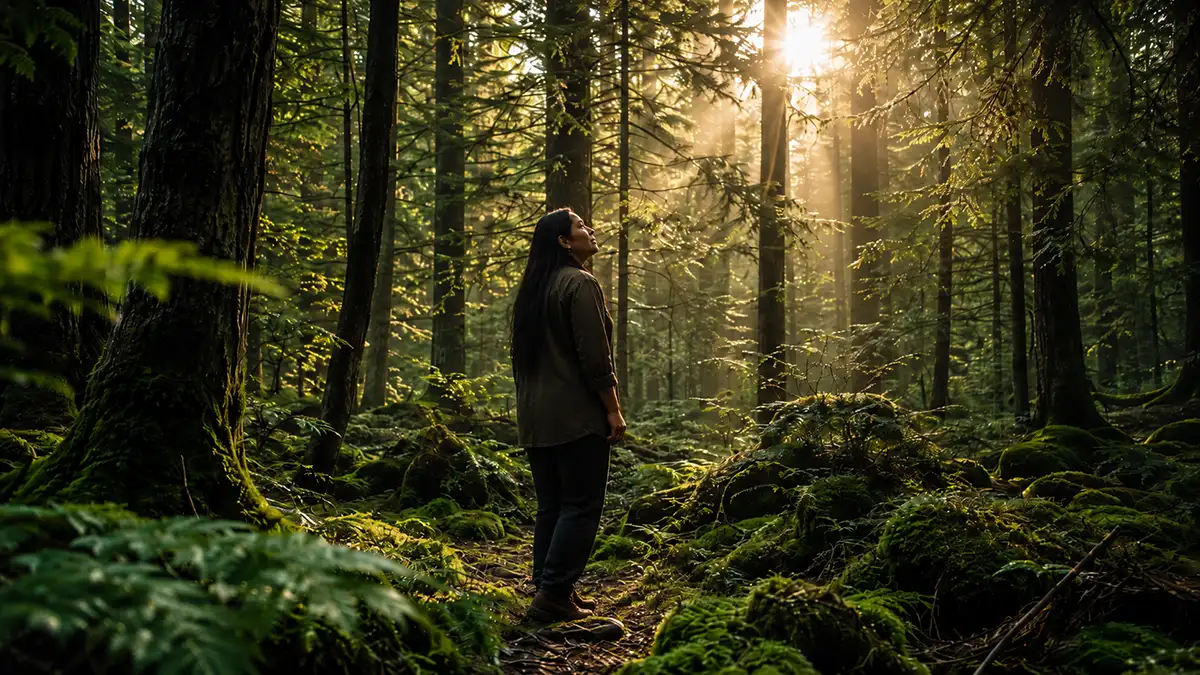
Forest bathing benefits may include greater relaxation, improved mood, restored attention and a deeper sense of connection with the natural world. Unlike hiking for distance or exercising outdoors, forest bathing invites us to slow down, awaken the senses and experience the forest without rushing toward a destination.
In a world filled with notifications, artificial light, traffic, deadlines and constant mental stimulation, simply spending quiet time among trees can feel surprisingly powerful. The forest does not demand that we perform, respond or produce. It offers another rhythm—one shaped by wind, water, birdsong, changing light and the gradual movement of living things.
Known in Japan as shinrin-yoku, forest bathing has become increasingly popular as a form of nature-based well-being. Researchers have investigated its possible effects on stress, mood, attention, blood pressure and other aspects of physical and psychological health.
The findings are promising, but they should be understood carefully. Forest bathing is not a miracle cure, and it should not replace medical treatment, therapy or professional guidance. It is better understood as a gentle complementary practice that may help people rest, reconnect and create more space for well-being.
What Is Forest Bathing?
Forest bathing is the practice of spending unhurried, attentive time in a forest or another natural environment. The word “bathing” does not refer to swimming or washing. It describes the experience of allowing yourself to be immersed in the atmosphere of the forest.
A person practicing forest bathing may walk slowly, sit beneath a tree, listen to birds, notice the scent of leaves, observe patterns of light or feel the texture of bark. There is no need to cover a certain distance, reach a viewpoint or complete a workout.
This makes forest bathing different from many familiar outdoor activities. Hiking usually has a route or destination. Running emphasizes physical effort. Wildlife observation may focus on finding particular species. Forest bathing, by contrast, centers on receptive awareness.
Forest bathing is less about moving through the forest and more about allowing the forest to move through your awareness.
The practice can be guided or self-directed. Some sessions follow a structured series of sensory invitations, while others are as simple as putting away the phone and spending quiet time beneath the trees.
Where Did Shinrin-Yoku Begin?
The modern term shinrin-yoku emerged in Japan during the 1980s. It is commonly translated as “forest bathing” or “taking in the atmosphere of the forest.”
The organized practice developed partly in response to increasingly urban and demanding lifestyles. It encouraged people to visit forests not only for recreation but also for rest, sensory awareness and preventive well-being.
Japan later became an important center for research into forest environments and human health. Scientists began comparing time spent in forest settings with time spent in urban environments, examining psychological responses and physiological indicators such as heart rate, blood pressure and cortisol.
Although the term is Japanese, the deeper recognition that nature can restore and teach human beings is not exclusive to one country. Many Indigenous and traditional cultures have long understood forests as living communities rather than collections of natural resources.
These traditions should not be reduced to modern wellness trends. Their relationships with forests may involve ancestry, territory, food, medicine, ceremony, identity and responsibility. Forest bathing can become more meaningful when it helps us respect those deeper relationships rather than simply turning nature into another product for personal consumption.
9 Forest Bathing Benefits for Mind and Body
Research into forest bathing benefits is continuing to develop. Studies vary in size, design, location and duration, so their results should not be exaggerated. Nevertheless, a growing body of evidence suggests that mindful time in forest environments may support several dimensions of well-being.
1. Forest Bathing May Help Reduce Stress
Stress is one of the main reasons people become interested in forest bathing. Daily life can keep the body in a state of constant readiness. Emails, traffic, financial concerns, news cycles and social expectations may leave little opportunity for genuine rest.
Forest environments offer a different type of stimulation. Natural sounds tend to be less demanding than alarms, engines and conversations. The movement of leaves is complex but not usually urgent. The landscape can hold our attention without constantly asking us to make decisions.
Studies of forest-based experiences have reported improvements in perceived stress and relaxation. Some research has also observed changes in stress-related physiological indicators after time in forest environments.
This does not mean that one walk will remove the causes of chronic stress. It suggests that forests may provide conditions in which the mind and body can temporarily step away from continuous pressure.
2. It May Support a Calmer Mood
Another frequently discussed benefit of forest bathing is its relationship with mood. People often describe feeling calmer, lighter or more emotionally settled after spending time in nature.
Scientific reviews have found associations between forest-based practices and reductions in negative emotional states such as tension, confusion, fatigue and low mood. Some participants also report greater vitality or positive affect after forest experiences.
Part of this effect may come from temporarily leaving environments associated with responsibility and overstimulation. A forest can create psychological distance from the places where worries normally repeat themselves.
Nature does not erase grief, anxiety or personal difficulty. However, it may give those experiences more room. Sometimes emotional balance begins not by forcing ourselves to feel better, but by entering a setting where we no longer have to hold everything so tightly.
3. Time Among Trees May Restore Attention
Modern attention is repeatedly divided. We move between messages, videos, browser tabs and unfinished tasks. Even moments that appear restful may involve significant mental stimulation.
Natural settings can engage attention differently. The mind may gently notice the movement of clouds, the sound of water or the changing shape of shadows without the effort required by work or digital media.
This kind of soft fascination may give directed attention an opportunity to recover. Afterward, some people find it easier to concentrate, think clearly or return to a task with renewed patience.
To experience this aspect of forest bathing, it helps to reduce digital interruption. Taking photographs is not inherently harmful, but constantly framing, posting and checking images can prevent the deeper rest that comes from simply being present.
4. Forest Bathing Encourages Mindful Awareness
Forest bathing is naturally compatible with mindfulness because it directs attention toward immediate sensory experience.
Instead of analyzing the past or anticipating the future, you begin noticing what is happening now:
- The temperature of the air against your skin;
- The rhythm of your breathing;
- The movement of branches above you;
- The scent of soil, rain or leaves;
- The distance between one birdsong and another;
- The feeling of the ground beneath your feet.
Sensory attention can interrupt repetitive thought patterns. It gently brings awareness back into the body and the present moment.
The goal is not to empty the mind. Thoughts will continue to arise. The practice is to notice them without following every one, then return to the living environment around you.
5. It May Support Cardiovascular Relaxation
Researchers have also examined how forest environments may influence heart rate, blood pressure and autonomic nervous system activity.
Some studies and reviews have observed favorable short-term cardiovascular responses during or after forest exposure. These findings may be related to relaxation, gentle movement, cleaner-feeling surroundings and reduced psychological pressure.
However, forest bathing should never be presented as a treatment for hypertension or heart disease. Anyone with a cardiovascular condition should continue following professional medical guidance.
The most responsible conclusion is that peaceful time in nature may complement a healthy lifestyle. It cannot replace medication, diagnosis, monitoring or individualized care.
6. It Creates an Opportunity for Gentle Movement
Forest bathing does not need to be physically demanding. A session may involve slow walking, pausing, sitting and observing. This makes it more approachable for people who do not identify with intense outdoor exercise.
Gentle movement can still be valuable. Walking slowly supports circulation, mobility and awareness of posture. Uneven natural terrain may also require more attentive movement than a flat indoor surface.
The important distinction is that movement serves presence rather than performance. You are not measuring pace, distance or calories. You are allowing the body to move according to the landscape and your own capacity.
People with mobility limitations can adapt the practice by choosing an accessible trail, botanical garden, shaded park or safe place to sit outdoors. Forest bathing is defined more by the quality of attention than by the number of steps taken.
7. It May Deepen the Sense of Connection with Nature
One of the most meaningful forest bathing benefits may be difficult to measure: the experience of belonging to the living world.
Urban life can make nature seem distant or decorative. Food appears in packaging. Water arrives through pipes. Wood becomes furniture. Plants become landscaping. Forest bathing invites us to encounter the living systems behind the objects and services we often take for granted.
When we spend attentive time among trees, we may begin noticing relationships everywhere. Fungi interact with roots. Fallen leaves return nutrients to the soil. Insects pollinate flowers. Birds distribute seeds. Water connects clouds, roots, streams and oceans.
Learning about forest communication can deepen this awareness by revealing that a forest is not simply a collection of isolated trees. It is a community shaped by exchange, competition, cooperation, disturbance and renewal.
Feeling connected with nature can also influence behavior. People may become more willing to protect what they have learned to notice and love.
8. Forest Bathing Can Create Space for Reflection
Forests can offer a valuable setting for reflection because they reduce many of the signals that keep us moving automatically through the day.
Without a screen or schedule directly in front of us, questions may emerge:
- What have I been carrying?
- Where am I moving too quickly?
- What deserves my attention?
- What can I release?
- What is beginning to grow?
The forest does not provide simple answers to every personal problem. What it can provide is a quieter place from which to listen.
This reflective dimension can support emotional resilience. Trees reveal that growth is not always visible, rest is part of every cycle and adaptation often happens gradually.
9. It Reminds Us That Rest Has Value
Many people have learned to evaluate every activity according to productivity. Even wellness can become another project filled with targets, equipment, applications and measurements.
Forest bathing offers a different lesson. It has no trophy and no final level. There is nothing to win. Its value comes from participation and attention.
A tree does not ask whether you have been productive enough to deserve its shade. A river does not require you to explain why you are tired. The forest receives your presence without demanding a performance.
Remembering that rest has value is not laziness. Rest supports clarity, creativity, patience and the ability to respond more thoughtfully to life.
Why Do Forests Feel So Restorative?
No single explanation accounts for every forest bathing experience. The effects likely arise from several factors working together.
Natural Soundscapes
Birds, wind, water and insects create layered soundscapes that can hold attention without demanding an immediate response. These sounds may feel less threatening or exhausting than mechanical and urban noise.
Visual Patterns
Forests contain repeating yet irregular patterns in branches, leaves, bark, light and shadow. These patterns offer rich visual information without the same pressure created by signs, screens and traffic.
Reduced Digital Stimulation
A visit to nature often creates an opportunity to step away from devices. Fewer notifications and decisions can reduce cognitive overload and allow attention to settle.
Fresh Air and Natural Aromas
The scent of soil, wood, leaves and rain contributes to the sensory experience. Trees also release aromatic compounds into their environment. Researchers continue to investigate how these compounds and other forest characteristics may interact with human physiology.
Gentle Physical Activity
Slow walking combines movement with sensory awareness. Exercise itself can support well-being, so some forest bathing benefits may reflect the interaction between natural surroundings, physical activity and psychological relaxation.
Psychological Distance
Leaving a familiar indoor or urban environment can create distance from habitual concerns. Problems may not disappear, but they can appear different when viewed from a wider landscape.
How to Practice Forest Bathing
You do not need special equipment, spiritual beliefs or previous meditation experience to begin. A simple session can last from 20 minutes to several hours, depending on your schedule, mobility and surroundings.
1. Choose a Safe Natural Place
Select a forest, woodland, botanical garden, quiet park or tree-filled trail. Choose a place where you feel reasonably safe and can move without rushing.
2. Reduce Distractions
Silence your phone or place it in a bag. Keep it available for emergencies, navigation or necessary communication, but avoid checking it repeatedly.
3. Pause Before Walking
Stand or sit quietly for a moment. Notice your breathing and how your body feels. There is no need to change anything immediately.
4. Walk More Slowly Than Usual
Let go of the need to reach a destination. Allow the path, light, sound and movement around you to determine your pace.
5. Engage the Senses
Ask yourself:
- What can I hear nearby?
- What can I hear in the distance?
- Which colors and textures are present?
- How does the air feel?
- What natural scents can I notice?
Avoid tasting wild plants, fruits or mushrooms unless they have been safely identified by a qualified expert.
6. Spend Time in Stillness
Find a safe place to sit or stand for several minutes. Notice what becomes visible when you stop moving. Often, birds and small animals become more noticeable after the environment grows accustomed to your presence.
7. Follow What Draws Your Attention
You may feel drawn to the sound of water, the shape of an old tree or sunlight falling across the ground. Allow curiosity to guide you without needing to name or explain everything.
8. Close the Practice Intentionally
Before leaving, take a final pause. Notice whether anything has changed in your breathing, thoughts, body or mood.
Some people close with gratitude. This does not need to be ceremonial or complicated. A quiet acknowledgment of the place, the trees and the time you received is enough.
Can You Practice Forest Bathing Without a Forest?
Access to large forests is not equal. Many people live in dense cities, areas with limited public green space or places where natural environments are difficult to reach safely.
Although a mature forest provides a particularly rich environment, the essential principles of forest bathing can be adapted.
Possible alternatives include:
- A botanical garden;
- A public park with mature trees;
- A community garden;
- A quiet riverside or lakeside path;
- A tree-lined neighborhood;
- A garden, courtyard or balcony with plants;
- A peaceful place near a single tree.
The practice may be smaller, but it can still be meaningful. Sit near a tree and observe it over several weeks. Notice how its leaves respond to weather, which birds visit and how the light changes throughout the day.
Even brief contact with nearby nature can remind us that the living world continues within cities. The goal is not to pretend that every green space is an untouched forest. It is to rebuild attention and relationship wherever genuine contact with nature is possible.
Safety and Responsible Forest Bathing
Forest bathing is generally gentle, but natural environments still require awareness and preparation.
- Choose trails and locations appropriate for your mobility and experience.
- Tell someone where you are going when visiting an isolated area.
- Check weather conditions before leaving.
- Carry water when necessary.
- Use suitable clothing and footwear.
- Be aware of insects, wildlife, poisonous plants and uneven terrain.
- Respect signs, protected areas and local guidance.
- Do not enter Indigenous territories or private land without permission.
- Do not harvest plants, bark, fungi, seeds or other materials unless explicitly permitted.
- Take all waste with you and avoid disturbing wildlife.
People with allergies, respiratory conditions, cardiovascular concerns or limited mobility may need to plan their visit more carefully. Forest bathing should be adapted to the person rather than treated as a challenge to overcome.
Health note: This article is for educational purposes only. Forest bathing may complement healthy routines, but it is not a diagnosis, cure or substitute for medical care, psychological support or emergency assistance.
The Deeper Lesson of Forest Bathing
Forest bathing is often introduced as something nature can do for humans. The forest may help us relax, focus and recover from stress. Those benefits are meaningful, but the relationship should not end there.
A forest is not a wellness facility created for our use. It is a living community with its own relationships, histories and needs.
To enter a forest attentively is to encounter countless lives unfolding beyond human schedules. Trees gather light. Roots move through soil. Fungi exchange nutrients. Insects transform fallen material. Birds carry seeds. Water passes through leaves, clouds, rivers and bodies.
This recognition can transform forest bathing from a personal relaxation technique into a practice of reciprocity.
We receive shade, oxygen, beauty, food, medicine, water regulation and emotional restoration from living ecosystems. In return, we can support conservation, reduce unnecessary consumption, respect Indigenous land rights, learn about local ecology and protect the green spaces within our communities.
Indigenous wisdom has long reminded humanity that health cannot be separated from territory, water, plants, animals and community. While different peoples hold distinct traditions that should never be generalized, copied or commercially appropriated, their continued defense of forests demonstrates a truth modern societies urgently need to remember: human well-being depends on the well-being of the living world.
The greatest of all forest bathing benefits may therefore be a change in relationship. We begin by seeking peace beneath the trees. Over time, we may understand that protecting the forest is also a way of protecting one another.
Returning to the Rhythm of the Forest
The growing interest in forest bathing benefits reflects a deeper need. Many people are searching for relief from lives that have become fast, fragmented and disconnected from natural rhythms.
Forest bathing does not require us to conquer a trail, achieve a perfect state of meditation or transform ourselves in a single afternoon. It asks for something simpler: that we arrive, slow down and pay attention.
Research suggests that time in forest environments may support relaxation, mood, attention and certain short-term indicators of physical well-being. Yet the experience can also offer something beyond measurement.
It reminds us that silence is not empty. Rest is not wasted. A forest is not merely scenery. And human beings are not separate from the systems that sustain life.
The next time you enter a place filled with trees, consider leaving the need to accomplish something behind. Walk slowly. Listen deeply. Notice what is already happening.
The forest may not solve every problem, but it can help us remember how to be present while we find our way.
Frequently Asked Questions About Forest Bathing
What is forest bathing?
Forest bathing is the practice of spending slow, attentive and sensory time in a forest or natural environment. It does not involve swimming. The term describes immersing yourself in the atmosphere of the forest.
What are the main forest bathing benefits?
Possible forest bathing benefits include relaxation, reduced perceived stress, improved mood, restored attention, gentle physical activity and a stronger connection with nature. Research is promising, but forest bathing should not be considered a cure or replacement for professional healthcare.
How long should a forest bathing session last?
There is no single required duration. A beginner may start with 20 to 30 minutes, while guided sessions can last several hours. The quality of attention is generally more important than covering a particular distance.
Is forest bathing the same as hiking?
No. Hiking commonly focuses on movement, exercise, distance or reaching a destination. Forest bathing emphasizes slowing down, awakening the senses and becoming receptive to the natural environment.
Can forest bathing help with anxiety?
Some studies suggest that forest-based experiences may support relaxation and improve certain measures of anxiety or emotional distress. However, forest bathing is not a treatment for an anxiety disorder and should not replace support from a qualified professional.
Can I practice forest bathing in a city?
Yes. A large forest offers a rich experience, but the principles can be adapted to a park, botanical garden, community garden or another safe green space. The essential practice is to slow down and pay close attention to nature.
Do I need a forest therapy guide?
No. A trained guide can provide structure and sensory invitations, but people can also practice forest bathing independently in a safe and familiar natural environment.
What should I bring for forest bathing?
Bring weather-appropriate clothing, safe footwear, water when needed and a phone for emergencies. Avoid carrying unnecessary equipment that could distract from the experience.
Continue Your Journey into the Living Forest
Explore more stories about forest intelligence, traditional knowledge, emotional resilience and humanity’s relationship with the natural world.
At Queen of the Forest, we believe that learning from the forest also means helping protect the cultures, communities and ecosystems that keep its knowledge alive.