Rapé and Meditation: Understanding the Relationship Between Ritual, Breath and Presence
Rapé and meditation are sometimes brought together in ceremonial, spiritual and contemplative settings. People who encounter this relationship may hear words such as grounding, intention, silence, prayer, cleansing and presence. Yet understanding the subject responsibly requires more than repeating modern wellness language.
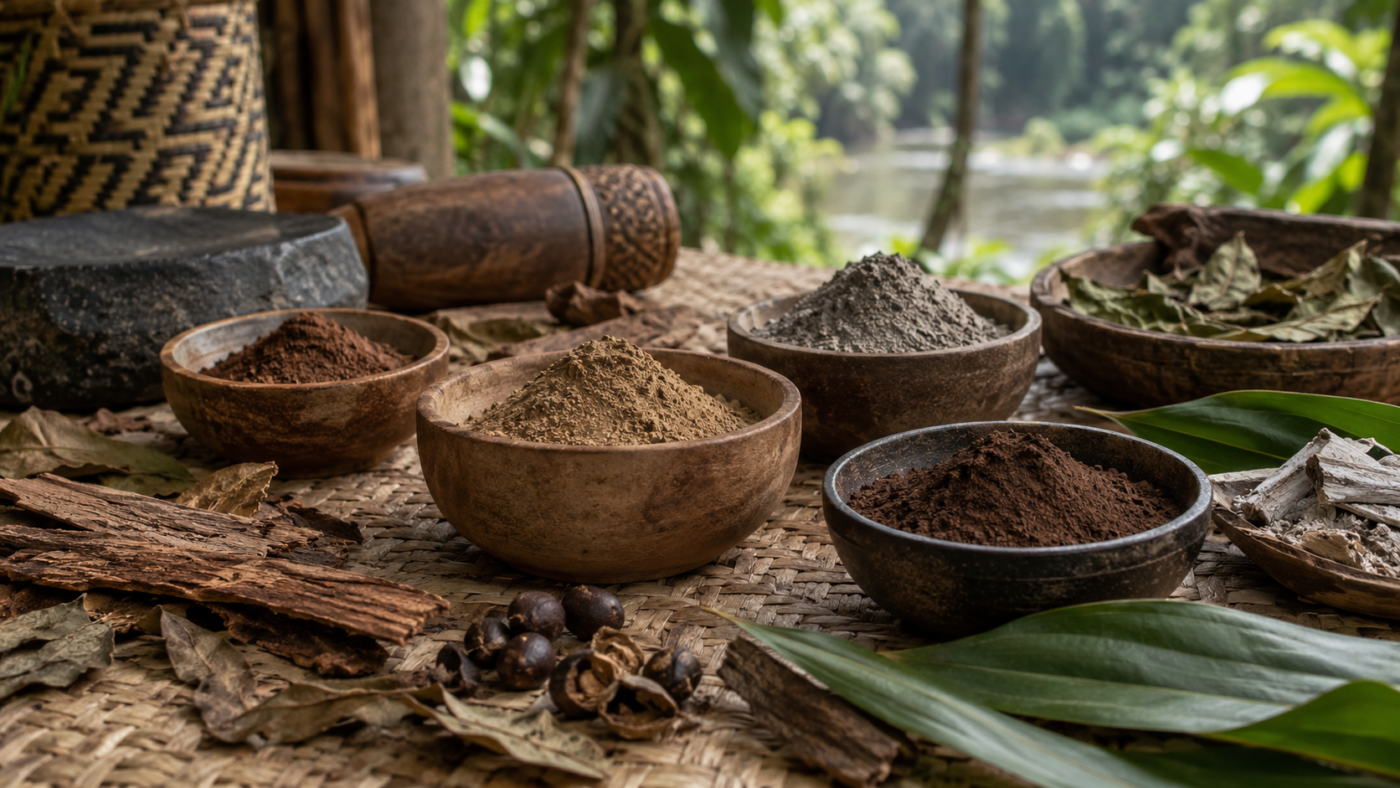
Rapé—also written as hapé, hapeh or rapeh in commercial and international contexts—is a broad term used for powdered preparations associated with different Indigenous peoples and traditions of South America. Many preparations contain tobacco, often combined with alkaline plant ashes or other botanical ingredients. Their composition, meaning and traditional use can vary greatly.
Meditation is equally diverse. It can refer to silent observation, prayer, focused attention, breath awareness, contemplation, movement or practices belonging to specific religious and philosophical traditions.
When rapé and meditation appear together, the connection usually comes not from a universal rule but from the way ritual can organize attention. Preparation, silence, intention and stillness may create a transition away from ordinary activity and toward a more concentrated state of awareness.
This article explores that relationship without presenting instructions for consuming or administering rapé. It also distinguishes traditional Indigenous contexts from contemporary wellness practices and addresses the health risks associated with tobacco and nicotine.
Rapeh is a general name applied to a wide variety of finely powdered preparations found in South America. In many Indigenous and contemporary preparations, tobacco is combined with ashes made from selected trees or other plant materials.
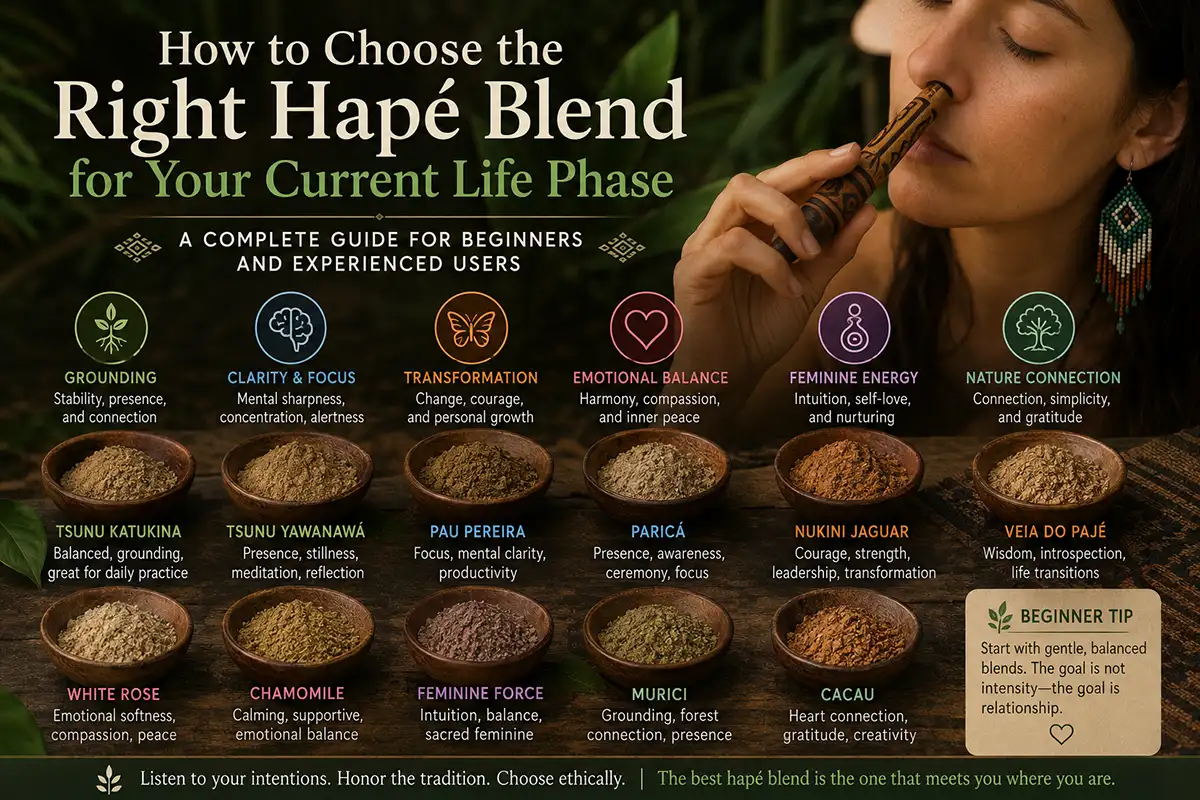
It is important not to assume that every product called rapé has the same ingredients. Recipes may differ according to the people who prepare them, the plants available in a particular territory, family knowledge, ceremonial purpose and contemporary commercial practices.
Some blends are strongly associated with tobacco, while other botanical ingredients may be emphasized in their names or descriptions. However, a plant name on a label does not automatically reveal the full formula, nicotine concentration, purity or safety of the preparation.
This variability is one reason broad health promises about rapé should be treated cautiously. A traditional name or forest ingredient does not make every commercial preparation chemically equivalent or medically proven.
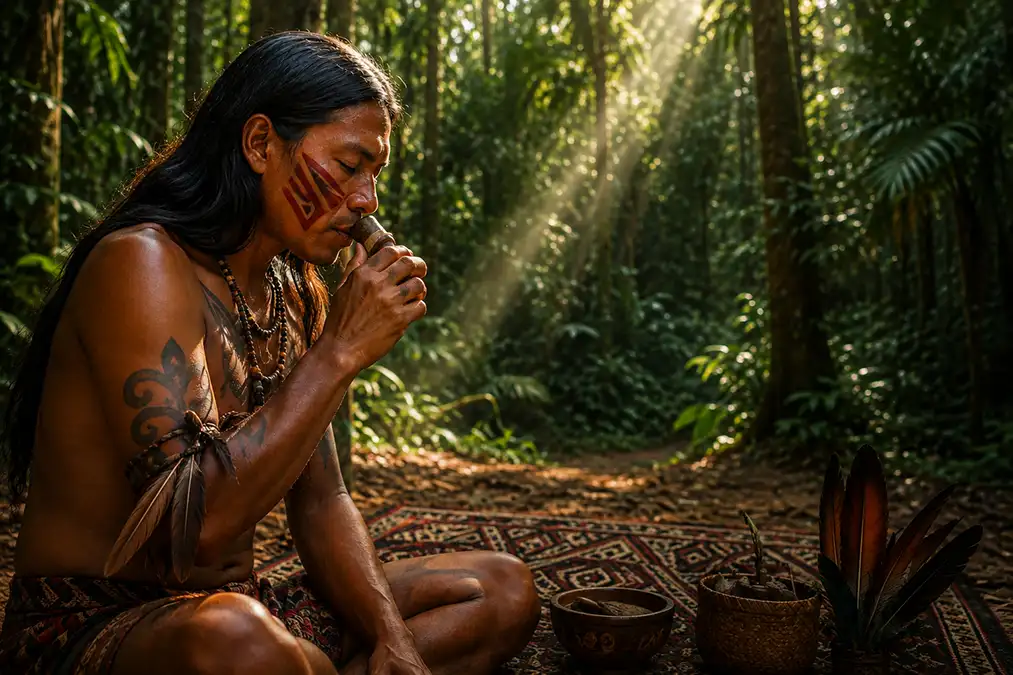
Within certain Indigenous contexts, rapé may be understood through spiritual, social, medicinal or ceremonial relationships. Outside those contexts, it may be marketed as a wellness product, meditation aid or tool for personal transformation.
These categories should not be treated as interchangeable. A medicine within one cultural system does not automatically become a clinically validated treatment when sold in another.
Why Rapeh Is Not One Universal Tradition
Online discussions often speak about “the Indigenous use of rapé” as though every Indigenous nation shares the same beliefs and practices. This is inaccurate.
The Amazon is home to many peoples, languages, territories and systems of knowledge. Even communities that use related plants may understand, prepare and transmit them differently.
Depending on the cultural context, rapé may be connected with:
- Prayer and spiritual concentration;
- Community gatherings;
- Preparation for other ceremonial activities;
- Relationships with plants, ancestors and territory;
- Traditional systems of healing;
- Hunting, work, conversation or social exchange;
- Knowledge transmitted through families or specialists.
This diversity matters. A practice observed among one people should not be automatically attributed to the Huni Kuin, Yawanawá, Nukini, Katukina, Puyanawa or every other Indigenous nation.
Responsible education identifies the specific source of information whenever possible. It also accepts that some knowledge is not intended for unrestricted publication or commercial reproduction.
Cultural respect begins by recognizing that Indigenous peoples are living, distinct communities—not a single symbolic category called “tribal wisdom.”
Why Are Rapeh and Meditation Sometimes Connected?
The association between rapé and meditation is often explained through the ideas of ritual, focused attention and a pause from ordinary activity.
A ritual creates a boundary. It marks a difference between what was happening before and what is happening now. In meditation, this transition may begin when someone turns off a phone, sits down, straightens the body or closes the eyes.
In ceremonial settings involving rapé, participants may also enter a period of silence, prayer, music, guided intention or concentrated awareness. These surrounding conditions can strongly influence how the experience is interpreted.
It is therefore difficult to separate the effects attributed to a substance from the effects of:
- Expectation;
- Social setting;
- Symbolism;
- Breathing patterns;
- Silence;
- Music or prayer;
- Guidance from a trusted person;
- The meaning assigned to the ritual.
This does not make the experience unreal. It means human experience is shaped by more than chemistry alone.
Meditation itself can alter how sensations, thoughts and emotions are noticed. A strong bodily sensation occurring in a ceremonial environment may be interpreted as cleansing, grounding or energetic movement. In another context, the same sensation might be described in medical or physiological language.
These interpretations belong to different frameworks. They should be discussed honestly rather than presented as though spiritual language and clinical evidence are identical.
The Role of Ritual in Rapeh and Meditation
Ritual is sometimes misunderstood as superstition or decoration. In reality, rituals can organize attention, behavior, memory and social relationships.
A ritual may slow people down. It can encourage them to recognize the significance of a moment and act with greater deliberation.
In the relationship between rapé and meditation, ritual may include elements such as:
- A clearly stated intention;
- A period of silence;
- Respectful preparation of a space;
- Prayer or contemplation;
- Attention to posture and breathing;
- Music, chanting or natural sounds;
- A closing moment of gratitude;
- Community agreements about conduct and respect.
None of these elements proves that a product is safe or therapeutic. Their importance lies in how they shape awareness and meaning.
Ritual can also discourage casual or compulsive behavior by placing boundaries around an activity. However, ritual language alone does not eliminate the possibility of nicotine dependence, overuse, commercial manipulation or psychological pressure.
A responsible ceremonial environment should never rely on secrecy, coercion or claims that discomfort must be endured to prove spiritual worth. Participants should retain the ability to decline, ask questions and leave without humiliation.
Breath, Attention and Awareness
Breath is central to many meditation systems because it is always present and can be observed without requiring an external object.
During simple breath awareness, a person may notice:
- The movement of the chest or abdomen;
- The sensation of air passing through the nose;
- The difference between inhalation and exhalation;
- Moments of tension or ease;
- The way thoughts interrupt attention;
- The body gradually becoming more settled.
In conversations about rapé and meditation, breath is sometimes described as a bridge between body, intention and spirit. This can be meaningful as contemplative or spiritual language.
At the same time, caution is necessary. The nose, throat and respiratory passages are sensitive tissues. Irritation, congestion, discomfort or other physical reactions should not automatically be interpreted as evidence of purification or healing.
Meditation does not require an intense physical sensation. People can cultivate attention through ordinary breathing, listening, walking, prayer, journaling or quiet observation of nature.
Breath Is Not a Test of Endurance
Some wellness spaces glorify intensity. A practice may be presented as more authentic when it is physically difficult, emotionally overwhelming or dramatic.
Presence, however, is not measured by how much discomfort someone can tolerate. A gentle practice can be profound. A quiet breath can reveal as much as an intense experience.
Anyone who experiences difficulty breathing, chest pain, faintness, severe headache, confusion or another concerning reaction needs appropriate medical attention—not spiritual pressure to continue.
Presence Rather Than Escape
One of the most common reasons people connect rapé and meditation is the desire to feel present.
Presence can be understood as the capacity to notice what is happening without immediately escaping into distraction, judgment or automatic reaction.
A present person may become aware of:
- Physical tension;
- Unfinished emotions;
- Repeated thoughts;
- The surrounding environment;
- The needs of other people;
- The consequences of personal choices.
Presence is not the same as feeling peaceful at all times. Sometimes paying attention reveals discomfort, sadness, fatigue or uncertainty.
Meditation can help people remain with these experiences more compassionately. Yet no substance should be treated as the only doorway to presence.
When someone begins to believe that meditation is impossible without a particular product, ritual leader or intense sensation, dependence may be psychological, social or chemical.
A sustainable contemplative practice gradually strengthens inner capacities that remain available in ordinary life: attention, honesty, patience, discernment and care.
Indigenous Context and Cultural Responsibility
Any serious discussion of rapé and meditation must recognize that commercial interest in Amazonian practices exists within a history of colonization, land invasion, missionary pressure, cultural extraction and exploitation of natural resources.
Indigenous knowledge is not simply a collection of ingredients available for outsiders to repackage. It is connected to people, language, territory, memory and responsibility.
Cultural respect includes:
- Naming the people and community connected with a tradition when permission exists;
- Avoiding invented stories about generic Amazonian spirituality;
- Not presenting every commercial blend as ancient or ceremonial;
- Seeking direct and transparent sourcing relationships;
- Paying producers fairly;
- Respecting restricted or private knowledge;
- Avoiding stereotypical imagery and costumes;
- Supporting Indigenous land, cultural and political rights;
- Allowing Indigenous people to speak for their own traditions.
It is also important to avoid using the word “sacred” as a marketing shortcut. Sacredness is not created by typography, packaging or a forest photograph. It arises from relationships, responsibilities and meanings recognized within a living community.
Learning Is Different from Claiming Authority
A non-Indigenous person can learn respectfully, support Indigenous creators and share properly attributed information. That does not automatically make the person a traditional healer, pajé, shaman or representative of an Indigenous nation.
Titles should not be adopted because they improve branding. Authority within Indigenous communities may be connected with ancestry, long-term training, community recognition, responsibility and relationships that cannot be obtained through a brief workshop.
Humility protects both the learner and the tradition.
Traditional Practice and the Modern Wellness Market
Rapé has moved beyond Indigenous territories into retreats, festivals, meditation circles, yoga communities and online stores around the world.
This expansion creates opportunities for cultural exchange and economic support, but it also creates risks.
Traditional practices can be simplified into attractive promises such as:
- Instant grounding;
- Emotional detoxification;
- Guaranteed spiritual connection;
- Removal of negative energy;
- Treatment of anxiety or depression;
- Opening of intuition;
- Rapid trauma release.
These claims may be meaningful as personal testimony or spiritual interpretation, but they should not be presented as universal medical facts.
The wellness industry often rewards certainty. Products sell more easily when their effects are described as predictable and transformative. Traditional knowledge, however, is usually more complex than a list of benefits.
Responsible communication distinguishes among:
- What a specific Indigenous community teaches;
- What an individual reports experiencing;
- What laboratory analysis has identified;
- What clinical research has demonstrated;
- What remains uncertain.
These forms of knowledge can enter respectful conversation without being falsely presented as equivalent.
Rapeh, Tobacco and Health Risks
Discussions of rapé and meditation frequently emphasize spirituality while minimizing tobacco exposure. This creates an incomplete picture.
Many rapé preparations contain tobacco and therefore nicotine. Nicotine affects the nervous and cardiovascular systems and can cause dependence.
The absence of smoke does not make a tobacco product harmless. Tobacco can contain toxic and carcinogenic compounds, and the health risks of smokeless products are recognized by public-health authorities.
Chemical research on commercial and traditional-style rapé samples has also found considerable variation in nicotine, pH and other constituents. An alkaline preparation may influence how nicotine is absorbed, making product composition especially relevant.
Possible concerns associated with rapé or other nasal tobacco products may include:
- Nicotine dependence;
- Increased heart rate or blood pressure;
- Dizziness, nausea or vomiting;
- Headache;
- Irritation of nasal tissues;
- Uncertain exposure to contaminants;
- Interactions with existing health conditions;
- Increasing frequency of use over time;
- Psychological reliance on the ritual.
The precise risk can vary according to ingredients, concentration, frequency, individual health and manufacturing conditions. Uncertainty should lead to caution—not confident safety claims.
Natural Does Not Mean Risk-Free
Tobacco is a plant. Nicotine is a naturally occurring compound. Neither fact makes exposure harmless.
Nature contains foods, medicines, irritants and poisons. Safety depends on chemistry, preparation, exposure, individual vulnerability and context.
Ceremonial Use Can Still Become Frequent Use
A person may begin using a nicotine-containing preparation only during meditation or ceremony. Over time, the association between the substance and relief, focus or spiritual identity may encourage more frequent use.
Warning signs may include:
- Feeling unable to meditate without it;
- Using it more often than originally intended;
- Experiencing cravings;
- Continuing despite physical irritation;
- Hiding the frequency of use;
- Feeling anxious when it is unavailable;
- Using spiritual explanations to dismiss health concerns.
Concern about dependence deserves compassionate, evidence-based support. It should not be treated as a spiritual failure.
Can You Practice the Same Qualities Without Rapé?
Yes. The core qualities commonly associated with rapé and meditation—intention, silence, attention, grounding and reflection—can all be explored without tobacco or nicotine.
Substance-free contemplative practices include:
Breath Awareness
Sit comfortably and observe ordinary breathing without forcing it. When attention wanders, gently return to the breath.
Listening Meditation
Notice nearby and distant sounds without labeling them as good or bad. Allow the soundscape to come and go.
Body Awareness
Move attention gradually through the body, observing tension, warmth, pressure and relaxation.
Walking Meditation
Walk slowly in a safe space while noticing balance, movement and contact with the ground.
Forest Bathing
Spend quiet, unhurried time among trees. Observe natural sounds, textures, scents and patterns without needing to reach a destination.
Prayer and Gratitude
Create a simple moment of gratitude aligned with your own beliefs. A meaningful ritual does not require copying an Indigenous ceremony.
Journaling
Write about what you are feeling, what requires attention and which intention you want to carry into the day.
These practices may appear less dramatic, but they can become deeply transformative through consistency.
Questions for Ethical Reflection
People researching rapé and meditation can use the following questions to evaluate the information, products and ceremonies they encounter:
- Is the specific Indigenous source of the tradition identified?
- Does the community appear to have consented to how its name and knowledge are used?
- Are medical claims clearly separated from spiritual beliefs and personal reports?
- Is the presence of tobacco or nicotine disclosed?
- Are health risks discussed honestly?
- Are participants free to decline without pressure?
- Is the practice being presented as necessary for meditation or spiritual progress?
- Are Indigenous producers paid fairly?
- Does the organization support communities beyond using their imagery?
- Is the product traceable to a transparent source?
- Are sacred titles, symbols or stories being used primarily to increase sales?
- Would the communication still feel respectful if members of the named community read it?
Ethical reflection does not require rejecting every form of cultural exchange. It requires slowing down enough to recognize power, responsibility and consequence.
From Product to Relationship
Modern commerce tends to separate products from the relationships that created them.
A packet may arrive without revealing:
- Who cultivated or gathered the plants;
- Where the ingredients came from;
- Who prepared the blend;
- What the community calls it;
- Whether the community approved its sale;
- How income is distributed;
- Whether the forest materials were harvested responsibly.
Restoring these relationships is part of responsible sourcing.
Queen of the Forest understands forest medicines as part of larger living systems involving communities, plants, territory, culture and reciprocity. Education should therefore accompany commerce.
Buyers should know that they are not purchasing Indigenous identity or guaranteed spiritual transformation. They are entering a chain of relationships that carries ethical responsibilities.
Understanding Rapeh and Meditation with Respect
The relationship between rapé and meditation is shaped by ritual, expectation, breath, silence, cultural meaning and physical effects. There is no single explanation that applies to every people, preparation or participant.
In some Indigenous traditions, rapé belongs to systems of knowledge connected with healing, prayer, community, territory and spiritual responsibility. In contemporary settings, it may be incorporated into meditation circles, retreats and personal wellness routines.
These modern adaptations should not erase the cultural origins of the practice or hide the health risks of tobacco and nicotine.
Respectful understanding requires several truths to remain visible at the same time:
- Indigenous traditions deserve accurate attribution and cultural autonomy;
- Personal spiritual experiences can feel meaningful;
- Personal experience is not the same as clinical evidence;
- Natural and ceremonial products can still carry health risks;
- Meditation does not require nicotine or any external substance;
- Ethical sourcing involves relationships, fairness and transparency.
Presence is ultimately not something a product can permanently provide. It is a capacity developed through attention, honesty, care and practice.
Ritual may help us pause. Breath may return us to the body. The forest may remind us that we belong to something larger. But the responsibility to live with greater awareness continues after the ceremony ends.
Frequently Asked Questions About Rapé and Meditation
Why are rapé and meditation sometimes used together?
Rapé and meditation may appear together because ceremonial settings often include silence, intention, prayer, breath awareness and concentrated attention. However, the relationship varies among Indigenous traditions and contemporary groups.
Does rapé improve meditation?
Some individuals report feeling more focused or grounded, but personal experiences are not proof of a universal benefit. Meditation can be practiced effectively without rapé, tobacco, nicotine or another substance.
Does every rapé blend contain tobacco?
Formulas vary, but many rapé preparations contain tobacco and nicotine. Labels may not always reveal the complete formula or concentration, making transparent sourcing and accurate ingredient information important.
Is rapé safe because it is natural?
No natural product is automatically safe. Tobacco contains nicotine and other harmful compounds. Safety may also be affected by concentration, contaminants, frequency of exposure, manufacturing conditions and individual health.
Can ceremonial rapé cause nicotine dependence?
A nicotine-containing product can create dependence even when it is used ceremonially. Ritual context does not remove nicotine’s pharmacological effects.
Is rapé part of every Amazonian Indigenous tradition?
No. The Amazon contains many distinct peoples and knowledge systems. Practices, ingredients, meanings and ceremonial roles differ among communities, and some peoples may not traditionally use rapé at all.
Can I meditate without rapé?
Yes. Breath awareness, silent observation, prayer, walking meditation, journaling and forest bathing can all support presence without tobacco or nicotine.
What does responsible sourcing mean?
Responsible sourcing includes identifying producers and ingredients, obtaining community consent where traditional names or knowledge are used, paying fairly, respecting cultural boundaries and avoiding unsupported health claims.
Is rapé a treatment for anxiety or depression?
Rapé should not be presented as a proven treatment for anxiety, depression or another medical condition. People experiencing mental-health difficulties should seek appropriate support from qualified professionals.
Sources and Further Reading
- World Health Organization — information on tobacco, nicotine and smokeless-tobacco health effects.
- Brazilian Health Regulatory Agency, Anvisa — public-health information concerning inhaled tobacco products.
- Stanfill and colleagues — chemical characterization of South American rapé tobacco products.
- Horizontes Antropológicos — research concerning medicines of the forest, Indigenous contexts and contemporary ceremonial networks.
- Public Ministry of Acre — Indigenous concerns regarding indiscriminate commercialization and use of rapé.
Continue Learning About Forest Traditions
Explore more educational articles about forest medicines, Indigenous knowledge, meditation, emotional resilience and humanity’s relationship with the Amazon.
Meaningful relationships with forest traditions begin with curiosity, but they grow through respect, transparency and reciprocity.