However, an accurate discussion must distinguish between three very different things:
- Traditional and cultural uses described by Indigenous knowledge holders
- Subjective experiences reported by individual participants
- Benefits demonstrated through reliable clinical research
These categories are not interchangeable.
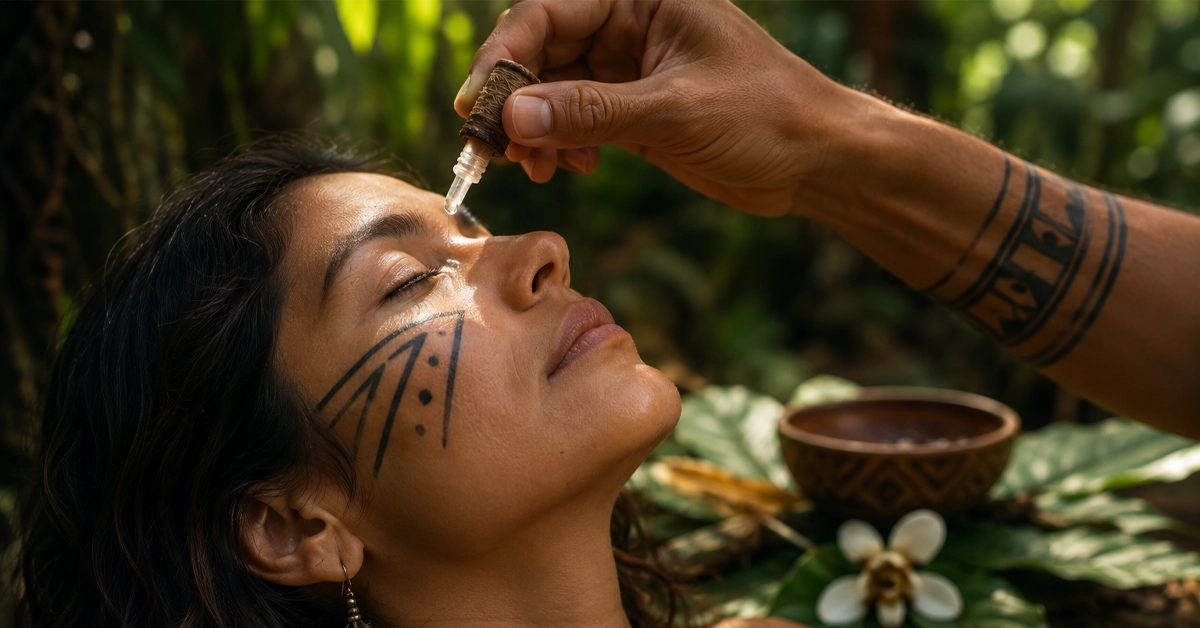
Sananga is a botanical preparation traditionally associated with certain Indigenous communities of the Amazon. It is generally described as a liquid plant preparation placed in the eyes within particular cultural or ceremonial contexts.
Because the eyes are delicate organs, any substance introduced into them deserves serious caution. Scientific evidence specifically evaluating Sananga’s effectiveness, sterility, chemical composition, appropriate preparation, and long-term ocular safety remains limited.
For that reason, this article does not claim that Sananga diagnoses, treats, prevents, or cures any medical or psychological condition. Instead, it examines the most commonly discussed sananga benefits as cultural associations and reported experiences while also explaining the important limitations, risks, and responsibilities surrounding the subject.
Sananga should not be used as a substitute for professional eye care, mental healthcare, or medical treatment.
What Is Sananga?
Sananga is the name commonly used for certain traditional Amazonian botanical preparations associated with the roots, bark, or other parts of plants from the Tabernaemontana genus. The exact plant, recipe, concentration, preparation method, and cultural meaning may differ between communities and producers.
This variation is important. Sananga is not necessarily one standardized formula manufactured according to a universal pharmaceutical specification.
Two preparations sold under the same general name may differ in:
- Plant species or botanical variety
- Part of the plant used
- Harvest location
- Preparation method
- Concentration
- Storage conditions
- Microbial cleanliness
- Cultural and ceremonial context
Some Indigenous peoples have traditionally associated related preparations with hunting, visual awareness, ritual purification, spiritual discipline, or community practices. These traditions are diverse and should not be presented as though every Amazonian people uses Sananga in the same way.
Readers seeking a broader introduction can also explore What Is Sananga?, our foundational guide to its origins, cultural context, and responsible representation.
Are Sananga Benefits Scientifically Proven?
Claims about sananga benefits are often much stronger online than the available scientific evidence supports.
At present, there is not a substantial body of controlled human clinical research demonstrating that Sananga safely improves vision, treats eye disease, enhances concentration, heals emotional distress, or produces other specific health outcomes.
Traditional use may be culturally meaningful, and personal experiences can feel profound. Neither traditional use nor a personal testimonial is automatically equivalent to clinical proof.
A reliable evaluation of an eye preparation would normally need to examine factors such as:
- Precise botanical identification
- Chemical composition
- Sterility
- Acidity or alkalinity
- Ocular toxicity
- Risk of infection
- Short- and long-term effects
- Interactions with existing eye conditions
- Consistent manufacturing standards
Until stronger evidence is available, descriptions of Sananga’s effects should use language such as “traditionally associated with,” “some participants report,” or “described within certain ceremonial contexts.”
They should not be presented as guaranteed therapeutic results.
Why Discussions About Sananga Benefits Require Eye-Safety Context
The eye has a highly sensitive surface that can be harmed by contaminated, irritating, acidic, alkaline, or incorrectly prepared substances.
Plant-derived does not automatically mean sterile, gentle, or safe for ocular use. Botanical materials can contain active compounds, natural irritants, microorganisms, particles, or substances whose concentration varies between preparations.
Traditional and non-pharmaceutical eye preparations have been associated in medical literature with problems including:
- Severe irritation
- Redness and inflammation
- Damage to the corneal surface
- Infection
- Light sensitivity
- Persistent pain
- Visual impairment
This does not prove that every Sananga preparation causes injury. It does mean that safety cannot be assumed simply because a preparation is natural or traditional.
Anyone experiencing eye pain, persistent redness, discharge, swelling, light sensitivity, reduced vision, or continued discomfort after exposure to an unknown substance should seek urgent professional eye care.
1. Reported Sananga Benefits for Focus and Mental Clarity
One of the most frequently discussed sananga benefits is a subjective sense of mental clarity.
Some adult participants describe feeling more attentive, alert, or mentally quiet after an intense and brief sensory experience. Others interpret the interruption of ordinary thought as a return to the present moment.
These reports may involve several overlapping factors:
- The intensity of the immediate experience
- Focused breathing or prayer
- Expectation
- The surrounding ceremonial environment
- A deliberate pause from normal activity
- Personal interpretation
This does not establish that Sananga medically improves concentration, cognition, memory, attention disorders, or neurological function.
People seeking support for persistent difficulty concentrating should consult an appropriate healthcare or mental-health professional rather than relying on an unverified eye preparation.
2. Reported Sananga Benefits for Present-Moment Awareness
Another commonly reported association is heightened presence.
Intense sensory experiences can temporarily draw attention away from internal dialogue and toward immediate physical sensations. Within a ritual setting, this may be interpreted as mindfulness, surrender, or renewed awareness of the present.
Participants may describe noticing:
- The rhythm of breathing
- Surrounding sounds
- Emotional reactions
- The body’s response to discomfort
- The intention behind a ceremony
Presence itself can be cultivated without applying plant substances to the eyes. Meditation, breathing exercises, prayer, journaling, walking in nature, and mindful observation can also create opportunities to slow down and reconnect.
Readers interested in the wider philosophy of attentive living may enjoy our article on Indigenous Wisdom and the Guardians of the Amazon.
3. Reported Sananga Benefits for Emotional Reflection
Some discussions of sananga benefits describe feelings of emotional release, calm, or greater awareness of personal patterns.
It is important to distinguish between an experience that encourages reflection and a treatment for an emotional or psychiatric condition.
A ritual can create a meaningful pause. During that pause, a participant may notice grief, fear, frustration, gratitude, or another feeling that had not received attention.
The emotional significance may arise from:
- The intention established beforehand
- The presence of trusted community members
- Prayer or ceremonial music
- A period of silence
- Expectation and personal meaning
- The larger process of self-reflection
Sananga has not been established as a treatment for anxiety, depression, trauma, grief, or another mental-health condition.
Anyone experiencing persistent emotional distress should seek support from a qualified professional or trusted support person.
4. Sananga and Meditation Practices
Sananga is sometimes discussed alongside meditation, prayer, breathwork, and ceremonial reflection.
In these settings, the preparation may be understood as part of a larger ritual rather than an isolated product. The surrounding structure may include intention, silence, music, guidance, community, or reverence for the forest.
Some adult participants report that this context helps them become more attentive to meditation. However, that does not demonstrate that Sananga is necessary for meditation or that it reliably deepens spiritual practice.
Meditation can be practiced safely without introducing any substance into the eyes.
The larger lesson may be found in the intentional structure:
- Creating a quiet space
- Reducing distractions
- Establishing a clear purpose
- Listening carefully
- Allowing time for reflection
These elements can support meaningful practice independently of Sananga.
5. A Renewed Connection With Nature
One of the broader themes associated with sananga benefits is a renewed relationship with the natural world.
For many people outside the Amazon, learning about Sananga becomes an introduction to Indigenous forest traditions, botanical knowledge, cultural diversity, and the ecological importance of the rainforest.
This curiosity can inspire greater appreciation for:
- Forests and rivers
- Plant diversity
- Indigenous territories
- Traditional ecological knowledge
- Relationships between culture and environment
- The protection of Amazonian ecosystems
However, connection with nature should not depend on consuming or applying a traditional preparation.
People can cultivate direct relationships with the living world by learning about their local ecosystems, supporting conservation, spending attentive time outdoors, reducing waste, and listening to Indigenous environmental leaders.
Our article on Forest Communication explores how roots, fungi, plants, and microorganisms create relationships beneath the soil.
6. Sananga as Part of Intentional Ritual
Ritual can transform the way people relate to time and attention.
Ordinary activities become meaningful when they are performed with purpose, gratitude, and awareness. Within some cultural settings, Sananga may be situated inside this larger understanding of ceremonial life.
Some participants describe the ritual surrounding Sananga as more significant than any single claimed effect.
The ritual may encourage them to:
- Pause before acting
- Clarify an intention
- Express gratitude
- Reflect on personal choices
- Reconnect with community
- Recognize the origins of a tradition
These practices are not exclusive to Sananga. A person can bring greater ceremony to daily life through mindful meals, gratitude, respectful gatherings, creative practices, time in nature, or moments of silence.
7. Greater Awareness of Personal Habits
Self-reflection is another reason people become interested in discussions about sananga benefits.
A ritualized pause can make certain habits more visible. A person may notice constant distraction, emotional reactivity, impatience, overwork, or disconnection from relationships.
The value of this awareness lies in what follows.
Reflection becomes meaningful when it leads to responsible action, such as:
- Improving communication
- Creating healthier routines
- Seeking professional support
- Spending more time outdoors
- Reducing unnecessary consumption
- Building stronger community relationships
No traditional preparation can make those changes on a person’s behalf.
Awareness may begin a process, but lasting change usually depends on continued choices, support, and accountability.
8. Growing Interest in Indigenous Wisdom
Interest in Sananga has introduced many people to the broader subject of Indigenous wisdom.
This can become a positive development when it encourages accurate education, direct listening, fair relationships, cultural respect, and support for Indigenous-led priorities.
It becomes harmful when Indigenous identity is reduced to marketing imagery or when cultural knowledge is removed from its people and sold without consent, attribution, or benefit sharing.
A responsible discussion should ask:
- Which specific people or community is connected to this preparation?
- Who produced it?
- Is the cultural attribution accurate?
- Did the community consent to how its name is used?
- Does the commercial relationship support the producers fairly?
- Are sacred or private teachings being exposed without permission?
Indigenous cultures are not wellness brands. They are living, contemporary societies with political rights, territories, languages, families, leaders, and distinct knowledge systems.
9. Supporting Cultural Continuity Through Ethical Relationships
Some people describe cultural support as one of the indirect sananga benefits of responsible global interest.
That support is only meaningful when the relationship is genuinely ethical.
Purchasing a product decorated with Indigenous imagery does not automatically support Indigenous peoples. Ethical engagement requires transparency about producers, sourcing, compensation, consent, and the use of community names.
Meaningful support may include:
- Buying through transparent Indigenous-led relationships
- Supporting territorial protection
- Listening to Indigenous educators
- Funding language and cultural initiatives
- Respecting intellectual property
- Avoiding imitation of restricted ceremonies
- Recognizing Indigenous authority over their own traditions
Culture is preserved by living communities, not by products alone.
10. A Reminder of Simplicity and Intentional Living
Modern wellness culture often depends on complicated programs, constant consumption, expensive devices, and promises of rapid transformation.
The broader philosophy surrounding many traditional practices offers a different message: attention matters.
People are often drawn to Sananga because the surrounding language emphasizes:
- Presence
- Intention
- Nature
- Gratitude
- Community
- Reflection
None of these qualities requires a product.
They can be cultivated through simple practices such as turning off a device, listening fully to another person, walking without distraction, preparing food carefully, observing the sky, or sitting quietly near a tree.
The most enduring lesson may not be that people need something new. It may be that they need to pay closer attention to what is already present.
11. Sananga as a Gateway to Broader Awareness
For some people, curiosity about sananga benefits becomes the beginning of a wider educational journey.
They may begin learning about:
- Amazonian biodiversity
- Indigenous territorial rights
- Traditional ecological knowledge
- Ethical commerce
- Botanical safety
- Cultural appropriation
- Rainforest conservation
This broader awareness can be constructive when it moves beyond personal experience and toward responsibility.
The most important question is not only, “What can this tradition give me?”
It is also:
“How can I learn without extracting, support without appropriating, and respect the people who carry this knowledge?”
Traditional Use Does Not Mean Universal Use
Amazonian peoples are diverse. A preparation associated with one community may be unknown, uncommon, restricted, or understood differently by another.
Even within one nation, knowledge and practices may vary by:
- Family
- Village
- Region
- Lineage
- Healer
- Historical period
Articles should therefore avoid phrases such as “all Amazonian tribes use Sananga” or “Indigenous people believe” without identifying a specific source or community.
Respect begins with recognizing diversity.
Reported Experience Versus Demonstrated Benefit
Online articles about sananga benefits frequently use customer testimonials as evidence. Testimonials can communicate how an individual interpreted an experience, but they cannot determine whether a preparation is medically effective or safe.
A personal report may be influenced by:
- Expectation
- Context
- Prior beliefs
- Group dynamics
- Natural changes in symptoms
- Other practices occurring at the same time
- The intensity of the immediate sensation
This does not mean that the individual is being dishonest. It means that subjective experience and scientific evidence answer different questions.
A responsible article can honor personal meaning without transforming it into a universal health claim.
Can Sananga Improve Eyesight?
Claims that Sananga corrects myopia, astigmatism, cataracts, glaucoma, infection, or another eye condition are not supported by adequate clinical evidence.
Vision problems can have very different causes. Some require prescription lenses, medication, surgery, monitoring, or urgent intervention.
Delaying professional assessment while relying on an unverified botanical preparation can allow a serious eye condition to worsen.
Anyone experiencing blurred vision, sudden visual changes, eye pain, flashes, loss of vision, injury, or persistent redness should consult a qualified eye-care professional.
Can Sananga Treat Emotional or Mental-Health Conditions?
Sananga has not been established as a treatment for depression, anxiety, trauma, attention disorders, addiction, or another mental-health condition.
A ceremonial experience may feel emotionally meaningful. Meaningful experiences can coexist with the need for evidence-based care.
People should not discontinue medication, therapy, or professional treatment because of claims made by a seller, facilitator, testimonial, or spiritual influencer.
Culture and spirituality can be important sources of meaning, but they should not be used to discourage people from receiving appropriate care.
Sananga Quality, Sterility, and Contamination
Any liquid placed in the eyes must be considered from the perspective of contamination risk.
A preparation can become contaminated through:
- Water quality
- Plant material
- Containers
- Hands and preparation surfaces
- Storage temperature
- Repeated opening
- Contact between a dropper and the body
- Sharing containers between people
A preparation that looks clear or smells normal is not necessarily sterile.
Traditional manufacture and pharmaceutical manufacture are different systems. A cultural history of use does not automatically establish that a commercially distributed bottle meets modern ophthalmic sterility standards.
This distinction should be clear in any responsible product or educational description.
Who Should Exercise Particular Caution?
Because scientific safety information is limited, no article can determine whether Sananga is appropriate for a particular individual.
Extra caution is especially important for people with:
- Existing eye disease
- Recent eye surgery
- Corneal injury
- Contact-lens complications
- Eye infection
- Severe dry eye
- Known sensitivity to plant preparations
- Unexplained changes in vision
Children and minors should not be encouraged to experiment with intense, unregulated preparations placed in the eyes.
Questions about individual eye health should be directed to a qualified ophthalmologist, optometrist, or other appropriate healthcare professional.
Warning Signs That Require Professional Eye Care
Eye injuries and infections can progress quickly. Professional assessment is important when symptoms are severe, persistent, or worsening.
Warning signs can include:
- Reduced or blurred vision
- Severe or continuing pain
- Persistent redness
- Swelling
- Discharge
- Strong sensitivity to light
- Difficulty opening the eye
- A sensation that something remains in the eye
- Symptoms that do not resolve promptly
An online article, seller, facilitator, or community discussion cannot replace an eye examination.
How to Evaluate Claims About Sananga Benefits
Readers can evaluate claims more responsibly by asking several questions.
Is the Claim Traditional, Subjective, or Clinical?
A traditional association, personal experience, and medical result are different categories of evidence.
Is the Specific Preparation Identified?
The botanical species, plant part, concentration, and preparation method may affect both experience and risk.
Was the Product Tested for Sterility?
Words such as pure, natural, sacred, fresh, or authentic do not establish microbiological safety.
Does the Claim Promise to Treat a Condition?
Claims about curing eye disease or mental-health conditions require strong evidence and appropriate regulatory oversight.
Is the Source Selling the Product?
Commercial interests do not automatically make information false, but they create a reason to examine claims carefully.
Are Risks Presented as Clearly as Benefits?
Responsible education should explain uncertainty and safety rather than discussing only desirable outcomes.
Respecting Indigenous Knowledge Without Romanticizing It
Sananga should not be used to create an idealized image of Indigenous peoples as mystical figures who exist only to provide spiritual experiences to outsiders.
Indigenous communities are contemporary societies facing real political, economic, environmental, and cultural challenges.
Respect means recognizing:
- The diversity of Indigenous nations
- Their authority over their own knowledge
- The importance of territorial rights
- The need for fair commercial relationships
- The difference between public and restricted traditions
- Their role as present-day leaders and knowledge holders
Romanticizing a tradition can be another form of erasure when it replaces real people with a fantasy created for outsiders.
Ethical Sourcing and Cultural Responsibility
Interest in sananga benefits has contributed to a growing international market. Consumers should understand that Indigenous names and forest imagery do not guarantee ethical sourcing.
A transparent seller should be able to explain, when disclosure is culturally appropriate:
- Who produced the preparation
- Which community or region it comes from
- How the relationship was established
- Whether the producer consented to the use of a community name
- How producers are compensated
- How the product is stored and labeled
Some traditional knowledge should remain private. Transparency does not require exposing restricted recipes or ceremonial secrets.
It does require avoiding false stories, invented lineage, and unsupported claims of Indigenous authorization.
Sananga, Hapé, and Other Amazonian Traditions
People often encounter Sananga through wider discussions involving Hapé or Rapé, forest ceremonies, traditional songs, or other Amazonian practices.
These traditions may coexist in some contemporary settings, but they should not be treated as interchangeable.
Each has its own:
- Origins
- Ingredients
- Cultural associations
- Risks
- Communities of knowledge
A product collection should not erase these differences by placing every Amazonian tradition under one vague category of “shamanic medicine.”
Accurate education strengthens cultural respect.
Safer Ways to Explore the Values Associated With Sananga
Many of the qualities associated with reported sananga benefits can be explored without placing an unregulated plant preparation into the eyes.
Someone seeking presence, nature connection, reflection, or intentional living can consider:
- Silent meditation
- Guided mindfulness
- Journaling
- Spending attentive time in nature
- Learning from Indigenous-authored books and talks
- Supporting Indigenous-led conservation
- Practicing gratitude
- Participating in community service
- Receiving qualified mental-health support
The values of clarity, respect, connection, and responsibility do not belong to a product. They can become part of everyday life.
Why Sananga Benefits Continue to Attract Global Interest
The increasing popularity of searches for sananga benefits reveals something about the modern world.
Many people are seeking:
- A sense of meaning
- Relief from constant distraction
- Connection with nature
- Community
- Spiritual depth
- Alternatives to excessive consumption
- Knowledge outside conventional institutions
These longings are real.
However, vulnerability can make people more susceptible to exaggerated claims. A practice should not be considered effective or safe merely because it is ancient, intense, natural, Indigenous-associated, or spiritually meaningful.
Responsible curiosity combines openness with discernment.
Understanding Sananga Benefits Through Respect and Evidence
The best approach to sananga benefits is neither automatic dismissal nor uncritical belief.
It is possible to recognize cultural significance while acknowledging scientific uncertainty.
It is possible to listen to personal stories without treating them as medical proof.
It is possible to honor Indigenous knowledge without copying restricted traditions.
It is possible to appreciate the search for clarity and connection while taking eye safety seriously.
This balanced approach protects both people and traditions.
Conclusion: Sananga Benefits, Cultural Meaning, and Responsible Awareness
Interest in sananga benefits reflects more than curiosity about an Amazonian botanical preparation.
It reflects a widespread longing for:
- Clarity
- Presence
- Connection
- Meaning
- Balance
- Relationship with nature
Within certain Indigenous and ceremonial contexts, Sananga carries cultural meanings that cannot be understood through a list of commercial benefits alone.
At the same time, scientific research specifically demonstrating its ocular safety and therapeutic effectiveness remains limited. Because plant preparations are placed directly in the eyes, contamination, irritation, infection, and injury must be treated as genuine concerns.
The most responsible conclusion is therefore not that Sananga is either a universal medicine or a tradition without meaning.
It is that cultural meaning, subjective experience, scientific evidence, and medical safety must be discussed honestly and separately.
Sananga can encourage a broader conversation about Amazonian traditions, Indigenous rights, ethical sourcing, and humanity’s desire to reconnect with the living world.
Perhaps the most valuable invitation is not to chase an intense experience, but to cultivate the qualities people are already seeking:
Attention. Responsibility. Humility. Gratitude. Connection.
Frequently Asked Questions About Sananga Benefits
What are the most commonly reported Sananga benefits?
Commonly reported sananga benefits include subjective feelings of mental clarity, presence, emotional reflection, spiritual focus, and connection with nature. These reports should not be interpreted as clinically proven medical benefits.
Are Sananga benefits scientifically proven?
There is currently limited scientific research specifically demonstrating Sananga’s safety or effectiveness in humans. Strong medical claims about vision, eye disease, mental health, or other conditions are not supported by an adequate body of clinical evidence.
What is Sananga made from?
Sananga is commonly described as a botanical preparation made from plants associated with the Tabernaemontana genus. The exact species, plant parts, concentration, recipe, and preparation method can vary.
Is Sananga safe for the eyes?
Safety cannot be assumed. The eyes can be harmed by irritating, contaminated, incorrectly concentrated, or non-sterile substances. Scientific information evaluating the safety of different Sananga preparations remains limited.
Can Sananga improve eyesight?
There is insufficient reliable clinical evidence that Sananga corrects refractive errors or treats conditions such as cataracts, glaucoma, infection, or other eye diseases. Vision concerns should be evaluated by a qualified eye-care professional.
Can Sananga treat anxiety or depression?
Sananga has not been established as a treatment for anxiety, depression, trauma, or another mental-health condition. People experiencing emotional distress should seek appropriate professional support.
Why does Sananga create an intense sensation?
The intensity may relate to the preparation’s botanical compounds, concentration, acidity or alkalinity, and interaction with the highly sensitive ocular surface. Intensity is not evidence of healing or effectiveness.
Does natural mean Sananga is safe?
No. Natural substances can irritate or injure the eyes, and botanical liquids can become contaminated. Safety depends on much more than whether an ingredient comes from a plant.
Is every Sananga preparation the same?
No. Preparations can vary by plant, region, producer, recipe, concentration, storage, and cultural tradition. The shared name does not guarantee identical composition or safety.
What should someone do after an adverse eye reaction?
Persistent pain, redness, swelling, discharge, light sensitivity, or changes in vision require prompt professional evaluation. An online article or product seller cannot diagnose an eye injury.
How can people learn about Sananga respectfully?
People can seek information from clearly identified Indigenous knowledge holders, recognize the diversity of Amazonian communities, support Indigenous-led initiatives, avoid medical exaggeration, and respect restricted cultural knowledge.
Does buying Sananga automatically support Indigenous communities?
No. Ethical support depends on the actual sourcing relationship, consent, attribution, compensation, and participation of the producers. Indigenous imagery alone does not prove ethical sourcing.
Can minors use Sananga?
Minors should not be encouraged to experiment with intense and unregulated preparations placed directly in the eyes. Questions involving eye health should be handled by a qualified healthcare professional and a responsible adult.
Can the values associated with Sananga be explored without using it?
Yes. Presence, reflection, gratitude, nature connection, and intentional living can be cultivated through meditation, journaling, mindful time outdoors, community involvement, and other practices that do not involve introducing botanical substances into the eyes.
Why is Sananga gaining global attention?
Sananga is gaining attention because of growing interest in Amazonian traditions, Indigenous knowledge, nature-based spirituality, ritual, and alternatives to modern patterns of distraction and disconnection.