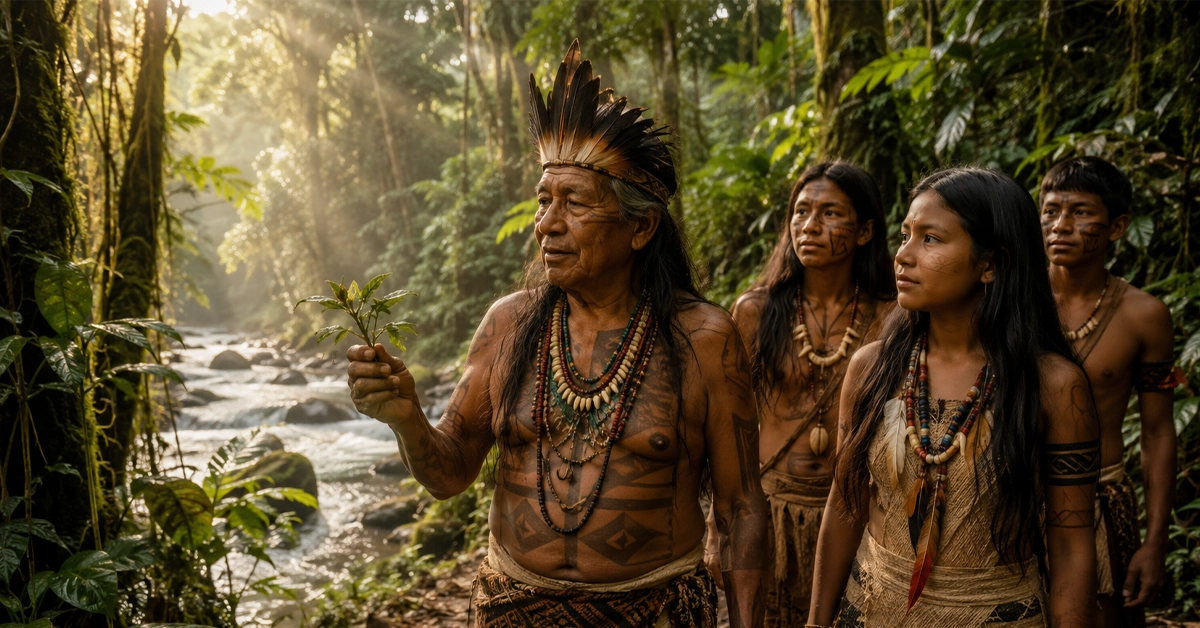
Humanity has never possessed more technology. We can communicate across continents instantly, access enormous amounts of information within seconds, and develop tools capable of transforming nearly every aspect of life.
Yet despite these advancements, many of the world’s greatest challenges continue to grow.
- Climate change
- Deforestation
- Loss of biodiversity
- Mental and emotional distress
- Social division
- Loneliness
- Loss of meaning
As societies search for solutions, more people are looking toward cultures that have maintained deep relationships with forests, rivers, plants, animals, and community for thousands of years.
The Amazon Rainforest is home to many distinct Indigenous nations. Each has its own language, history, worldview, ceremonies, artistic traditions, and forms of knowledge. Their wisdom was not developed in isolation from daily life. It emerged through observation, participation, memory, adaptation, and direct relationship with the living world.
This Indigenous wisdom does not provide one simple answer to every modern problem. Nor should Indigenous cultures be treated as symbols from the past. Indigenous peoples are contemporary communities, political actors, educators, artists, farmers, healers, leaders, and defenders of their territories.
What their knowledge systems offer is a different way of understanding life: one grounded in relationship, responsibility, reciprocity, and respect.
What Is Indigenous Wisdom?
Indigenous wisdom refers to the knowledge, values, practices, observations, and ways of understanding the world developed by Indigenous peoples over many generations.
It may include:
- Traditional ecological knowledge
- Knowledge of plants and animals
- Community values and responsibilities
- Oral histories
- Languages and naming systems
- Agricultural practices
- Traditional healing knowledge
- Spiritual teachings
- Seasonal knowledge
- Land and water management
- Art, music, storytelling, and ceremony
Unlike information that exists only in books, Indigenous knowledge is often transmitted through lived experience.
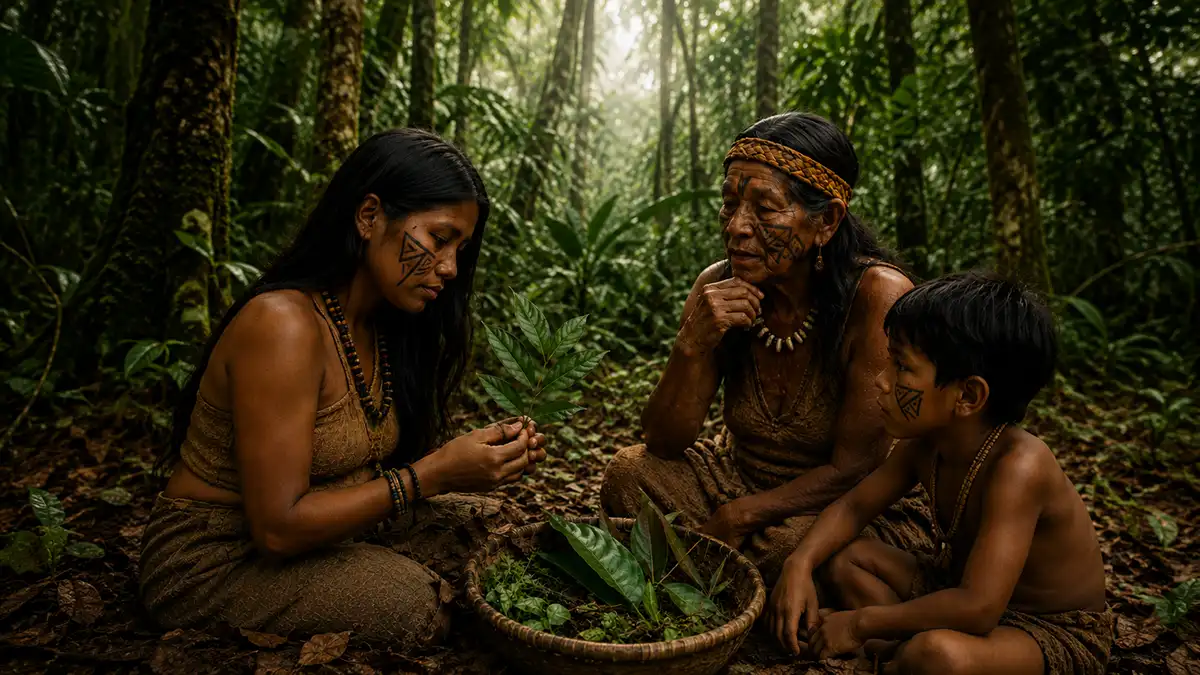
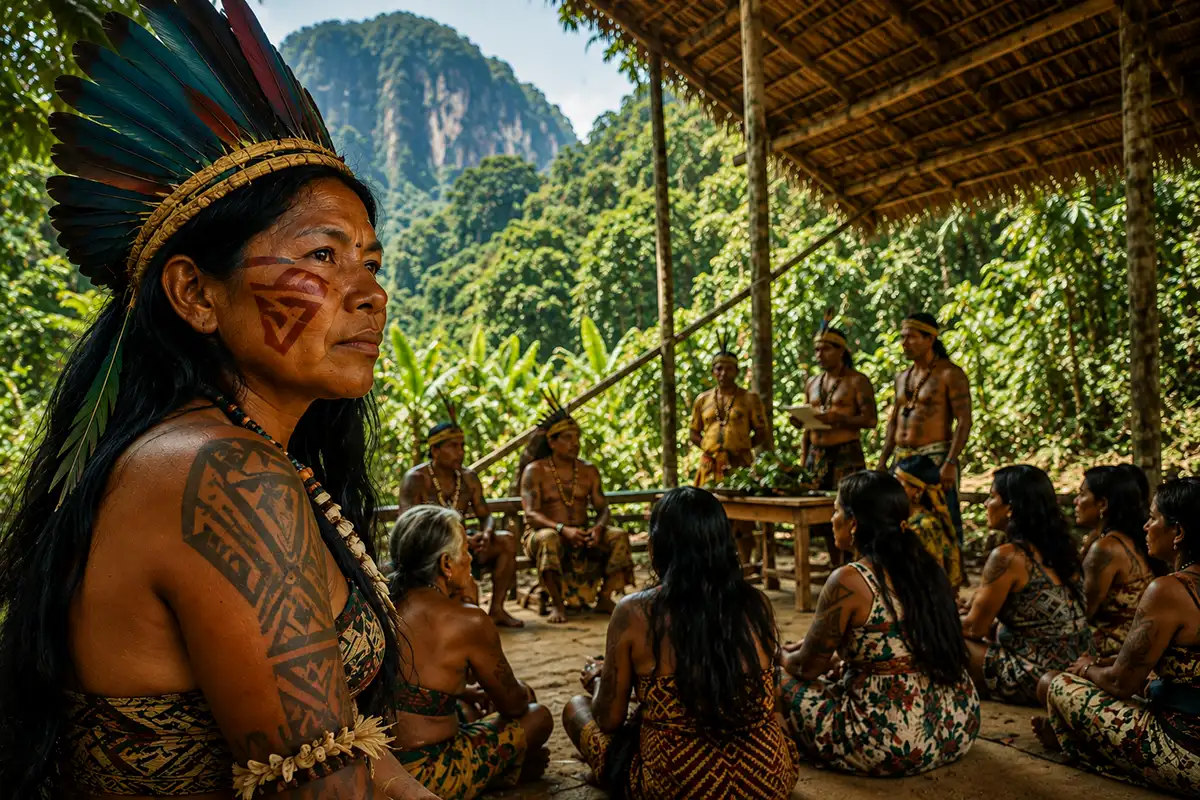
Children learn by observing and participating. Elders teach through stories, songs, example, and memory. Knowledge is practiced in gardens, forests, rivers, homes, ceremonies, and community gatherings.
In many cultures, wisdom is not measured only by how much information a person possesses. It is also measured by how responsibly that person lives in relationship with family, community, territory, ancestors, and future generations.
This understanding makes Indigenous knowledge different from information collected without responsibility. Knowledge creates obligations. To know the forest is also to care for it.
Indigenous Wisdom Is Not One Single Tradition
It is important to avoid speaking about Indigenous peoples as if they were one culture.
The Amazon is home to hundreds of Indigenous peoples, including communities with very different languages, histories, territories, and traditions. The Huni Kuin, Yawanawá, Asháninka, Shipibo-Konibo, Kayapó, Yanomami, Puyanawa, Nukini, Katukina, and many other peoples maintain distinct identities.
Practices associated with one nation should not automatically be attributed to another. A song, pattern, plant preparation, ceremony, or story may belong to a particular lineage, family, region, or community.
Respecting Indigenous wisdom therefore requires specificity. It means asking who preserved a teaching, where it comes from, and how it should be represented.
Our broader collection on Indigenous Wisdom explores different relationships between traditional knowledge, ecology, spirituality, and contemporary life.
The Forest as a Living Teacher
One of the most profound themes found within many Amazonian knowledge systems is the understanding that the forest itself is a teacher.
In modern societies, education often happens primarily inside classrooms. Knowledge is separated into subjects, written into books, and evaluated through examinations.
Within many Indigenous traditions, the forest is a living school.
- Trees teach patience and endurance.
- Rivers teach movement and adaptation.
- Animals teach attention and instinct.
- Seasons teach change.
- Plants teach relationship and responsibility.
- The night sky teaches orientation and time.
This does not mean that every observation is interpreted in the same way by every community. It means that knowledge develops through continuous participation in the environment.
The forest is not simply an object to be measured or controlled. It is a source of life, identity, food, medicine, memory, spirituality, and instruction.
This perspective creates a fundamentally different relationship with the environment. Instead of asking only how nature can serve humanity, Indigenous wisdom often asks how humans can live responsibly within nature.
Our article about forest communication examines how modern ecology is also revealing complex relationships among trees, fungi, roots, soil, and other organisms.
Interconnection: The Foundation of Indigenous Wisdom
A recurring principle across many Indigenous worldviews is interconnection.
People, plants, animals, rivers, soil, weather, ancestors, and future generations are not understood as completely separate realities. They participate in a larger web of relationships.
This understanding influences how decisions are made.
When life is viewed through the lens of interconnection, short-term gain cannot easily be separated from long-term consequences.
The health of a river affects fish, animals, forests, farms, and communities. The health of the forest influences water, rainfall, temperature, soil, and biodiversity. Damage to one part of the system creates effects elsewhere.
Modern environmental problems often grow when parts of a system are treated in isolation. A forest becomes timber. A river becomes a source of energy. Soil becomes a production surface. Animals become commodities.
Indigenous wisdom reminds us that every visible resource is supported by relationships that may not be immediately visible.
The forest survives not because each tree exists alone, but because countless beings participate in an interconnected system.
Traditional Ecological Knowledge
Traditional ecological knowledge is one of the most widely discussed dimensions of Indigenous wisdom.
It includes generations of observations about:
- Plant growth
- Animal behavior
- Weather patterns
- Seasonal cycles
- Soil conditions
- Water movement
- Fire
- Food systems
- Migration
- Ecological change
This knowledge is often highly local. It is connected to a specific territory and develops through long-term experience within that place.
A person may know when a particular fruit will ripen by observing rainfall, insects, bird behavior, and the flowering of another plant. A community may understand the condition of a river through changes in fish, sediment, water level, and vegetation.
These observations are not random beliefs. They are part of accumulated systems of knowledge tested through daily life.
Traditional ecological knowledge can also adapt. Indigenous cultures are not frozen in the past. Communities observe new environmental conditions, incorporate useful tools, and respond to changing realities while preserving essential relationships with territory and culture.
Indigenous Wisdom and Sustainability
Few subjects demonstrate the relevance of Indigenous knowledge more clearly than sustainability.
For generations, many Indigenous communities have developed ways of using forests, rivers, and soils while maintaining ecological diversity. These systems often depend on careful observation rather than maximum extraction.
Common principles may include:
- Taking only what is needed
- Respecting reproductive seasons
- Rotating cultivation areas
- Maintaining plant diversity
- Protecting sacred or sensitive locations
- Sharing resources within the community
- Considering the needs of future generations
This does not mean every historical Indigenous practice was environmentally perfect. Indigenous peoples, like all human societies, have adapted, made decisions, and faced ecological pressures.
However, many Indigenous land-management systems have preserved biodiversity more effectively than extractive models based on continuous expansion.
The central difference is often one of relationship. Sustainability is not treated merely as a technical calculation. It is connected to ethics, identity, gratitude, and responsibility.
Living With Enough Instead of Always Seeking More
Many contemporary economies depend on constant growth.
More consumption. More production. More extraction. More accumulation.
Yet one of the most important lessons associated with Indigenous wisdom is the principle of enough.
Enough does not mean stagnation or forced poverty. It means recognizing limits and understanding that taking without allowing renewal eventually destroys the source of life.
The forest demonstrates cycles rather than endless accumulation.
Leaves fall and return nutrients to the soil. Animals consume and become part of other cycles. Plants grow, reproduce, die, and nourish new life. Waste in one part of the ecosystem becomes nourishment elsewhere.
Human societies often remove resources without restoring the systems that produce them. The principle of enough challenges this pattern.
It asks:
- What do we actually need?
- What must remain for others?
- What must remain for the future?
- What relationships are damaged by excess?
In a world facing ecological limits, enough may be one of the most revolutionary ideas available to us.
Reciprocity as a Way of Life
Reciprocity is another important theme within many Indigenous traditions.
To receive creates a responsibility to give something back.
A person who harvests from the forest may offer gratitude, follow seasonal limits, care for the surrounding area, share with the community, or participate in ceremonies that acknowledge the source of life.
Reciprocity does not always involve a direct exchange between two individuals. It may occur across generations.
An elder preserves knowledge for children not yet born. A community protects a river that future generations will depend upon. A family plants trees whose fruit will be harvested years later.
This long-term perspective contrasts sharply with systems that reward immediate profit while transferring environmental costs to others.
Indigenous wisdom teaches that receiving without giving back eventually weakens the relationship upon which life depends.
Indigenous Wisdom and Community
Modern society frequently emphasizes individual achievement.
Personal success. Personal wealth. Personal recognition. Personal identity.
Many Indigenous cultures take a more relational view. The well-being of the individual is closely connected to the well-being of the family, community, and territory.
People become resilient when knowledge is shared, responsibilities are carried together, elders are respected, and children are nurtured by more than one person.
Community can provide:
- Belonging
- Protection
- Shared memory
- Practical support
- Cultural identity
- Collective purpose
This does not mean that Indigenous communities are free from conflict. Every community contains disagreement, personality, change, and complexity.
The lesson is not that community is always easy. The lesson is that human survival has always depended on relationships.
Strong communities create resilience because people do not face every challenge alone.
The Role of Elders
Many modern cultures celebrate novelty. New technology, new trends, new ideas, and rapid transformation are often treated as automatically superior.
Within many Indigenous traditions, elders hold a central place because they carry experience, memory, language, and long-term knowledge.
An elder may remember:
- Changes in rainfall
- Former river paths
- The location of important plants
- Community histories
- Traditional songs and stories
- Past conflicts and their consequences
- Seasonal patterns no longer easily visible
Elders are living libraries, but they are more than sources of information. Their knowledge may also embody judgment, responsibility, and cultural continuity.
This dimension of Indigenous wisdom reminds us that progress does not always require abandoning the past.
Sometimes moving forward requires remembering what previous generations already learned.
Storytelling as a Knowledge System
Stories are sometimes dismissed as entertainment or mythology. Within oral cultures, however, stories can preserve complex knowledge.
A story may teach:
- Where a community came from
- How a plant should be treated
- Why an animal behaves in a certain way
- What happens when a rule is broken
- How to respond to danger
- How to understand responsibility
Stories make knowledge memorable. They connect information with emotion, place, identity, and imagination.
A child may forget a list of rules but remember a story for an entire lifetime.
Storytelling also allows knowledge to remain flexible. Each generation can relate an old teaching to new circumstances without losing its central meaning.
Our article on Spirit Animals in Dreams explores how animals, dreams, and symbolic stories can communicate teachings about courage, transformation, and connection.
The Importance of Indigenous Languages
Language is one of the most important vessels of Indigenous wisdom.
A language may contain precise names for plants, soils, animal behaviors, water conditions, spiritual relationships, and seasonal changes that are difficult to translate into another language.
When a language disappears, humanity may lose more than vocabulary. It may lose a unique way of organizing knowledge and understanding reality.
Many Indigenous languages are threatened by displacement, discrimination, loss of territory, and educational systems that historically punished children for speaking their ancestral language.
Supporting language revitalization is therefore also a form of ecological and cultural preservation.
A plant name may contain information about its appearance, habitat, use, or relationship to another species. A place name may preserve a historical event or warning about the land.
Language and territory are often deeply connected.
The Spiritual Dimension of Indigenous Wisdom
Although Indigenous traditions vary greatly, many recognize a spiritual dimension within the natural world.
Forests, rivers, animals, mountains, plants, and celestial beings may carry meaning beyond their physical form.
The world is not divided neatly into matter and spirit. Daily life, ecology, ancestry, healing, and spirituality may be part of the same reality.
This perspective encourages humility.
A river is not only water to be used. It may also be a living presence, an ancestor, a source of memory, or a being deserving respect.
A plant is not only a collection of chemicals. It may also be understood through its relationships, its history, its territory, and its place within ceremony.
Whether a reader approaches these teachings spiritually, philosophically, or symbolically, they offer a valuable reminder: life becomes richer when the world is approached with reverence rather than domination.
Readers interested in Amazonian spiritual traditions can explore our educational introductions to Rapé or Hapé and Sananga.
Indigenous Healing Knowledge
Many Amazonian peoples maintain extensive knowledge of plants, diets, body practices, midwifery, massage, prayer, song, and ceremonial traditions.
This knowledge is often based on generations of observation and practice. It may also be closely connected to spiritual teachings and relationships with specific territories.
However, Indigenous healing systems should not be reduced to a collection of products for global consumption.
A plant preparation separated from its cultural context may lose important elements of meaning, responsibility, and guidance.
It is also essential to distinguish traditional use from modern medical evidence. Respecting Indigenous knowledge does not require making unsupported claims that a traditional preparation cures every illness.
Responsible dialogue can recognize the value of traditional healing while also supporting safety, informed consent, scientific research, and access to qualified healthcare.
Indigenous Wisdom and Resilience
The history of Indigenous peoples includes extraordinary resilience.
Communities have endured colonization, disease, displacement, forced conversion, violence, environmental destruction, discrimination, and attempts to suppress their languages and traditions.
Despite these pressures, many cultures continue to preserve and revitalize their identities.
This resilience is supported by several factors:
- Strong community relationships
- Connection to territory
- Cultural identity
- Spiritual grounding
- Oral history
- Adaptability
- Collective memory
Resilience is not simply the ability to survive. It is the ability to preserve meaning, dignity, identity, and purpose through change.
Modern societies facing instability can learn from this understanding.
Material resources matter, but people also need stories, relationships, places, practices, and values that help them understand who they are.
Indigenous Wisdom and Climate Change
Climate change is altering rainfall, temperature, river levels, animal movement, fire patterns, and plant cycles throughout the Amazon.
Indigenous communities are often among the first to notice these changes because their daily lives remain closely connected to local ecosystems.
Hunters may observe changes in animal distribution. Farmers may notice shifts in planting seasons. Elders may compare current rainfall with patterns remembered from decades earlier.
This place-based knowledge can complement scientific monitoring.
Satellite data can reveal large-scale environmental change. Local knowledge can reveal how that change affects particular plants, rivers, trails, farms, and communities.
The most effective responses may emerge when different knowledge systems work together respectfully.
However, Indigenous communities should not be asked to solve a crisis they did not create while continuing to face threats to their territories.
Recognizing the value of Indigenous wisdom must include protecting Indigenous rights, leadership, and land.
Why Protecting Indigenous Territories Protects Biodiversity
Indigenous territories often contain exceptionally high levels of biodiversity.
This is not accidental. It reflects generations of relationship, management, cultural responsibility, and resistance to large-scale extraction.
When Indigenous land rights are respected, communities are better able to protect forests from illegal logging, mining, land invasion, and destructive development.
Protecting territory also protects:
- Languages
- Sacred places
- Food systems
- Medicinal knowledge
- Wildlife corridors
- Rivers and watersheds
- Community autonomy
Conservation cannot be separated from human rights.
A forest is not truly protected if its guardians are displaced or denied authority over their ancestral lands.
Indigenous Wisdom and Modern Science
Indigenous wisdom and modern science are sometimes presented as opposites. This comparison is often misleading.
They are different knowledge systems with different methods, histories, strengths, and limitations.
Modern science relies on formal hypotheses, measurement, experimentation, peer review, and reproducibility.
Indigenous knowledge often relies on long-term observation, oral transmission, lived experience, community validation, and relationship with a particular place.
These systems do not need to become identical in order to learn from one another.
Scientific research may help identify mechanisms behind an ecological observation. Indigenous knowledge may guide researchers toward relationships that would otherwise be overlooked.
Collaboration can be valuable when it is based on consent, respect, benefit sharing, and recognition of Indigenous intellectual ownership.
It becomes exploitative when researchers extract knowledge without permission, compensation, or meaningful community participation.
Technology Without Wisdom
Technology is one of humanity’s greatest creative achievements. It can improve medicine, communication, education, agriculture, and environmental monitoring.
Yet technology alone cannot determine how it should be used.
A tool can protect a forest or accelerate its destruction. Data can strengthen communities or place them under surveillance. New medicines can save lives or become inaccessible to the people whose knowledge contributed to their development.
Technology provides capability. Wisdom provides direction.
Without ethics, responsibility, and long-term thinking, a solution to one problem may create several new problems.
One of the most important lessons of Indigenous wisdom is that knowledge should remain connected to consequences.
The question is not only, “Can we do this?”
It is also:
- Should we do it?
- Who will benefit?
- Who may be harmed?
- What will remain for future generations?
What Indigenous Wisdom Teaches About Leadership
Modern leadership is often associated with visibility, authority, status, and individual power.
Many Indigenous traditions offer another model: leadership as responsibility.
A respected leader may be expected to listen carefully, preserve community balance, remember collective history, protect territory, and think beyond personal interest.
Leadership can involve service rather than domination.
This does not mean every Indigenous political system is identical or ideal. It means that leadership can be measured by the well-being of the community rather than the power accumulated by the individual.
This lesson is deeply relevant to governments, companies, organizations, and families.
Power becomes meaningful when it protects life.
What Indigenous Wisdom Teaches About Time
Modern societies often organize life around speed.
Faster communication. Faster production. Faster growth. Faster decisions.
Many Indigenous knowledge systems are shaped by seasonal and ecological time.
A seed cannot be forced to become a tree immediately. A river changes according to rain and season. Knowledge may require years of observation. Trust develops through repeated relationship.
This understanding does not reject efficiency. It recognizes that some processes cannot be accelerated without damaging them.
Healing, education, community building, ecological restoration, and cultural transmission all require time.
The forest teaches that slow growth can create deep roots.
Common Misconceptions About Indigenous Wisdom
Indigenous Peoples All Share the Same Beliefs
Indigenous cultures are highly diverse. Teachings from one people should not automatically be attributed to another.
Indigenous Wisdom Belongs Only to the Past
Indigenous peoples are contemporary societies. They use technology, participate in politics, operate businesses, create art, attend universities, and develop new strategies for cultural survival.
Traditional Means Unchanging
Traditions adapt. Cultural continuity does not require refusing every new tool or idea.
Every Traditional Claim Is Scientifically Proven
Traditional use and scientific evidence are different forms of knowledge. Both should be represented accurately without exaggeration.
Anyone Can Freely Use Indigenous Knowledge
Some knowledge is public, while other teachings may be private, sacred, collective, or restricted. Access does not automatically mean ownership.
Indigenous Communities Exist Only to Teach Outsiders
Indigenous knowledge is first connected to Indigenous life, identity, territory, and future. Communities do not exist as spiritual resources for outsiders.
Learning Without Appropriating
Interest in Indigenous wisdom can lead to respect and solidarity, but it can also lead to cultural appropriation.
Appropriation occurs when cultural names, symbols, practices, or knowledge are removed from their context and used without consent, understanding, credit, or benefit to the people who created them.
Respectful learning may include:
- Listening to Indigenous voices directly
- Naming the specific people connected to a teaching
- Supporting Indigenous-led organizations
- Buying directly or through transparent partnerships
- Avoiding imitation of restricted ceremonies
- Not presenting oneself as an authority after limited exposure
- Recognizing cultural and intellectual ownership
The goal should not be to collect spiritual identities or reproduce sacred traditions.
The goal should be to become a more responsible relative within the living world.
How to Apply Indigenous Wisdom in Everyday Life
Most readers cannot and should not attempt to copy the ceremonies or cultural practices of Amazonian peoples.
However, the underlying principles can inspire practical changes without pretending to belong to a tradition that is not one’s own.
Practice Reciprocity
When you receive something, consider how you can contribute to the source that sustained you.
Learn the Ecology of Your Own Place
Discover the rivers, plants, animals, seasons, and environmental challenges of the region where you live.
Listen to Elders
Ask older relatives and community members about changes they have witnessed and lessons they have carried.
Reduce Waste
Notice what you consume, what you discard, and whether your habits can become more circular.
Strengthen Community
Share knowledge, care for neighbors, participate in local projects, and avoid treating independence as the only form of strength.
Think Beyond the Present
Consider how today’s choices may affect people and ecosystems decades from now.
Approach Nature as Relationship
Instead of experiencing forests, rivers, and animals only as scenery, recognize them as participants in the systems that sustain your life.
Indigenous Wisdom and the Future of Humanity
As global challenges become more interconnected, technological solutions alone may not be enough.
Scientific innovation remains essential. Renewable energy, ecological restoration, medicine, communication, and environmental monitoring will all play important roles.
Yet humanity also needs wisdom.
We need the ability to consider limits, consequences, relationships, and future generations.
The future may require a respectful dialogue between ancient knowledge and modern innovation.
This does not mean romanticizing Indigenous cultures or expecting them to provide simple solutions for the rest of the world.
It means recognizing Indigenous peoples as contemporary knowledge holders whose rights, territories, and perspectives must be respected.
It also means accepting that a sustainable future cannot be built while continuing to silence the communities that have protected many of the planet’s most biodiverse regions.
Why Indigenous Wisdom Matters More Than Ever
We live in an age of unprecedented information.
Yet information alone does not guarantee understanding.
Data can tell us that a forest is disappearing. Wisdom asks why it is being destroyed, who benefits, who suffers, and what responsibilities follow from knowing.
The Amazon’s Indigenous peoples remind us that knowledge becomes meaningful when joined with relationship, responsibility, and respect.
The lessons of Indigenous wisdom speak to universal questions:
- How should we live?
- How should we treat one another?
- How should we care for the Earth?
- How much is enough?
- What do we owe future generations?
- How do we create a future worth inheriting?
These questions are not new.
They are becoming increasingly urgent.
Conclusion: Learning From the Guardians of the Amazon
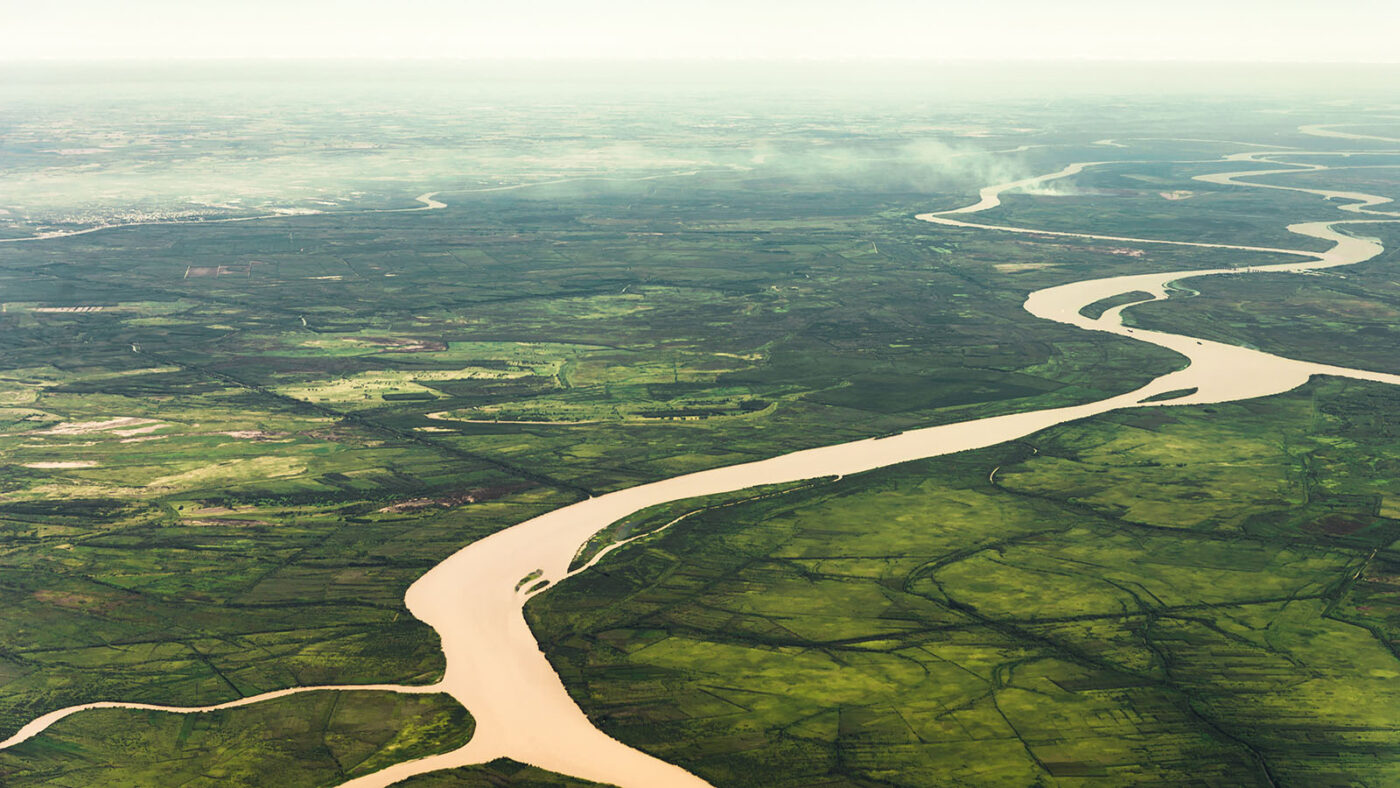
The Amazon is often described as one of the planet’s greatest treasures. Its forests influence climate, hold extraordinary biodiversity, protect vast water systems, and support countless forms of life.
Yet one of its greatest treasures is also the knowledge carried by its peoples.
For generations, Indigenous communities have developed ways of living that emphasize relationship, reciprocity, community, observation, resilience, and respect for life.
Indigenous wisdom reminds us that humanity is not separate from nature.
We are part of it.
The goal is not to abandon science, cities, or modern life. The goal is to bring knowledge back into relationship with responsibility.
It is to remember what truly matters:
- Connection
- Gratitude
- Community
- Humility
- Responsibility
- Reciprocity
- Respect for future generations
The forest has been teaching these lessons for thousands of years.
Its guardians continue to carry them forward.
The question is not whether Indigenous peoples possess knowledge that matters to the modern world.
The question is whether the modern world is prepared to listen without extracting, imitate without understanding, or praise without protecting.
Real listening requires respect.
Real respect requires action.
Frequently Asked Questions About Indigenous Wisdom
What is Indigenous wisdom?
Indigenous wisdom includes the knowledge, values, practices, stories, ecological observations, languages, and spiritual teachings developed by Indigenous peoples through generations of lived experience.
Why is Indigenous wisdom important?
Indigenous wisdom is important because it preserves knowledge about ecosystems, community resilience, cultural identity, sustainability, healing traditions, and long-term relationships with land and water.
What can Indigenous wisdom teach modern society?
It can teach the importance of reciprocity, community, ecological limits, respect for elders, long-term thinking, cultural identity, and responsibility toward future generations.
Is Indigenous wisdom the same in every community?
No. Indigenous peoples are culturally, linguistically, and historically diverse. Each community has its own traditions, territory, knowledge systems, and forms of spiritual and ecological understanding.
What is traditional ecological knowledge?
Traditional ecological knowledge refers to observations and practices related to plants, animals, seasons, water, soil, weather, farming, hunting, and environmental change developed through long-term relationship with a specific territory.
How does Indigenous wisdom support sustainability?
Many Indigenous systems emphasize balance, reciprocity, seasonal awareness, biodiversity, limited extraction, community responsibility, and preserving resources for future generations.
How can modern science work with Indigenous knowledge?
Collaboration can occur through respectful research, community leadership, informed consent, fair compensation, benefit sharing, and recognition of Indigenous ownership over cultural and intellectual knowledge.
Why are Indigenous territories important for conservation?
Indigenous territories frequently contain highly biodiverse forests, rivers, wildlife habitats, and traditional land-management systems. Protecting territorial rights can help protect entire ecosystems.
How can people learn from Indigenous cultures without appropriating them?
People can listen to Indigenous voices, credit specific communities, support Indigenous-led organizations, respect restricted knowledge, avoid copying sacred ceremonies, and maintain transparent, fair relationships.
Is Indigenous wisdom opposed to technology?
No. Indigenous communities frequently use modern technology for communication, education, mapping, environmental monitoring, business, and political organization. The central question is how technology is used and whom it serves.
Why are Indigenous languages important?
Indigenous languages preserve unique names, ecological observations, oral histories, spiritual concepts, cultural memory, and ways of understanding specific territories.
What role do elders play in Indigenous knowledge systems?
Elders often preserve long-term memory, oral history, language, ecological knowledge, stories, songs, and cultural teachings. Their experience helps connect younger generations with community history.
What does reciprocity mean in Indigenous traditions?
Reciprocity means understanding that receiving creates responsibility. People who benefit from land, water, community, or knowledge are expected to give back, protect relationships, and consider future generations.
Can Indigenous wisdom help address climate change?
Indigenous knowledge can contribute place-based observations, sustainable land-management practices, biodiversity protection, and long-term environmental perspectives. Climate action must also protect Indigenous rights and leadership.
Why should Indigenous wisdom not be romanticized?
Romanticization reduces diverse contemporary peoples to idealized symbols. Respect requires recognizing Indigenous communities as complex societies with modern realities, political rights, internal diversity, and authority over their own knowledge.