The Call of the Star People: Cosmic Connections in Forest Traditions
Stories of origin, celestial allies, and the bridges between sky and Earth
Looking Up from the Forest
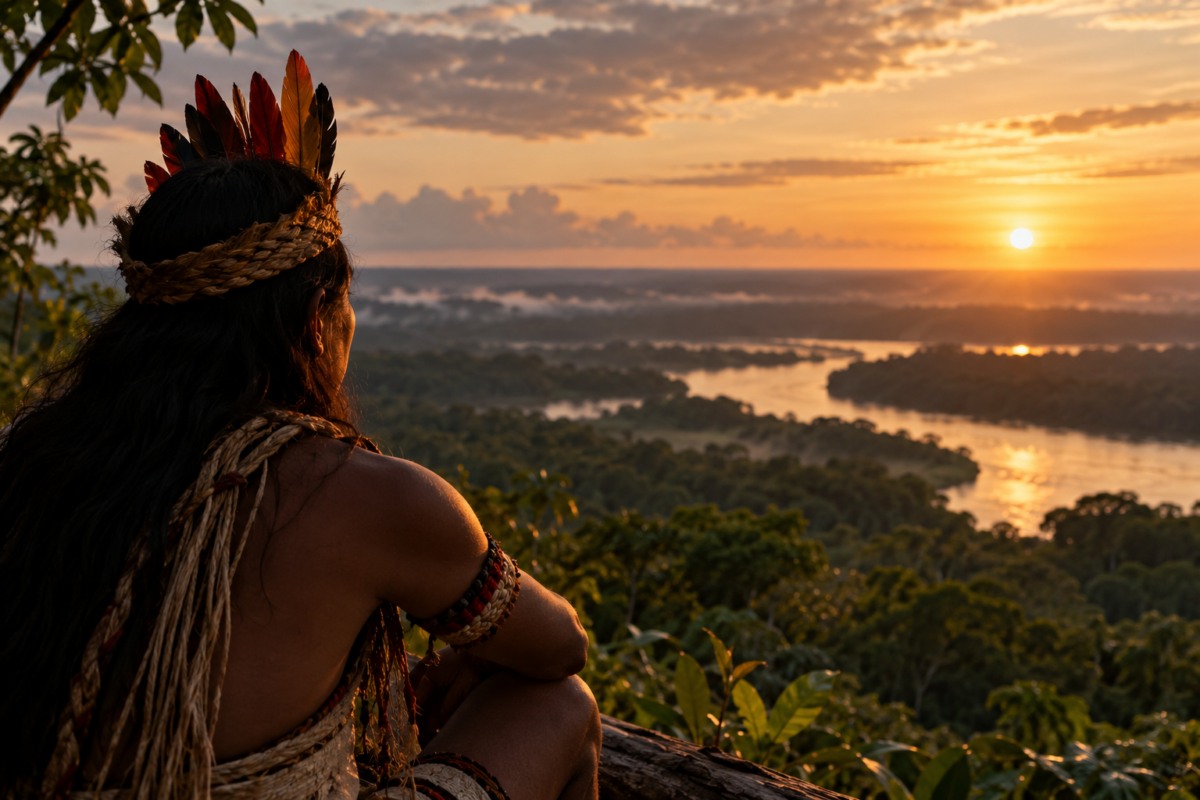
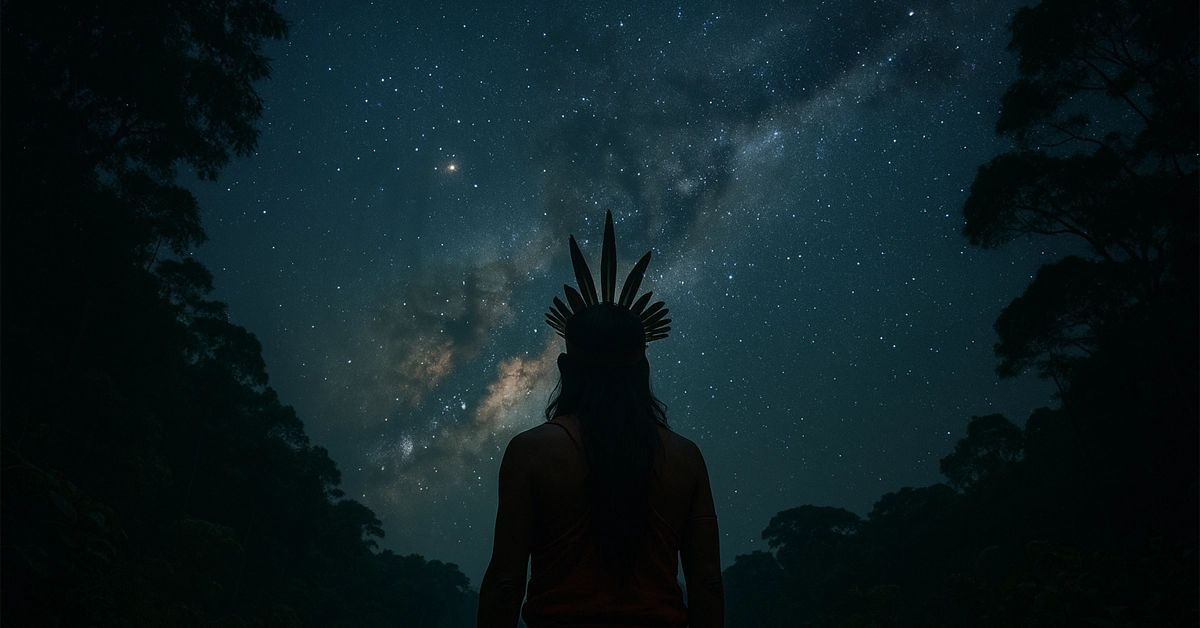
The Amazon rainforest is a universe of green — rivers like veins of silver, trees like towers, animals singing in endless symphonies. Yet, for the peoples who live beneath its canopy, the sky is just as alive as the forest floor. When night falls and the dense veil of stars covers the heavens, Indigenous eyes do not see a void. They see family. They see origin. They see allies.
For many tribes across the Americas, the stars are not distant suns but beings connected to their own story. Some speak of coming from the Pleiades, others of cosmic serpents that descended to teach, others still of ancestors who ascended and now shine above as guides. This cosmology does not divide Earth and sky but weaves them into a single fabric.
This is the call of the Star People — the sense that humanity is not confined to Earth, but has always been in relationship with the cosmos.
Origins Written in the Stars
The Pleiades: A Common Ancestral Home
Across continents, from the Amazon to the Andes, from North America to Oceania, the Pleiades constellation is seen as a place of origin. Among some Amazonian peoples, the cluster of seven stars is called “the house of the ancestors.” Ritual calendars often begin when the Pleiades reappear in the dawn sky, marking new cycles of planting, harvesting, and ceremony.
The stars are more than navigational tools — they are markers of humanity’s cosmic lineage. To gaze upon the Pleiades is to remember where we come from.
The Milky Way: The Great River Above
For the Tukano and other riverine tribes, the Milky Way is understood as a mirror of the Amazon itself — a celestial river carrying the souls of the departed. In ceremonies, shamans describe traveling along this star-river to meet guides, spirits, and ancestors who continue their journey beyond Earth.
The Cosmic Serpent
In many myths, a great serpent descends from the stars to bring knowledge and medicine. This serpent is mirrored in the anaconda of the rivers and in the spirals of visionary art. The “cosmic serpent” symbolizes the DNA of life itself — the link between biology and cosmology, Earth and sky.
Allies in the Sky
The forest peoples see not only origins but allies among the stars. Each constellation is alive, each planet a relative.
- Bird Constellations: Some tribes see great birds in the stars — harpy eagles, hummingbirds, macaws. They are protectors and messengers, carrying prayers upward.
- Animal Spirits: Jaguars, tapirs, and serpents are mapped in the constellations, echoing their presence in myth and ceremony.
- Ancestor Spirits: The stars themselves are said to be the eyes of the ancestors, watching, guiding, and reminding the living of their place in the great web.
In this worldview, the cosmos is not cold or empty but intimate — filled with relationships and reciprocity.
Ceremonies Under the Stars
Ceremonial life in the forest often aligns with celestial rhythms. Ayahuasca ceremonies are scheduled by the moon; rituals of planting and harvest follow star cycles; prayers to the spirits are offered under certain constellations.
For the Huni Kuin, chants called huni meka sometimes reference stars as teachers of songs. The Shipibo weave the patterns of constellations into their kené designs, which are both visual and auditory maps of the universe.
To look at the night sky in the Amazon is to sit inside a cosmic temple — where the ceiling is alive with ancestors and allies, and the ceremonies below mirror the ceremonies above.
The Philosophical Meaning: A Non-Separate Cosmos
What these traditions reveal is a radically different cosmology than the modern Western view. In the Indigenous understanding:
- There is no separation between Earth and sky, human and star, body and spirit.
- Time is cyclical, marked by the return of stars and seasons, not linear progression.
- Knowledge is relational — the stars teach, the plants teach, the animals teach. Humans are students in a vast school of life.
This worldview is both humble and expansive. It roots people deeply in the Earth while reminding them of their cosmic origins.
Why the Star People Still Call Us
For many seekers today, there is a resonance with these stories. People feel the call of the stars — a longing for connection with something greater than Earthly routines.
The Indigenous traditions remind us that this longing is not new. It is ancient. The call of the Star People is a call to remember that we are children of the cosmos, that our DNA carries the memory of stars, that our spirits are both rooted in the soil and reaching for the infinite.
Lessons for Humanity
From the forest’s perspective, here are some of the lessons the Star People offer:
- Live in cycles: Just as the stars return each season, so too do our lives flow in patterns of return and renewal.
- Honor origin: We are not alone, nor are we accidental. We are part of a vast story written in light.
- Seek guidance: The cosmos is not mute. When we look up with reverence, we may receive direction and wisdom.
- Bridge opposites: The path is not Earth or sky, but Earth and sky — learning to live as cosmic beings grounded in soil.
A Bridge of Light
The call of the Star People is not just about mythology. It is a living invitation — to see ourselves as beings of both Earth and sky, as children of rivers and constellations, as participants in a vast dance of life that transcends worlds.
In the forest, when night falls, the stars are not distant. They are family. They are memory. They are destiny.
And perhaps this is the lesson for us all: to remember that we are never alone under the stars. Every light above is a reminder of our eternal belonging — to the Earth, to the cosmos, and to the infinite mystery that binds them together.
[ux_products ids=”149763″]
Continue exploring
All stories
The medicines of the forest