Amulets of the Forest: The Protective Power of Sacred Objects
How Indigenous Spiritual Tools Guard the Body, Soul, and Space
Carriers of Spirit
Throughout the world, cultures have carved meaning into stones, feathers, bones, and beads. In the Amazon rainforest, this sacred relationship with nature takes form in objects that are far more than decorative—they are living allies. Kuripes, necklaces, earrings, feather headdresses, and even sacred seeds serve not only as expressions of beauty but as spiritual armor, vessels of power, and conduits for ancestral connection.
Among the tribes of the forest, the line between the seen and the unseen is thin. Every object has a presence, every material holds energy, and every adornment is a prayer. These amulets of the forest are worn not just on the body but in the spirit. They are guardians, companions, and symbols of a cosmology where protection comes not from separation but from deeper connection.
This article explores the spiritual, cultural, and energetic significance of these sacred objects. From their creation to their daily use, we will journey into a world where every feather, bead, and shape has a story—and a purpose.
The Purpose of Amulets in Indigenous Cosmology
In many Indigenous traditions, illness and misfortune are not random. They are often seen as energetic imbalances, spiritual intrusions, or disconnection from nature. In this view, healing involves restoring alignment—not only through plants and prayers but also through symbols.
Sacred objects serve as spiritual technologies. Like antennas, they receive and transmit frequencies. A feather worn on the crown is not a fashion choice—it aligns the upper energy centers with the sky. A jaguar tooth necklace is not just a trophy—it embodies the courage and force of the animal spirit.
These objects are protectors not because they act as physical shields, but because they vibrate with intention. Their form holds a purpose, their material holds memory, and their use is guided by ceremonial knowledge passed down through generations.
Kuripe: The Self-Applicator as a Personal Portal
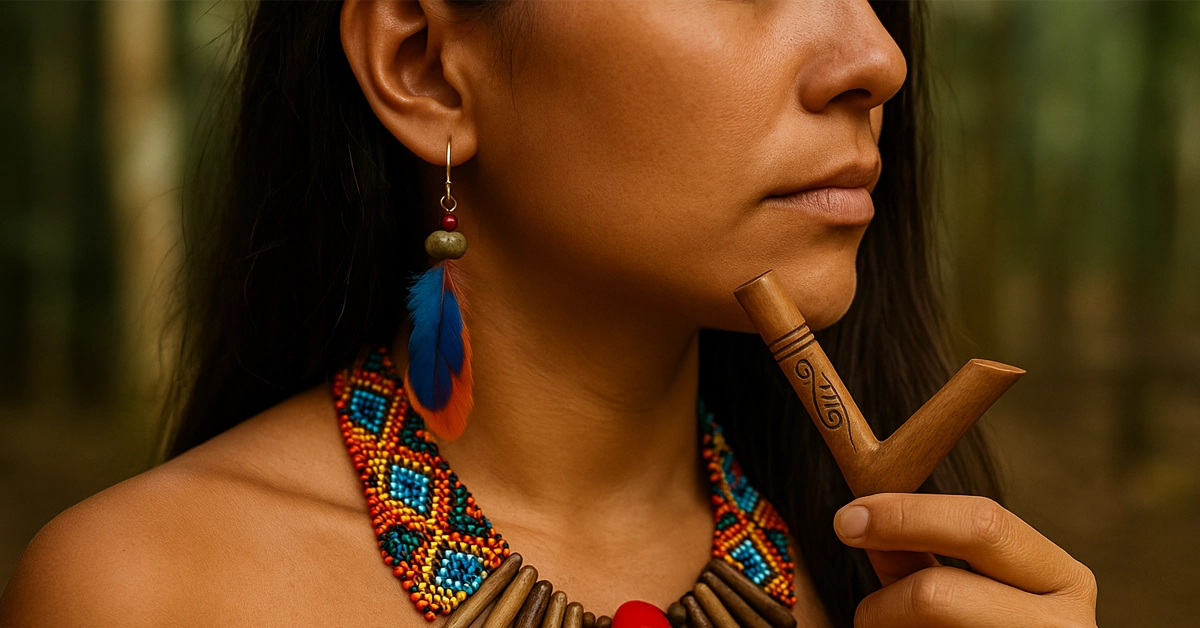
Perhaps one of the most iconic and personal sacred objects today is the kuripe, the self-applicator for rapéh (or hapeh) snuff. Shaped in a “V,” it represents a bridge between breath and earth, spirit and intention.
Kuripes are often made of bamboo, wood, bone, or metal. Many are adorned with carvings, beads, or paint. Some carry symbols like the sun, moon, snake, or jaguar. Others are simple and bare, holding silence like a prayer.
When someone uses a kuripe, they are not merely inhaling a substance. They are activating a ritual. The kuripe becomes a teacher, a mirror, and a guide. Its very form—one tube to the mouth, the other to the nostril—encourages presence, discipline, and surrender. As an amulet, it serves as both a protector and a threshold.
Feather Adornments: Wings of the Ancestors
In Amazonian traditions, feathers are considered one of the most powerful materials. They come from beings of the sky—creatures who move between earth and spirit. To wear feathers is to remember one’s own spiritual nature.
Feather earrings, headdresses, and fans are more than ornamental. Each feather has a meaning, each bird a message. The harpy eagle represents power and vision. The macaw offers joy and vibrant communication. The owl, silence and wisdom in the dark.
Feathers are often arranged in specific ceremonial shapes—radiant sunbursts, protective circles, or spiral flows. They are used in healings to “sweep” dense energies away or placed on altars as offerings to the elements. In this way, feathers become living prayers in motion.
Beaded Necklaces: Sacred Geometry and the Power of Color
Beadwork among Indigenous groups—especially the Wixarika (Huichol), Shipibo, and Yawanawá—is a sacred art. Every pattern is a map, every color a vibration.
These beaded necklaces and bracelets are woven with deep intention. The patterns often represent visionary realms, geometric portals, sacred animals, or ancestral teachings. Blue might invoke water and dreams. Red may represent the vitality of fire. Yellow channels sunlight and spiritual clarity.
When worn, these items are not just expressions of culture—they are embodiments of protection, healing, and remembrance. They tune the energetic field of the wearer and resonate with the spirits being honored.
Many tribes believe that creating beadwork is a spiritual practice in itself. The process is meditative and often done in prayer. The final object holds not just the materials, but the very breath and vibration of the maker.
Seeds, Stones, and Bones: Memory of the Forest
The forest offers more than plants—it offers talismans. Certain seeds like jarina (vegetable ivory), huayruro, or mucuna are known for their protective qualities. These seeds are gathered and strung together into bracelets, anklets, or necklaces that are worn in ceremony and daily life.
Huayruro, with its striking red and black coloration, is believed to ward off negative energy. Jarina, polished like bone, brings strength and grounding. Stones are also used, especially quartz, amethyst, and serpentine, often believed to amplify spiritual awareness.
Even bones and teeth—especially of animals like jaguar, puma, or monkey—are worn with reverence. They do not symbolize dominance but communion. To wear the tooth of a jaguar is to carry its spirit, not its conquest.
These elements of the forest—seeds, stones, and bones—are not lifeless. They are considered elders in their own right. They hold memory, presence, and ancestral resonance.
The Making of a Sacred Object
To be truly protective, a sacred object must be born from sacred process.
Among many Indigenous groups, objects used for spiritual purposes are not made casually. The process involves:
- Permission: Seeking guidance from the spirits or ancestors before collecting materials.
- Prayer: Infusing each step with intention and songs.
- Ceremony: Sometimes, the objects are made during specific moon cycles or after dietas with master plants.
For example, a kuripe carved during a dieta with tobacco will carry a different energy than one made industrially. A necklace beaded by an elder after a vision will hold the frequency of that vision.
These practices ensure that the object is not just “charged” but inhabited—imbued with spirit and aligned purpose.
Wearing the Medicine: The Role of the User
Just as the object has a role, so does the wearer.
To wear a sacred object is to enter into relationship. It is not a passive accessory but an active ally. One must listen, respect, and sometimes even “feed” the object with prayer, smoke, or song.
Some traditions teach that objects can absorb heavy energies, and must be cleansed—by bathing in the river, placing under moonlight, or fanning with sacred smoke. Others suggest rotating objects or letting them rest between uses, like any living helper.
What matters is the consciousness behind the act. The amulet is not magic on its own—it is a co-creator in the ceremony of presence.
The Rise of Sacred Fashion: A Caution and a Celebration
As Indigenous fashion and sacred tools become popular worldwide, there’s both excitement and concern.
On one hand, people around the globe are reconnecting with ancestral ways through symbols, patterns, and rituals. This can bring awareness, solidarity, and reverence.
On the other, there is risk of cultural appropriation—of using sacred symbols without understanding their origin or meaning. To wear a kuripe made by an Indigenous artisan is an act of support. But to copy one in plastic for mass consumption without honoring its roots may desecrate its power.
At Queen of the Forest, we believe in transparency, fair trade, and respect. Every object is sourced in partnership with the communities that birth them. Behind each item is a story, a family, and a lineage of knowledge. When you wear these items, you carry more than style—you carry spirit.
Everyday Rituals with Sacred Objects
You don’t have to be in a full ceremony to benefit from the presence of a sacred object. Here are ways people integrate them into everyday life:
- Morning Rituals: Wearing a specific necklace or applying rapéh with a kuripe before starting the day.
- Prayer Spaces: Keeping feathers, beads, and stones on an altar or near your meditation space.
- Protection on the Move: Carrying a seed bracelet or stone in your pocket when traveling or in dense environments.
- Dream Work: Sleeping near certain amulets to deepen connection with spiritual guidance.
These small practices root us. They remind us that the sacred is not reserved for temples or forests—it can be woven into the rhythms of daily life.
The Living Medicine in Objects
Amulets of the forest are not relics of the past—they are voices of the living Earth. In their feathers and beads, stones and bones, they carry the memory of ceremony, the breath of the ancestors, and the prayers of those who made them.
To wear them is to walk with guardians.
To make them is to weave intention into form.
To honor them is to remember that everything—absolutely everything—can be sacred when approached with reverence.
And perhaps this is the real protection: not a shield that keeps the world out, but a presence that keeps the spirit in alignment with the deeper song of life.
[ux_products]
Continue exploring
All stories
The medicines of the forest