

Feathers and Plumes: The Spiritual Code of Sacred Birds
The Symbolism of Feathers in Ceremonial Headdresses, Rituals, and Indigenous Wisdom
More Than Ornament
Across Indigenous cultures around the world, feathers are not mere decoration. They are sacred tools, spiritual codes, and cosmic signatures. They are worn not to impress, but to express alignment with spiritual realms and the natural forces of the Earth. A feather in a headdress, on a ceremonial garment, or in a ritual altar is not just beautiful—it is meaningful.
From the Amazon rainforest to the North American plains, from Andes mountaintops to the jungles of Africa, feathers have served as bridges between humans and the bird nations. They carry messages, prayers, and medicine.
This article explores the deep spiritual symbolism of feathers, their roles in Indigenous ritual and identity, the meaning of colors and shapes, and how they connect us to the winged ones—our airborne ancestors and allies.
The Feather as a Messenger
In many Indigenous cosmovisions, birds are seen as spirit messengers. Because they soar above the Earth and touch the sky, birds inhabit both the earthly and celestial realms. Their feathers, therefore, become instruments of communication between these worlds.
When a feather falls to the ground, it is often seen as:
- A message from Spirit
- A confirmation from an ancestor
- A sign of guidance or protection
- A blessing from the natural world
Shamans and elders interpret feathers based not only on the bird species but also the context—where it was found, its orientation, its condition. A pristine feather in your path is a sign to pay attention. A worn or broken one may symbolize the closing of a cycle.
The Role of Feathers in Ceremonial Attire
1. Headdresses (Cocars)
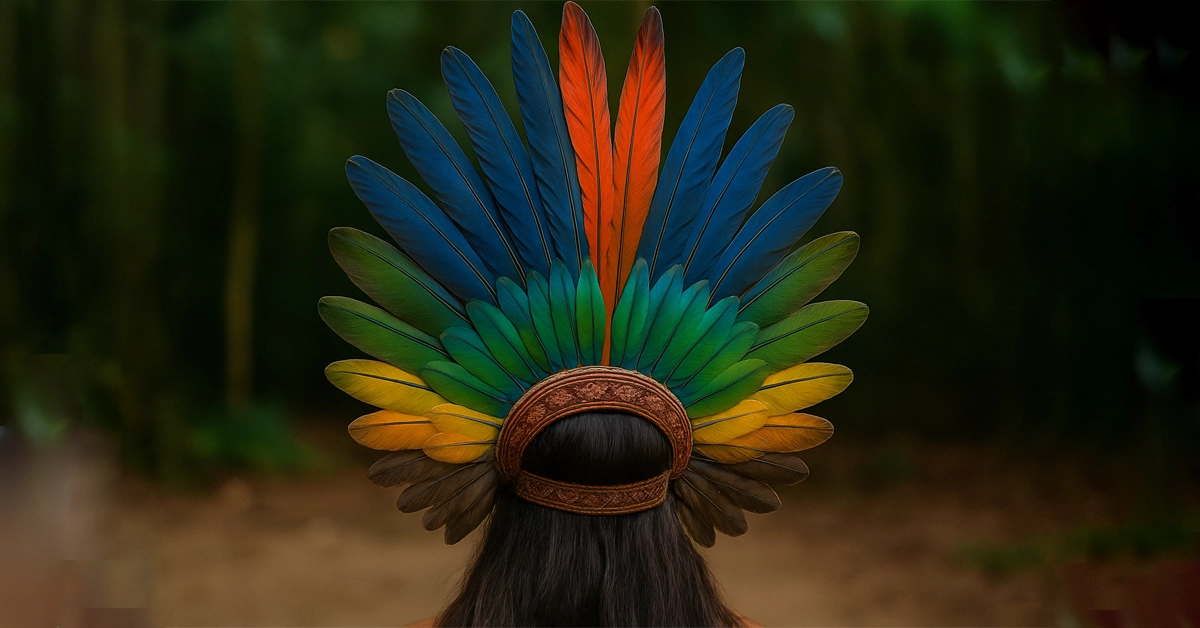
Among Indigenous peoples of the Amazon, like the Huni Kuin, Yawanawa, and Kayapo, elaborate cocars made from macaw, parrot, and hawk feathers represent spiritual status, connection to animal spirits, and alignment with the sacred.
Each feather is placed intentionally:
- At the crown for divine connection
- At the sides for balance and perception
- In a circular pattern for the cycles of life and nature
In the North American traditions, war bonnets or eagle feather headdresses were earned—not claimed—through acts of spiritual merit, bravery, or leadership.
“A single eagle feather is worth more than gold in our way,” says a Lakota elder. “Because it carries the prayer of the eagle and the permission of the sky.”
2. Feathered Capes and Tunics
In the Andes and parts of Central America, tunics and capes made with feather mosaics were used in sacred dances and initiation rites. The movement of feathers with the body mirrored the flight of spirit, allowing the wearer to become one with the bird.
Colors were not just chosen for aesthetics—they carried specific meanings (more on that below).
️ 3. Ritual Fans and Smudging Tools
Feathers are also used in ritual fans, where they help cleanse the energy field, direct smoke in smudging ceremonies, and move stagnant energy.
Hawk feathers for clarity, turkey feathers for grounding, owl feathers for vision—each species is selected according to the spirit of the ceremony.
Colors of Feathers and Their Meanings
Each feather carries the energy of color, shape, and species, creating a nuanced spiritual language. Here are common colors and their symbolic resonance across traditions:
| Color | Spiritual Meaning |
| White | Purity, spirit, peace, divine connection |
| Black | Protection, mystery, ancestral presence |
| Red | Life force, courage, vitality, earth energy |
| Yellow | Illumination, mental clarity, sun energy |
| Blue | Communication, healing, sky energy |
| Green | Heart opening, harmony with nature |
| Brown | Stability, grounding, connection to land |
| Rainbow/Multicolor | Unity of forces, shamanic power, divine balance |
In the Amazon, red and blue macaw feathers symbolize the balance of fire and water, masculine and feminine, action and intuition.
Sacred Birds and Their Symbolism
Each bird species has its own spiritual role. Here are a few powerful messengers across Indigenous traditions:
Eagle
- Represents vision, strength, divine authority
- Associated with the sky realm, creator energy, and solar wisdom
- Feathers used only with permission, often after significant rites
️ Dove
- Bringer of peace, compassion, and gentle presence
- Its feather symbolizes surrender and spiritual softness
Owl
- Messenger of the night, dreams, the unseen
- Feathers often used in rituals of inner vision or shadow work
Hummingbird
- Symbol of joy, vitality, and resilience
- Feathers carry the vibration of the heart and the sweetness of life
Macaw and Parrot (Amazon)
- Represent color, sound, language, and tribal memory
- Often appear in visions or sacred dreams as carriers of ancestral songs
Feathers as Spiritual Technology
To Indigenous shamans, feathers are not symbolic—they are tools of spiritual technology. They function like antennas or wands, moving energy, channeling frequencies, and connecting to other realms.
Some uses include:
- Blowing prayers or smoke over someone using a feather
- Brushing a body to remove energetic blockages
- Holding feathers in both hands to align the hemispheres of the brain
- Using feathers to mark space in ritual circles
The movement of a feather in a ceremony mimics wind—an invisible force that carries spirit. And like wind, it purifies, activates, and awakens.
The Ethics of Feather Use
In modern spirituality, it’s important to approach feathers with reverence and responsibility. Many birds, including eagles and macaws, are endangered. Feathers should never be taken from live birds or bought from unethical sources.
In Indigenous cultures, feathers are:
- Gifted, not bought
- Earned through ceremony or vision
- Gathered only after they naturally fall
If you feel called to work with feathers, ask permission—from the bird spirit, from the Earth, and from your own heart. Never use sacred symbols as fashion or aesthetics only.
When a Feather Finds You
Sometimes, feathers come into your life in unexpected moments:
- You’re walking through a forest, and a bright feather lies in your path
- You’re meditating and feel the image of a winged bird appear
- You receive a feather from a friend or healer in a time of change
These are not coincidences. In many traditions, it means Spirit is speaking—offering you guidance, reassurance, or an invitation.
Sit with the feather. Listen. Let it show you what it came to say.
Feathers in Dreams and Visions
Feathers often appear in:
- Shamanic journeys
- Ayahuasca or rapéh ceremonies
- Dreams where birds fly around or drop feathers from above
These symbols may signify:
- Receiving a blessing or initiation
- A message from your spirit guides
- A need to reconnect with your truth or voice
Many people describe visions of feathered beings or ancestral shamans dressed in plumes, offering healing and ancient knowledge.
How to Honor a Feather Spiritually
If you are gifted or find a feather, treat it like a sacred being. Some ways to honor it:
- Place it on your altar with intention
- Clean it with smoke (sage, palo santo, or mapacho)
- Speak to it—feathers are believed to hold memory and respond to words
- Use it in your meditations or rituals
- Return it to the Earth when the time feels right
Feathers are not possessions—they are temporary companions on your path of awakening.
Flight, Spirit, and the Soul
Feathers remind us that we are not bound to the ground. They carry the code of flight, of perspective, of soul over matter. They remind us that the body is temporary, but the spirit soars.
When we wear or hold feathers with reverence, we are not imitating birds—we are aligning with spirit, with the wind, with the unseen dimensions of existence.
So next time you see a feather, pause. Don’t just look—feel. Ask:
- What is this feather trying to tell me?
- What part of me is ready to rise, to see, to heal?
The answer, like the feather, may land softly—yet carry the weight of a thousand wings.
Continue exploring
All stories
The medicines of the forest