The Dew of the Forest: Plants That Are Born from Silence

Nocturnal Blooming, Shamanic Visions, and the Sacred Timing of Nature
In the Hour When the Forest Breathes
There is a sacred silence that settles upon the forest in the hours before dawn—a stillness so complete, it feels like the Earth is listening. In these early hours, when human activity sleeps and only the subtle songs of insects and the distant calls of owls remain, something miraculous happens: plants awaken.
Not all growth is loud. Not all beauty reveals itself under the sun. Some plants are born from silence, from darkness, from the kiss of night dew. These are the mystic botanicals, the hidden ones, the plants that bloom in secret and speak the language of stillness.
This article dives into the spiritual and ecological mystery of nocturnal and dawn-blooming plants, their connection to ancestral wisdom, and how shamanic traditions see these plants as guardians of silence and portals to deeper consciousness.
The Sacred Rhythm of Night
Modern life often praises the sun—daylight, speed, productivity. But nature does not move in straight lines. She breathes in cycles. And night is not absence, but preparation. Darkness is not void, but womb.
In the forest, the night brings:
- Cooling of the air
- Settling of dust and disturbance
- Return of moisture to the leaves
- Activation of nocturnal pollinators (moths, bats, beetles)
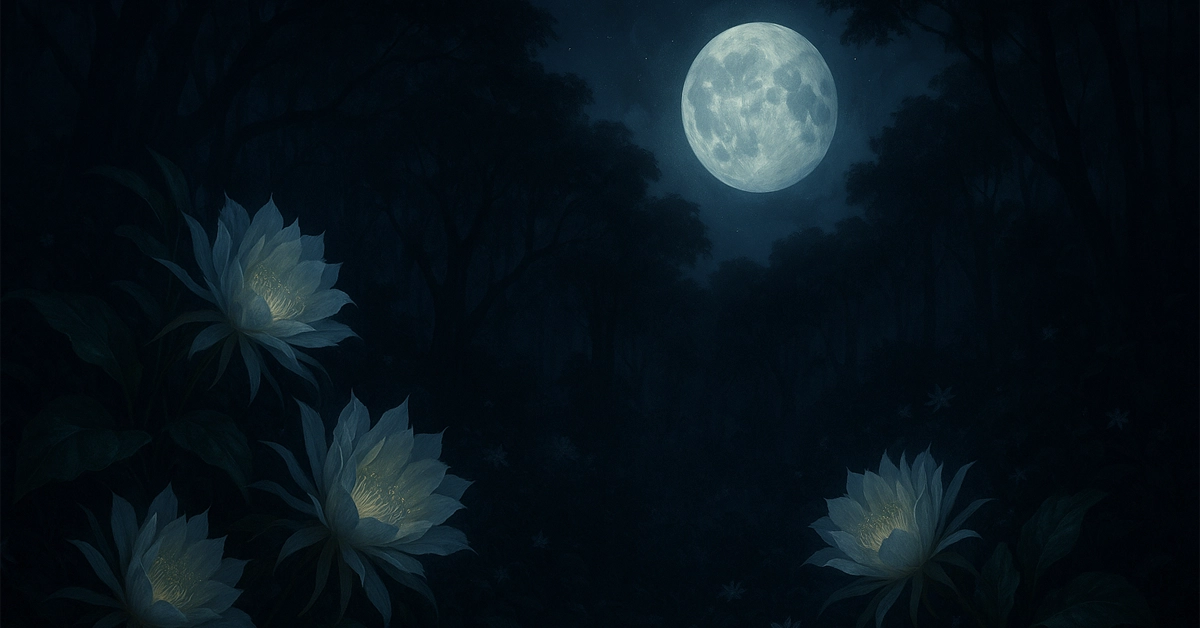
- Opening of flowers that bloom only in the moonlight
These conditions are not random—they are perfect conditions for subtle birth.
Plants That Bloom at Night or Dawn
Here are a few remarkable examples of plants that reveal themselves when the world is most quiet:
1. Night-Blooming Jasmine (Cestrum nocturnum)
- Blooms only after sunset
- Emits a fragrance that deepens through the night
- Used in certain Amazonian traditions to calm the nervous system and invite dream clarity
Spiritual meaning: inner awakening, fragrance of truth, unseen gifts
2. Moonflower (Ipomoea alba)
- Large white blooms that open at dusk and close by sunrise
- Associated with the moon and feminine energy
- Sometimes planted near ceremonial altars as symbols of ephemeral beauty
Spiritual meaning: transience, sacred femininity, messages from the moon
3. Queen of the Night Cactus (Selenicereus grandiflorus)
- Blooms only once a year, at night
- The bloom lasts only a few hours
- Associated with rare spiritual insight and timing
Spiritual meaning: once-in-a-lifetime revelations, purity, the now moment
4. Brugmansia (Sacred Tree Datura)
- Opens its trumpet-shaped flowers in the evening
- Highly psychoactive; used with extreme caution in traditional rituals
- Thought to open vision between worlds
Spiritual meaning: shadow navigation, inner journey, mystery initiation
5. Rare Amazonian Ferns and Mosses
- These do not bloom, but unfurl and absorb dew in early morning silence
- Some are used as part of forest camouflage by hunters and shamans
- Their slow and silent growth reflects the energy of patience and protection
The Dew: A Symbol of Grace and Subtle Blessing
In many Indigenous cultures, dew is sacred. It is not rain, not storm, but a gentle and mystical condensation that appears without force. It teaches that not all blessings come through effort. Some arrive simply by being present.
Dew symbolizes:
- Divine subtlety: the small shifts that change everything
- Silent nourishment: the forest drinks in silence
- Sacred timing: dew does not fall—it emerges at the right moment
In some forest prayers, shamans refer to dew as the “breath of the Earth” or “the tears of the dawn.” It is used to anoint tools, cleanse the eyes, or bless ceremonial spaces before sunrise rituals.
Shamanic Visions and the Hour Before Light
In the shamanic worldview, the time just before dawn—often between 3 a.m. and 5 a.m.—is considered the most potent for spiritual work.
This is the hour when:
- Spirit animals are most active
- The veil between worlds is thin
- Plants whisper messages to those who know how to listen
- The body is most responsive to sacred plant medicines like rapéh and sananga
Those who have participated in ayahuasca or forest ceremonies often describe profound visions occurring just before the sun rises—when the forest is humming with invisible song.
This moment is called in some traditions “a hora da verdade”—the hour of truth.
Why Do These Plants Choose the Night?
Nature is a master of design. Night-blooming plants often develop in ecosystems where:
- Day heat would damage fragile blossoms
- Nocturnal pollinators (like bats and moths) are more effective
- Competition for attention is lower
- Spiritual messages are meant to be discovered, not broadcasted
In the spiritual realm, night bloomers are plants of inner work, hidden truths, and quiet power.
They do not shout—they whisper.
They do not dazzle—they invite.
Human Lessons from Nocturnal Plants
What can we, fast-moving and light-seeking beings, learn from these silent companions?
1. Trust in the Unseen
Not all growth is visible. Sometimes your deepest healing happens in darkness, in silence, away from the public eye.
2. Honor Your Timing
Just like a moonflower that only opens at dusk, you are not meant to bloom 24/7. There is a sacred moment for your unfolding.
3. Listen More, Speak Less
The wisdom of the night is felt, not explained. These plants remind us to cultivate inner stillness to receive guidance.
4. Let Dew Be Enough
Not all nourishment comes in abundance. Sometimes, a single drop of spiritual dew is enough to awaken a forest within you.
Nocturnal Rituals Inspired by the Forest
If you wish to connect to this energy, consider the following simple rituals:
✨ Dew Gathering Prayer
At dawn, walk barefoot into the grass or forest. Place your hands on a leaf covered in dew. Close your eyes. Say:
“Thank you, Earth, for the gifts that come in silence.
Thank you, Plant Spirits, for the lessons that bloom unseen.”
Then gently anoint your third eye or heart with dew.
Moon Bloom Meditation
Under moonlight, sit near plants that open at night. Breathe slowly. Imagine your heart as a flower, blooming with each inhale, softening with each exhale.
Ask: “What is growing in me that I cannot yet see?”
Forest Stillness Ceremony
Rise before sunrise. Without speaking, light a candle. Sit with your plant medicines (rapéh, sananga, or just tea). Inhale their silence. Let the first rays of the sun awaken your next step.
The Silence That Teaches
In a world addicted to noise and speed, the dew of the forest teaches us to slow down. To sit. To feel. To be.
The plants that bloom at night, those that whisper to the soul at dawn, are not lesser—they are older, wiser, deeper. They carry the codes of a time when all things were in harmony. When humans listened. When the Earth spoke in fragrance and the wind carried prayers.
May we learn once again to walk at the rhythm of dew, to bloom not only in the spotlight but in the shadow. To trust that even in silence, the sacred is growing.
Continue exploring
All stories
The medicines of the forest