The Forest Remembers

The Forest Remembers: The Powerful Truth About Nature’s Memory
The forest remembers in ways that are not always visible, but deeply felt.
Every movement, every sound, every cycle leaves a trace. The forest is not a passive environment — it is a living system where everything interacts, responds, and evolves.
What appears silent is often full of memory.
The forest remembers not through words, but through patterns, relationships, and continuous presence.
What Does It Mean That the Forest Remembers?
The idea that the forest remembers reflects the understanding that nature holds continuity.
Plants grow from soil enriched by previous life. Water cycles carry elements across ecosystems. Animals adapt to patterns shaped over generations.
This continuity creates what can be understood as memory.
Memory in Natural Systems
Nature operates through cycles.
These cycles are not random — they are structured and responsive.
Because of this, the concept that the forest remembers aligns with how ecosystems function.
Each cycle builds upon what came before.
Scientific perspectives on ecosystems show how interconnected systems evolve over time (source: Ecosystem).
The Forest as a Living Network
The forest is not a collection of isolated elements.
It is a network.
Trees, plants, soil, and organisms interact constantly.
This network allows the forest to adapt and respond.
This is one way to understand how the forest remembers.
Patterns and Continuity
Patterns repeat in nature.
Seasons change, cycles return, and processes continue.
These patterns create continuity.
Continuity is a form of memory.
The idea that the forest remembers reflects this ongoing repetition.
The Human Perception of Nature’s Memory
Humans often interpret memory as something internal and individual.
However, in nature, memory can be seen as distributed.
It exists across systems, interactions, and time.
This broader view helps explain why the forest remembers feels intuitive.
Awareness Through Observation
To understand the forest, observation is essential.
When attention slows down, patterns become visible.
Changes in growth, sound, and movement reveal structure.
This is where the idea that the forest remembers becomes experiential.
Connection with Forest Traditions
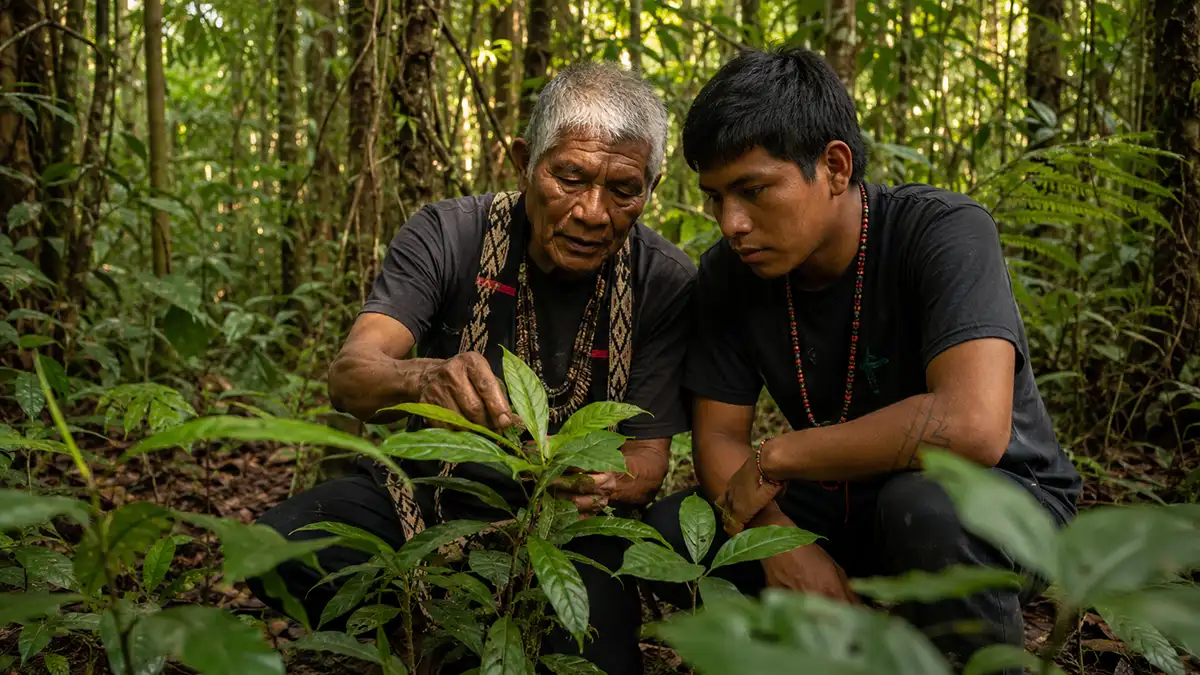
Many traditions describe the forest as alive and aware.
This perspective aligns with the idea of continuity and connection.
For those exploring deeper awareness, our Rapéh Guide offers insights into traditional approaches to presence.
You can also explore rapéh benefits to understand grounding practices.
Experience the Living Forest
The forest continues whether we observe it or not.
It holds cycles, patterns, and relationships that sustain life.
For adult practitioners exploring deeper awareness, Queen of the Forest offers sacred tools including our rapéh collection and handcrafted kuripe applicators.
These tools should always be approached with respect and awareness.
Memory Beyond Words
The forest remembers through cycles, patterns, and interaction.
It does not store memory in a single place.
It expresses it through continuity.
And through that continuity, life persists.
What does it mean that the forest remembers?
It means that ecosystems carry continuity through cycles, patterns, and interactions.
Does nature have memory?
Nature shows forms of memory through repeated processes and adaptation.
Why do forests feel alive?
Because they are dynamic systems where everything interacts and responds.
How can I understand the forest better?
By observing patterns, slowing down, and paying attention to natural processes.
Continue exploring
All stories
The medicines of the forest