The Animals That Reforest: Silent Guardians of the Amazon
Beneath Paws and Wings: The Miracle of Regeneration
While great machines leave trails of devastation, silently, other beings work in the opposite direction. They wear no badges, appear in no headlines, and receive no international funding. Yet their role is vital. In the Amazon rainforest, the true agents of reforestation walk on paws, fly on wings, and tread lightly with claws. They are the animals—seed dispersers, invisible gardeners, guardians of regeneration.
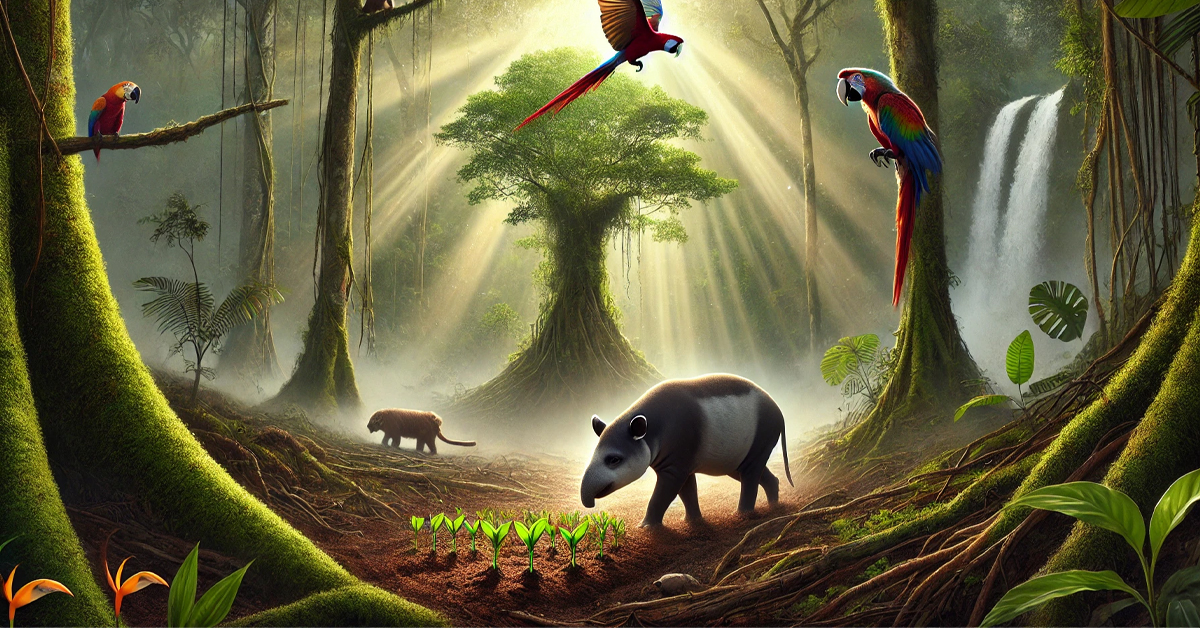
Every step of a tapir, every flight of a macaw, every leap of a monkey carries a promise of the future. In their wanderings, they eat fruits, spit seeds, defecate fertility. And wherever they go, something is born. The forest is rebuilt through the bodies of these creatures. There is no reforestation more ancient or effective than this: animal-driven regeneration.
The Dance of the Dispersers: Who Are They?
In the Amazon, thousands of animal species act as seed dispersers. They feed on fruits and carry the seeds far from the parent plant, allowing new trees to grow in different, often degraded, areas.
1. The Tapir (Tapirus terrestris)
Known as the “gardener of the forest,” the tapir is one of the largest seed dispersers in the biome. It travels long distances and, with its efficient digestive system, releases intact seeds in its droppings. Its silent work creates corridors of natural reforestation.
2. Macaws and Parrots
These colorful birds not only enchant with their songs and feathers, but they also spread life. As they feed on fruits in the canopy, they drop pieces and seeds during flight, ensuring that fruit trees sprout far from their original locations.
3. Monkeys
Capuchins, howlers, uakaris, and many other Amazonian primates play an essential role in the forest’s regeneration. Their habit of carrying fruits along trails and dropping remnants along the way turns every branch into a potential cradle for new trees.
4. Fruit-Eating Bats
Though nocturnal and often overlooked, bats are powerful nighttime planters. Their droppings, rich in seeds, fall in hard-to-reach places—caves, crevices, and clearings—contributing to diversity and regeneration in less accessible areas.
5. Rodents and Ants
Agoutis bury seeds as food reserves, often forgetting where they hid them. In doing so, they inadvertently plant trees. Ants carry seeds to their nests, aiding in dispersal and germination.
Seeds in the Womb of the Forest
The seeds dispersed by animals carry more than the potential for life. They carry genetic memory, resilience, adaptation. When they fall upon the soil, they find a sacred field—the fertile womb of the Earth. The forest receives, shelters, transforms.
This natural cycle of feeding, dispersal, and regeneration is one of the most efficient forms of reforestation on the planet. It requires no machines or genetic engineering. It is an ancient dance between fauna and flora—a pact of love between species.
Animals as Protectors of the Future
In a fast-paced world that destroys in hours what took centuries to grow, the work of animals is a reminder that nature has its own ways of healing. They carry no ecological slogans, but move with coherence. They hold no campaigns, yet act with wisdom.
Protecting the animals of the forest is protecting the natural regenerators of the ecosystem. Without them, even human-led reforestation is limited, as many Amazonian trees rely exclusively on animal dispersal to reproduce.
The End of the Cycle and a New Beginning: When Humans Learn from Animals
Perhaps the greatest lesson lies here: while we search for technologies to save the forest, the forest teaches us—through its animals—how it saves itself: with time, silence, movement, and collaboration.
By imitating nature’s rhythms, we can design smarter reforestation efforts, integrating fruit-bearing species, ecological corridors, and enabling the return of dispersing animals. It’s a joint effort: where there is wildlife, the forest is reborn.
Queen of the Forest: Allies of Living Regeneration
At Queen of the Forest, we understand that protecting the forest is not only about planting trees, but respecting the cycles the forest has created itself. We honor the animals who, without seeking applause, weave life with every step.
Every forest medicine that reaches you carries this knowledge. The tree that offered the tobacco may have been seeded by a monkey. The root of the Ayahuasca may have sprouted from a gift left by a tapir. Behind every leaf, there is a story of cooperation.
By valuing the wisdom of the forest and consuming mindfully, you become part of this sacred web of regeneration. Not just as an observer, but as an ally.
The Heartbeat of the Forest Echoes in Feet, Paws, and Wings
The Amazon pulses with the footsteps of its inhabitants. With every flight of a macaw, every dive of a tapir in an igarapé, seeds are scattered, futures are planted. The forest does not surrender. It reinvents itself—and its architects wear feathers, claws, and fur.
May we see with new eyes. May we protect with greater love. And may we learn from the animals that the healing of the Earth begins with small gestures, repeated with constancy, guided by the wisdom of those who have always known how to live in balance.
Continue exploring
All stories
The medicines of the forest