Lines of the Plants, Lines of the Hands: The Forest’s Palmistry
The Silent Geometry of Life
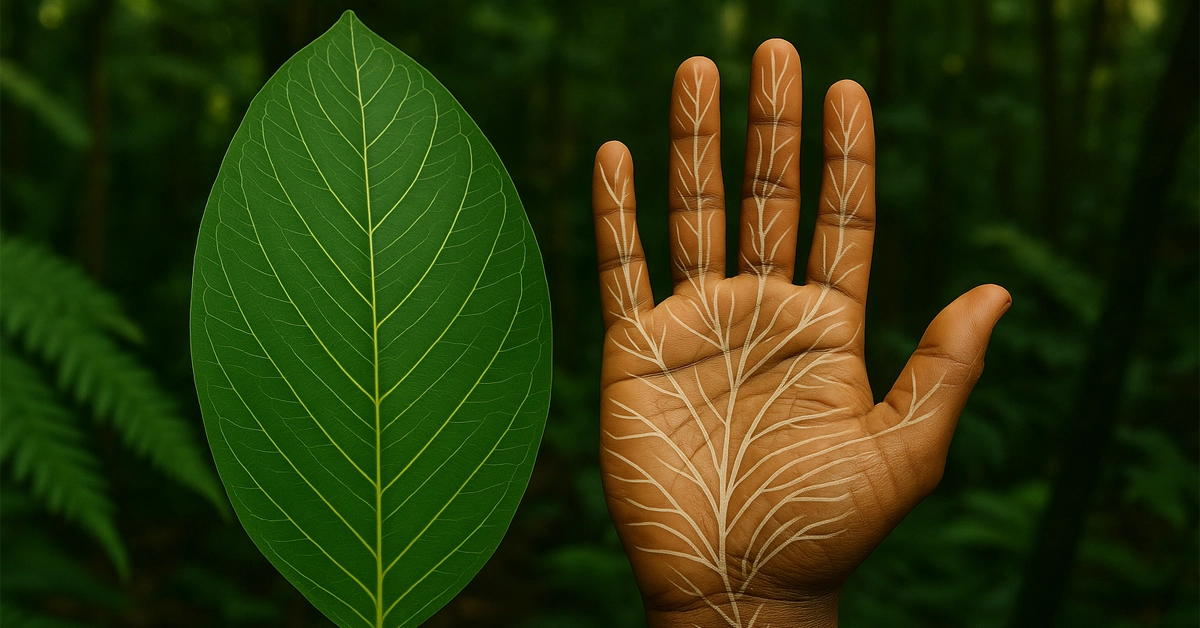
Every leaf, every stem, every hand carries a map. The veins of a plant spread outward like rivers across a land, while the lines of a human palm trace the mysteries of destiny. At first glance, these patterns may seem unrelated, but for Indigenous peoples and spiritual seekers, they are threads of the same fabric — signs of the unity between human beings and the forest.
To compare the lines of plants with the lines of hands is to enter a language older than words. It is to realize that nature writes in symbols, and that we ourselves are written in the same alphabet.
The Veins of Leaves: The Forest’s Handwriting
The Architecture of Flow
In plants, veins serve as pathways of life. They carry water, minerals, and sunlight-transformed sugars to every cell, sustaining growth and vitality. Yet beyond biology, these lines are sacred geometry, maps of balance and circulation that mirror the invisible flows of energy in all living beings.
Patterns of Connection
Some leaves display parallel lines, like infinite paths running side by side. Others branch like rivers, forming networks that echo the veins of the human body. In their silence, plants reveal what Indigenous peoples have always known: the forest is alive with signs.
The Palm of Humanity: A Map of Destiny
Ancient Palmistry
Across cultures, the lines of the hand have been read as signs of destiny. The life line, heart line, and head line are seen as pathways of vitality, emotion, and thought. Just as a leaf reveals the health of a tree, a hand reveals the journey of a soul.
Indigenous Perspectives
Among some Amazonian peoples, hands are painted during ceremonies with designs that resemble leaves, roots, and rivers. These markings remind the wearer that human life is inseparable from nature. The hand is not only a tool of survival but also a mirror of the cosmos.
Parallels Between Plants and Hands
Flow of Life
The veins of a plant and the lines of a hand both carry life. In one, sap flows; in the other, blood and energy. Both are channels of vitality, fragile yet resilient, shaping the story of survival.
Growth and Memory
Just as the lines of a hand deepen with time and experience, the veins of a plant reveal its growth, its resilience to storms, and the memory of its seasons. Both are records of the past and prophecies of the future.
Diversity of Patterns
No two leaves are identical, and no two hands bear the same lines. Each carries a unique design, a personal map of existence. Yet together, they speak of a universal pattern — individuality woven into unity.
Indigenous Symbolism of Lines
The Forest as Hand
Many Indigenous myths describe the forest as a great being whose veins are rivers and whose leaves are fingers of light. To walk in the forest is to walk across the hand of the Earth.
Ritual Body Paintings
Body paintings often replicate the lines of plants, symbolizing protection and connection. To wear these patterns is to invite the forest into one’s own being, to align human energy with the flow of natural life.
The Hand as Root
In prayer or ceremony, open hands are lifted to the sky or pressed to the earth. They are seen as roots extending from the human body, channels that connect us to cosmic and terrestrial energies.
Myths and Stories of Connection
The Palm Leaf Story
Some tribes tell of a time when humans and plants shared the same body. The Creator separated them, giving one the gift of movement and the other the gift of rootedness. To ensure they never forgot their kinship, He marked both with lines — on the leaves of plants and the palms of hands.
The Hand of the River
Another story speaks of a great spirit who placed his hand upon the earth, leaving behind rivers and streams as his fingerprints. Plants grew along these lines, and when humans were created, their palms bore the same pattern, so they would remember their origin.
Spiritual Teachings of the Lines
Interconnectedness
The resemblance between plants and hands is not coincidence but teaching. It reminds us that we are branches of the same tree, veins of the same heart. The forest does not stand outside of us — it flows within us.
Reading the Signs
To read the lines of a hand is to glimpse the destiny of a person; to read the lines of a plant is to understand the health of the forest. Both practices are forms of listening — listening to what life has inscribed silently across time.
Healing and Balance
In Indigenous healing, plants are often applied to the hands — rubbed as ointments, painted as dyes, or held as instruments in prayer. This meeting of leaf and palm is a ritual of alignment, restoring harmony between human and nature.
The Modern Relevance of Ancient Patterns
Science and Symbolism
Modern science studies the fractal geometry of plants and the unique whorls of fingerprints, finding universal mathematical principles. Spiritual traditions have long known what science now confirms: life is written in repeating patterns.
A Call to Belonging
In a time when humanity often feels disconnected from nature, the comparison between plants and hands calls us home. Every time we hold a leaf, we are holding a mirror of ourselves. Every time we open our hand, we open a map of the forest.
The Living Script of Creation
The lines of the plants and the lines of the hands are not random marks. They are sacred scripts, written by the same author — the Earth itself. They remind us that human destiny is inseparable from the forest, that our lives are inscribed in the same flowing patterns.
To study them is to remember. To honor them is to heal.
And to place a leaf upon one’s palm is to see the truth revealed: we are not apart from nature — we are its continuation, its reflection, its voice made flesh.
Continue exploring
All stories
The medicines of the forest