7 Secrets of Forest Communication: The Invisible Language Explained
Forest Communication: The Invisible Language of the Forest
Forest communication is something many people feel before they can fully explain it. The moment you enter a living forest, something changes. The air feels charged, the silence feels full, and the entire environment seems to carry a presence that is subtle, intelligent, and deeply aware. Even before the mind can name it, the body often senses that the forest is not empty. It is alive with relationship, rhythm, and exchange.
For those who have spent time in old forests, rainforests, or wild places, this feeling is familiar. There is often a sense that the forest is speaking in a language beyond words. It speaks through movement, stillness, scent, vibration, moisture, birdsong, and unseen patterns of connection between plants, animals, fungi, wind, and water. This is part of what makes forest communication such a fascinating and powerful idea.
To explore the invisible language of the forest is to open ourselves to a more sensitive way of perceiving life. It asks us to slow down, to pay attention, and to remember that intelligence in nature does not always announce itself through human forms of expression. Sometimes it arrives through silence, presence, and an atmosphere that can only be felt when we become quiet enough to listen.
What Is Forest Communication?
Forest communication refers to the countless ways the forest exchanges information, energy, and signals through living systems. On one level, this includes biological communication: trees releasing chemical signals, roots interacting underground, fungi forming networks, animals responding to subtle environmental changes, and entire ecosystems adjusting through complex feedback loops.
On another level, forest communication can also be experienced symbolically, emotionally, and spiritually. Many people feel that the forest communicates not only through science, but through intuition. A place may feel welcoming, tense, ancient, wise, grieving, or deeply still. These perceptions may not always be measurable in conventional terms, yet they are real to human experience.
The idea of forest communication brings together both dimensions: the visible and the invisible, the ecological and the intuitive. It invites us to understand the forest not as a mute backdrop, but as a living field of intelligence.
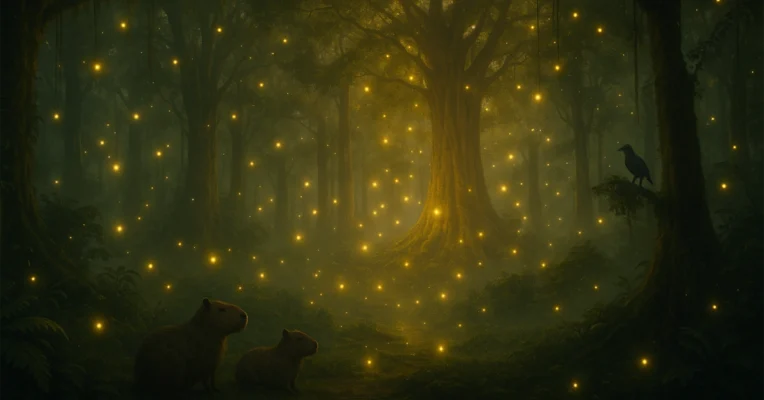
How the Forest Communicates Without Words
Human beings often assume that language must involve spoken words, but the forest shows us another possibility. Communication can happen through scent, vibration, timing, electrical activity, moisture exchange, sound patterns, visual cues, and relational behavior between species. In the forest, communication is not linear. It is woven, layered, and continuous.
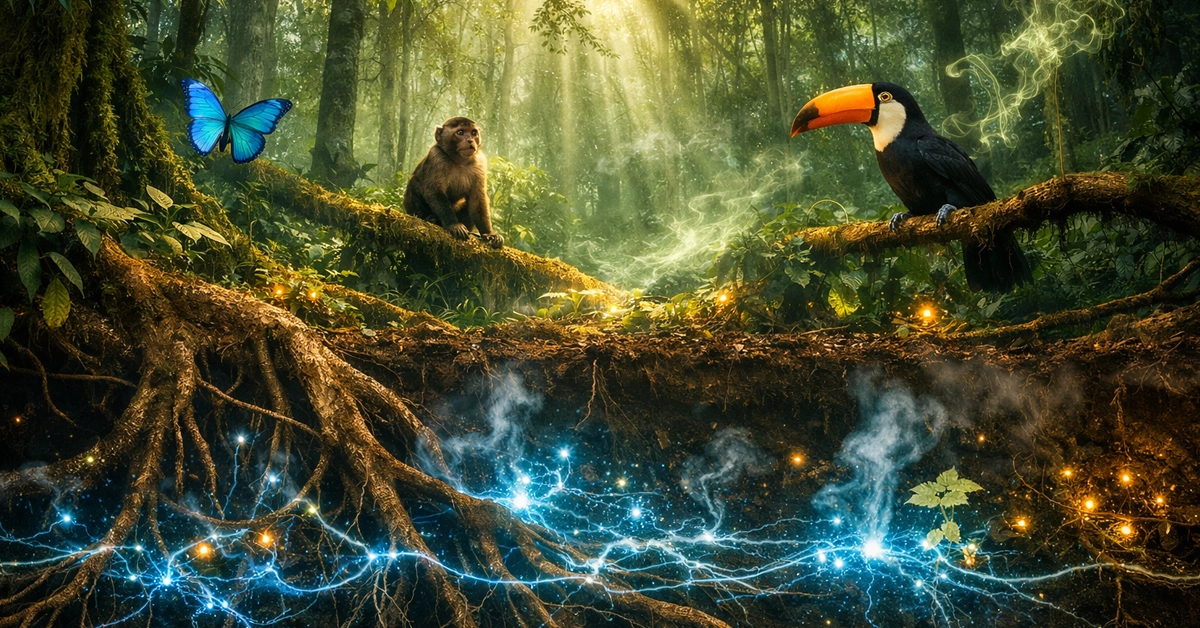
Trees may send distress signals through airborne chemicals when threatened. Mycorrhizal fungal networks connect root systems beneath the soil, allowing forms of exchange that challenge older ideas of plant isolation. Birds respond to movement and alarm one another. Insects shift their behavior according to subtle changes in temperature, light, and chemical presence. Water itself carries messages through flow, erosion, and seasonal rhythm.
Seen in this way, forest communication is not mystical fantasy. It is a profound reality of life expressing itself through relationships that are often too subtle or too complex for hurried perception.
The Invisible Language of Nature
The invisible language of nature includes everything that is sensed but not easily translated into ordinary speech. A forest can feel welcoming one day and heavy the next. A trail may seem ordinary at first, then suddenly luminous when attention deepens. There are moments when the whole atmosphere seems to shift, and although nothing dramatic has happened outwardly, inwardly something has clearly changed.
This is where many people begin to sense that the forest communicates on more than one level. Nature may speak through mood, energetic resonance, synchronicity, and symbolic encounters. A falling leaf, a sudden silence in the birds, a breeze that arrives at the exact moment of inner clarity, an animal appearing during a turning point in life — these experiences have shaped human spiritual imagination for generations.
The invisible dimension of forest communication does not cancel the scientific one. Instead, it expands our understanding of how deeply life is interconnected and how much of communication may happen beyond the narrow band of what modern people typically notice.
Scientific Perspectives on Forest Communication
Modern ecological research has offered fascinating insights into how forests function as interconnected living systems. Scientists have studied plant signaling, root symbiosis, fungal communication networks, and the cooperative as well as competitive behaviors of trees and plants sharing an ecosystem. These discoveries have changed the way many people think about forests.
Plants are not passive decorations. Trees are not isolated columns of wood. Forests are dynamic systems with exchange, adaptation, responsiveness, and memory-like patterns that emerge over time. Chemical signaling, resource sharing, underground fungal associations, and highly responsive ecological relationships all suggest that the forest is far more communicative than it once seemed.
If you want to explore related perspectives on subtle ecology and living systems, you may also enjoy our article on The Forest as a Mirror.
Why You Feel Different in the Forest
Many people report feeling calmer, clearer, softer, or more inward when they enter a forest. Others feel awe, grief, alertness, or emotional release. These reactions are not accidental. The forest affects the nervous system through sound, air quality, sensory richness, shade patterns, negative ions, moisture, phytoncides, and the absence of urban overstimulation. But there may also be something more.
Part of forest communication may be the way the forest changes our own state of perception. In daily life, many people move too quickly to notice subtle forms of exchange. In the forest, that speed begins to dissolve. Attention widens. Listening deepens. The body becomes more receptive, and suddenly life seems more textured, more symbolic, and more alive.
This is one reason the forest has always been a place of retreat, prayer, ceremony, and insight. It does not merely surround us. It influences the way we perceive reality.
Signs of Forest Communication
Forest communication can be noticed in many ways. Sometimes it appears as a biological event: birds falling silent at once, trees releasing scent after rain, vines orienting toward light, insects responding to unseen changes. At other times, it appears through direct human experience: a sudden feeling of being watched, held, welcomed, or corrected by the atmosphere of a place.
Some people notice repeating symbols in the forest, such as certain animals appearing during emotional turning points or specific plants attracting attention during times of healing. Others describe moments when the forest seems to answer a question not with words, but with a shift in sensation, weather, sound, or inner certainty.
To notice forest communication, it helps to become less demanding of literal explanations and more respectful of subtle forms of perception. Not everything meaningful arrives in language. Much of life speaks through pattern, tone, and timing.
Forest Communication and Indigenous Wisdom
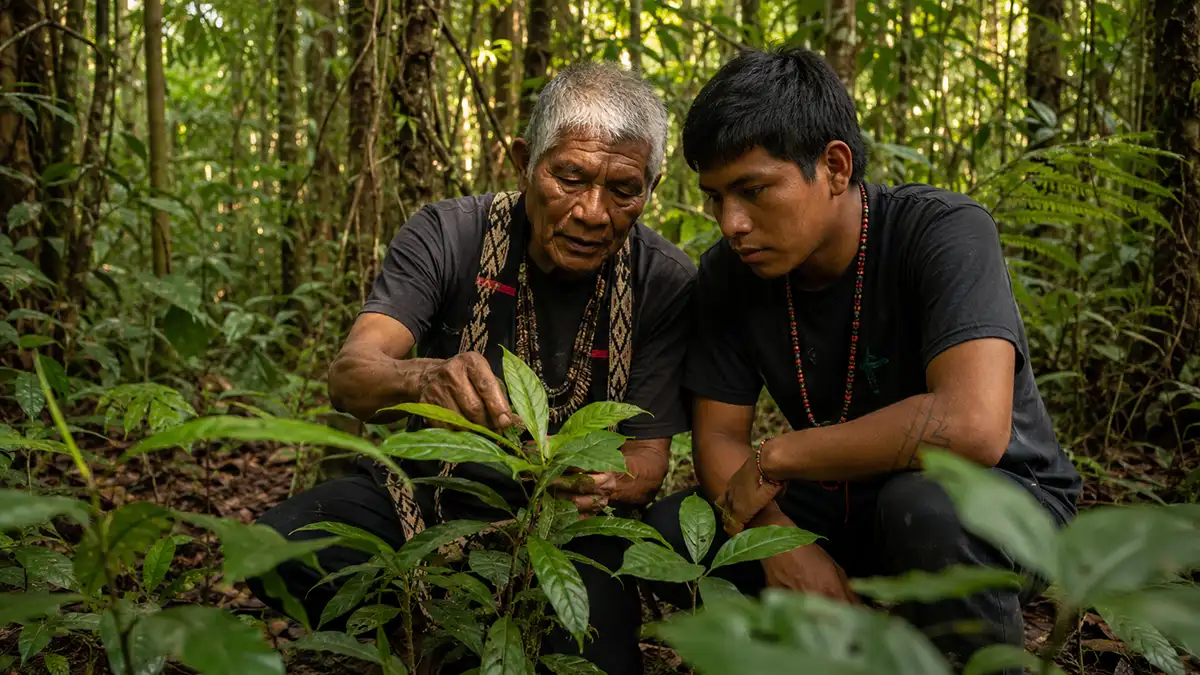
For many indigenous peoples, the idea that the forest is alive and communicative is not new at all. It is part of an ancient way of understanding reality. In many traditions, the forest is not treated as an object or resource first, but as a community of beings, presences, and intelligences that deserve reverence and reciprocity.
This perspective helps restore balance to modern thinking. It reminds us that the world is not made only of things, but of relationships. Plants, animals, waters, winds, and territories all participate in a living order that human beings are part of, not above. Forest communication, in this sense, is not just a theory. It is a way of living with greater humility.
Anyone approaching this topic should do so with respect. Indigenous knowledge is not merely poetic decoration for modern spirituality. It is living knowledge carried by real peoples and traditions whose relationship with the forest has been shaped over countless generations.
The Spiritual Dimension of Forest Communication
Beyond ecology, many people experience forest communication as something spiritual. This does not necessarily mean dramatic visions or supernatural events. Often it is quieter than that. It may arrive as a feeling of being seen, a sudden inner stillness, a release of old emotional weight, or the sense that the forest holds an intelligence that is compassionate, ancient, and vast.
In spiritual life, communication often deepens when words become insufficient. The forest can become a teacher precisely because it speaks through presence rather than argument. It invites surrender, attention, and direct experience. In that silence, many people begin to hear parts of themselves more clearly as well.
This is also why nature and sacred medicine traditions are often linked in the imagination of seekers. The forest is not simply scenery around spiritual work. It is part of the field in which awakening, remembering, and purification may unfold.
If you feel drawn to this broader relationship with nature, you may also want to explore our Rapéh Guide and our collection of sacred rapéh inspired by ancestral forest traditions.
How to Listen to the Forest More Deeply
Listening to the forest begins with slowness. It is difficult to perceive subtle communication while rushing, talking constantly, or trying to force a spiritual experience. The forest tends to reveal itself more clearly when approached with patience, humility, and presence.
One way to deepen your relationship is to sit quietly in one place for an extended period. Let the environment settle around you. Notice the layers of sound, shifts in wind, movements in the canopy, patterns of insect life, moisture in the air, and changes in your own breathing. Often, what first appears silent slowly becomes full of expression.
Journaling after time in nature can also help. Write down what you felt, noticed, or encountered. Over time, patterns may emerge. This makes forest communication more visible not because the forest changes, but because your awareness becomes more refined.
Why Forest Communication Matters Today
In a world shaped by speed, distraction, and extraction, the idea of forest communication carries profound importance. It challenges the modern habit of treating nature as mute matter. It calls us back into relationship, reminding us that the Earth is not only biologically alive, but relationally alive.
This shift matters spiritually, emotionally, and ethically. When people begin to sense the forest as intelligent and communicative, exploitation becomes harder to justify. Reverence grows. Protection becomes personal. Ecological care is no longer just a political duty or scientific recommendation — it becomes a response to relationship.
The more deeply we understand forest communication, the more difficult it becomes to see the destruction of forests as a distant issue. The loss is not only environmental. It is also a loss of language, mystery, medicine, and ways of knowing that humanity urgently needs.
Conclusion
Forest communication reveals a truth that many people have felt intuitively for a long time: the forest is not silent. It speaks through roots and fungi, through scent and moisture, through birds and shadows, through atmosphere and living presence. It communicates ecologically, symbolically, and spiritually, often all at once.
To listen to the invisible language of the forest is to become more human, not less. It is to remember that intelligence exists beyond our own thoughts and that relationship is the true fabric of life. The forest does not need to speak in words to be understood. It asks only that we become quiet enough to hear what has always been there.
And perhaps that is the deeper invitation of all: not only to study the forest, but to re-enter conversation with the living world.
FAQ About Forest Communication
What is forest communication?
Forest communication refers to the many ways the forest exchanges signals, information, and energy through plants, fungi, animals, atmosphere, and subtle ecological relationships.
Can trees communicate with each other?
Yes. Trees can communicate through chemical signaling, root interactions, and symbiotic fungal networks that connect living systems underground.
Why do I feel different in the forest?
Many people feel different in the forest because natural environments affect the nervous system, deepen attention, and reconnect us with slower and more relational rhythms of life.
Is forest communication scientific or spiritual?
It can be understood in both ways. Science explores the biological systems of communication in forests, while spiritual experience explores the intuitive and symbolic dimensions of how the forest is perceived.
How can I learn to listen to the forest?
You can learn to listen to the forest by slowing down, sitting in silence, observing carefully, journaling your experiences, and spending more intentional time in natural environments.
Related Reading
If this subject resonates with you, you may also enjoy reading The Forest as a Mirror, reflecting on Animal Spirit Meaning, and exploring our Rapéh Guide for a deeper relationship with ancestral forest wisdom.
For a broader scientific overview, you can also read this introduction to plant communication.
Continue exploring
All stories
The medicines of the forest