Some of the most important workers in a Brazilian forest are easy to overlook. They move quietly between flowers, fit inside spaces much smaller than familiar honeybees and maintain complex colonies within the landscape.
These are Brazil’s native stingless bees.
The story of stingless bees in Brazil is about far more than honey. It connects pollination, biodiversity, Indigenous knowledge, cultural continuity and the relationships humans choose to maintain with species small enough to disappear without many people noticing.
In August 2026, international attention turned toward one of these relationships through the story of Guarani knowledge holder Marcio Karai in the Jaraguá Indigenous Territory near São Paulo.
Karai cares for numerous native stingless-bee species, including mirim and jataí bees. He learned this knowledge from his father and grandfather and sees protecting the bees as connected with his community and future generations.
His story points toward a larger truth:
Sometimes conservation begins with learning to notice what the modern world has learned to walk past.
What Are Stingless Bees?
Stingless bees are a diverse group of social bees found primarily in tropical and subtropical environments. They belong to the tribe Meliponini.
Despite their common name, “stingless” does not necessarily mean complete absence of a stinger. Their stingers are reduced and generally cannot be used defensively in the way familiar honeybees use theirs.
Different species may defend colonies through behaviors including:
- Biting;
- Swarming around intruders;
- Using sticky plant resins;
- Guarding narrow nest entrances.
“Stingless bee” is therefore not one species.
It describes an extraordinarily diverse group of native pollinators.
Brazil Is a Global Center of Stingless-Bee Diversity
Brazil contains hundreds of native stingless-bee species distributed among different ecosystems.
Recent references commonly identify roughly 250–300 described species, although exact totals may change as taxonomy and scientific knowledge develop.
This diversity reflects differences among Brazilian biomes, climates, flowers and nesting environments.
Why Pollinators Matter
Flowers are reproductive structures.
For many plants, pollen must move between flowers before fruits and seeds can develop.
Bees are among the animals that perform this work.
As bees visit flowers for nectar, pollen and other resources, pollen can attach to their bodies and move between blossoms.
The result can eventually become a seed, a fruit and another generation of plants.
One Bee Can Connect an Entire Food Web
A pollinated flower becomes fruit.
An animal eats that fruit.
Seeds move.
Fallen organic matter feeds insects and microorganisms.
Nutrients return to soil.
Another plant grows.
A bee is only one participant, but pollination connects many ecological relationships.
What Is Meliponiculture?
The management of native stingless bees is known as meliponiculture.
It differs from conventional Brazilian apiculture, which usually involves the introduced honeybee Apis mellifera.
Meliponiculture may involve:
- Conservation;
- Pollination;
- Education;
- Traditional knowledge;
- Research;
- Honey and wax production;
- Community livelihoods.
Reducing meliponiculture to honey production misses much of its ecological significance.
Indigenous Peoples Knew These Bees Long Before Modern Beekeeping
Long before European-style apiculture arrived in Brazil, Indigenous peoples maintained relationships with native bees.
Knowledge could include:
- Nest locations;
- Bee behavior;
- Forest plants;
- Honey;
- Wax;
- Seasonal patterns;
- Names and classifications;
- Cultural relationships.
These traditions differ among peoples.
There is no single universal Indigenous bee tradition in Brazil.
A Contemporary Guarani Story From Jaraguá
In August 2026, Reuters documented the work of Guarani knowledge holder Marcio Karai in the Jaraguá Indigenous Territory near São Paulo.
Karai cares for 13 varieties of native stingless bees, including mirim and jataí.
His story illustrates that Indigenous ecological knowledge is not simply historical.
It is contemporary knowledge being practiced today.
Knowledge Passed From Father to Son
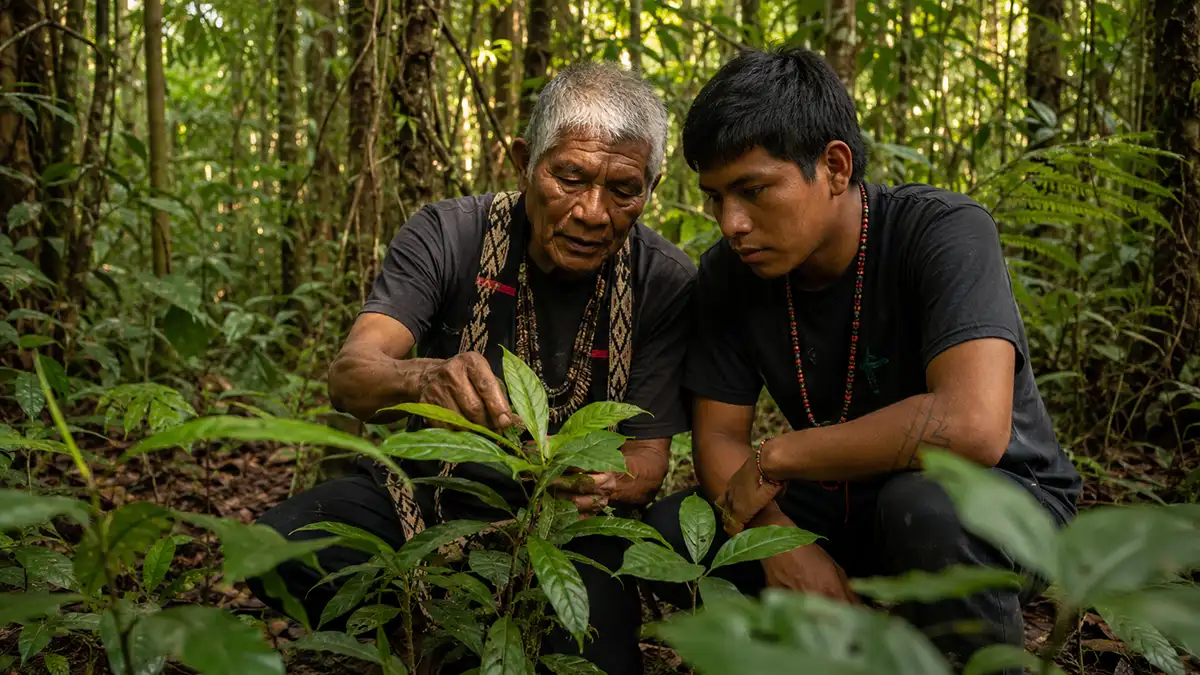
Karai described learning bee care from his father and grandfather.
This demonstrates how ecological knowledge can move through relationships.
Someone identifies a bee.
Someone observes a colony.
Someone remembers which flowers appear during a season.
Someone teaches again.
Living knowledge depends on continued practice.
The Challenge of the Next Generation
Knowledge transmission requires time, territory, cultural pride and economic possibility.
Young people should not have to choose between maintaining cultural knowledge and having economic security.
Conservation becomes stronger when traditional knowledge can remain both meaningful and viable.
The Jataí Bee: Small and Remarkably Resilient
Jataí is one of Brazil’s best-known native stingless bees and is commonly identified scientifically as Tetragonisca angustula.
It is a small social bee found across wide areas of Latin America.
Its modest size can hide its ecological importance.
In Karai’s personal interpretation, reported by Reuters, jataí also carries symbolism connected with Guarani resistance.
That interpretation should be understood within its specific cultural context rather than generalized to all Indigenous peoples.
Mirim: A Name Shared by More Than One Small Bee
The name mirim appears in common names for several small stingless bees.
Common names carry valuable local knowledge but do not always correspond to one scientific species.
Scientific identification becomes important when precision is needed for research, conservation or sourcing.
Honey Is Only Part of the Story
Stingless-bee honey can have distinctive flavors, aromas and textures.
But focusing only on honey can distort the ecological relationship.
Before asking how much a colony can produce, we can ask:
What allows this colony to thrive?
The answer leads toward flowers, habitat, water, climate and responsible management.
Wax Can Carry Cultural Meaning Too
In the Guarani community documented by Reuters, stingless-bee wax participates in ceremonial practices.
This illustrates how one natural material can carry biological, practical and cultural meanings simultaneously.
Meaning depends upon relationship.
Bees Connect Plants and Culture
Stingless bees interact with plants.
People interact with bees.
Plants feed ecosystems and communities.
Bee products may enter cultural traditions.
One small pollinator can therefore exist at the intersection of ecology, food, culture, territory and knowledge.
This is biocultural diversity.
What Threatens Brazil’s Stingless Bees?
Habitat Loss
Removing native vegetation reduces flowers and nesting opportunities.
Habitat Fragmentation
Isolated habitat fragments may contain fewer continuous resources.
Pesticides
Certain pesticide exposures can affect insect survival, behavior and colony health.
Climate Change
Changes in temperature and rainfall can alter flowering seasons and suitable habitat.
Urban Expansion
Urban development can eliminate native vegetation and nesting sites.
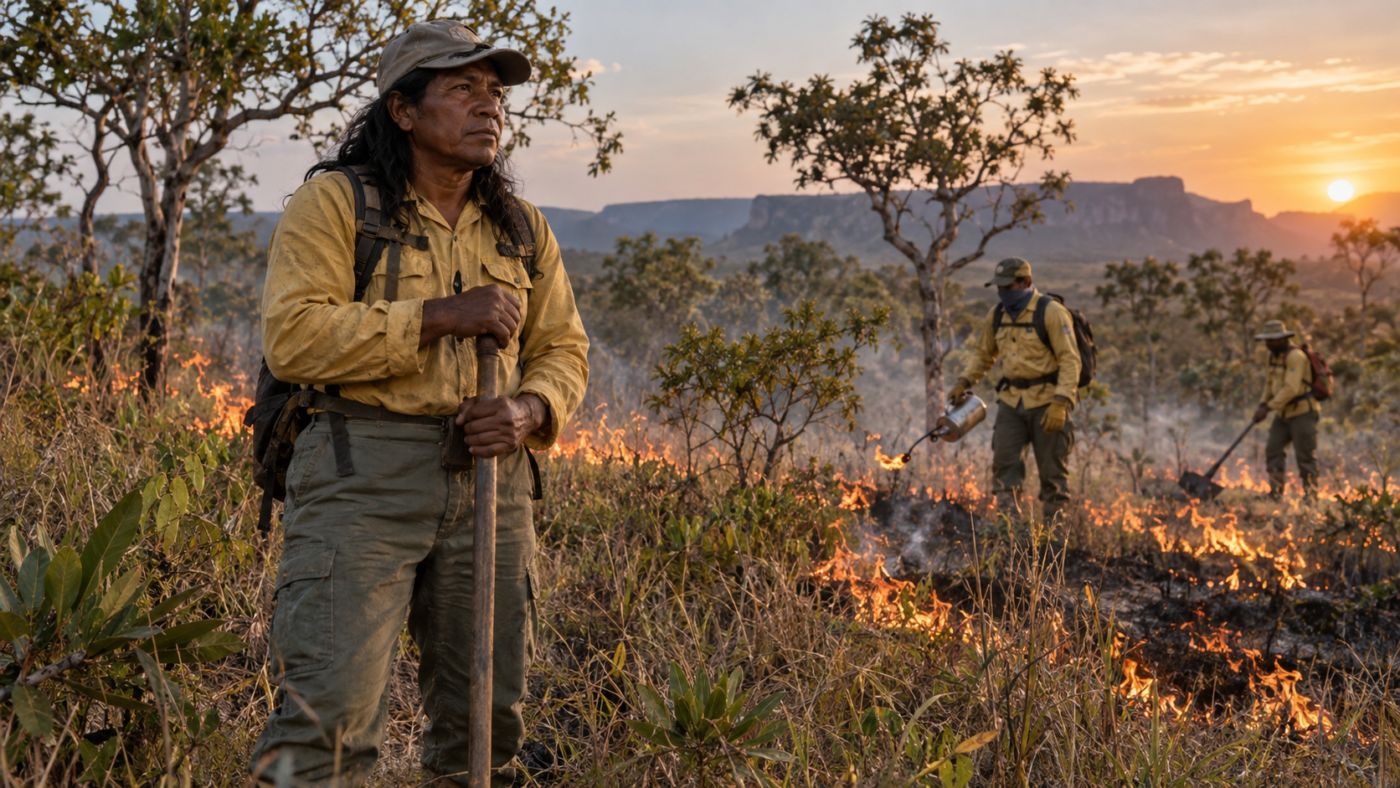
Fire
Fire can rapidly remove flowers, colonies and nesting habitat from local landscapes.
A Bee Needs More Than a Hive
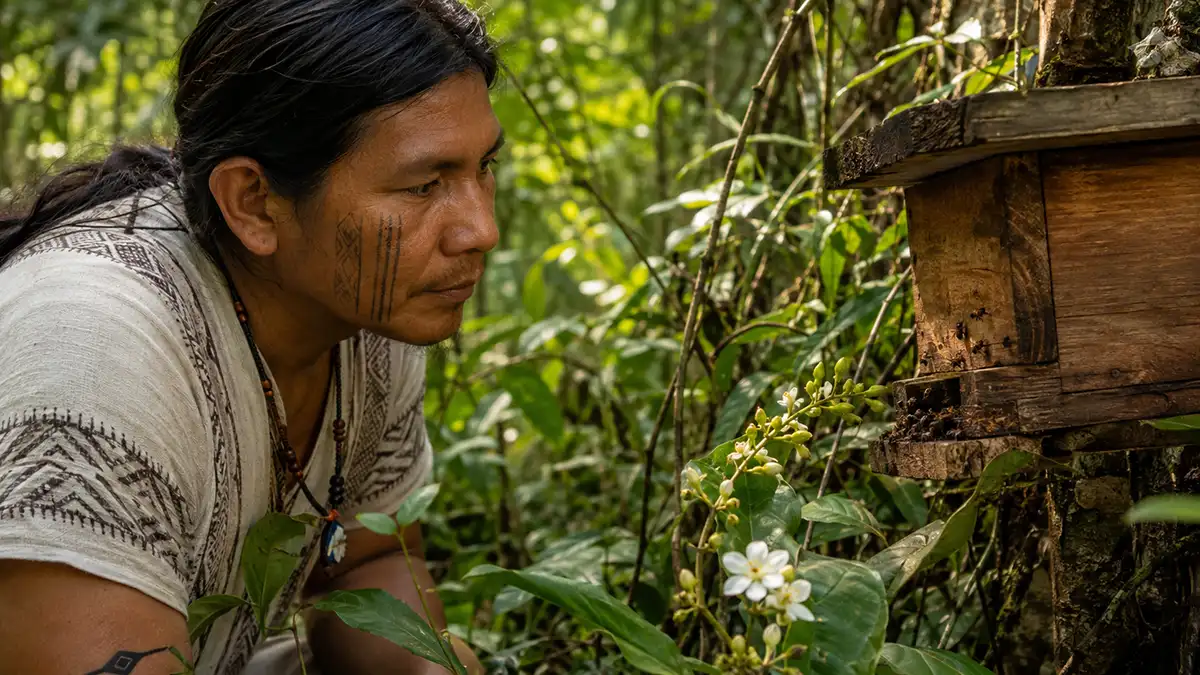
Bee boxes can support responsible management programs, but a box alone cannot preserve a species.
A colony also needs:
- Diverse flowers;
- Vegetation;
- Water;
- Suitable habitat;
- Safe environmental conditions;
- Seasonal continuity of floral resources.
Protecting bees means protecting the world around the hive.
Native Plants and Native Bees Evolved in Relationship
Plants differ in shape, flowering period, scent and floral resources.
Bees differ in size, behavior, flight range and methods of collecting resources.
Together they form complex pollination networks.
Biodiversity creates resilience within these networks.
Why Imported Honeybees Are Not a Replacement for Native Bees
Apis mellifera is an important agricultural and honey-producing bee.
But one successful species cannot replace the ecological diversity represented by hundreds of native bee species.
Different pollinators interact with different flowers in different ways.
Protecting pollination means protecting diversity.
Bees Can Reveal Changes in the Forest
Long-term observers may notice changes in bee abundance, flowering seasons, plant availability or colony behavior.
These observations can help identify environmental change.
Science can measure patterns while local and Indigenous knowledge can help reveal where and how to look.
Indigenous Knowledge and Science Can Work Together
Scientific research can investigate:
- Genetics;
- Pesticide exposure;
- Pollination networks;
- Climate effects;
- Population trends.
Traditional ecological knowledge can contribute:
- Long-term local observation;
- Species recognition;
- Seasonal relationships;
- Habitat history;
- Cultural meanings.
These systems can enter dialogue without pretending to be identical.
Indigenous People Should Be Researchers, Not Just Sources
Indigenous knowledge holders can participate as researchers, authors, ecological monitors, data owners and conservation decision-makers.
The people who know the bees may understand questions outsiders have not yet learned to ask.
Conservation Can Support Cultural Continuity
Community-led stingless-bee projects can potentially strengthen:
- Ecological education;
- Language;
- Knowledge transmission;
- Native-plant restoration;
- Youth participation;
- Cultural traditions.
The strongest programs begin with community priorities.
Why Forest Restoration Needs Pollinators
Planting trees is only one part of restoring a forest.
Forests must reproduce.
Flowers need visitors.
Fruits and seeds need to develop.
Ecological relationships must return.
Pollinators are part of this regenerative process.
Small Species Can Carry Enormous Ecological Importance
Conservation campaigns often focus on large charismatic animals.
Yet ecosystems also depend on bees, fungi, soil organisms, insects and microorganisms.
The health of the forest depends on relationships operating at every scale.
What Meliponiculture Can Teach Us About Conservation
Caring for native bees encourages people to notice flowers, seasonality, weather, trees and habitat.
The bee becomes a teacher because caring for it requires understanding the ecosystem around it.
The Danger of Turning Traditional Knowledge Into a Trend
As stingless-bee products attract greater commercial attention, Indigenous knowledge can become marketing language.
Responsible communication should ask:
- Which people?
- Which species?
- Which territory?
- What does the community actually teach?
- Was permission given?
- Does the community benefit?
Indigenous Knowledge Is Not a Marketing Ingredient
Indigenous identity should not be attached to products simply to increase perceived authenticity.
When community names or stories are used, the relationships behind them should be transparent and respectful.
What Can Readers Do to Help Native Bees?
- Support native vegetation;
- Avoid unnecessary pesticide use;
- Protect flowering plants;
- Support habitat restoration;
- Learn about local native bees;
- Support Indigenous-led conservation;
- Support responsible agriculture;
- Protect habitat diversity.
Protect habitat, and ecological relationships have a chance to survive.
What Businesses Can Learn From the Bees
A colony survives through relationships.
So does a forest-based supply chain.
Plants, producers, communities, ecosystems and customers all participate in the system.
Responsible sourcing begins by seeing that network rather than only the final product.
From Pollination to Reciprocity
Pollination is an ecological exchange.
Human relationships with forests can also move away from extraction and toward reciprocity.
Instead of asking only:
What can we take?
we can ask:
What relationship allows continued abundance?
The Forest Needs Its Small Guardians
Indigenous communities should not be expected to protect ecosystems for the rest of society without territorial rights, resources and economic opportunities.
Supporting Indigenous conservation means supporting people, community autonomy and territory—not simply romanticizing them as guardians.
The Future of Brazil’s Stingless Bees Is Also a Human Story
Native-bee conservation involves land use, agriculture, pesticides, climate, urban planning, Indigenous rights, education and economics.
It also involves whether future generations have opportunities to continue learning about these species.
Conservation depends upon continuity.
Conclusion: Stingless Bees of Brazil Connect Forests, Flowers and Generations
The story of stingless bees Brazil holds is much larger than the insects themselves.
A tiny jataí moving between flowers participates in plant reproduction.
A colony inside a forest becomes part of an ecological network.
Someone learning to recognize and care for that colony participates in another network:
- Knowledge;
- Family;
- Culture;
- Territory.
The contemporary Guarani story documented in 2026 reveals how these networks overlap.
Knowledge passes between generations while bees connect plants across landscapes.
True conservation must therefore keep relationships alive.
The bee.
The flower.
The forest.
The language.
The person who knows.
The young person learning.
Brazil’s stingless bees remind us that enormous ecological processes can depend on very small lives.
Sometimes protecting a forest begins by noticing a creature small enough to rest on the tip of a finger.
Frequently Asked Questions About Stingless Bees in Brazil
What are stingless bees?
Stingless bees are social bees belonging to the tribe Meliponini. Their stingers are reduced and generally cannot be used defensively like those of familiar honeybees.
How many stingless-bee species are there in Brazil?
Brazil is home to hundreds of native stingless-bee species. Recent references commonly identify roughly 250–300 described species, although exact totals can change with taxonomy and new scientific information.
What is meliponiculture?
Meliponiculture is the management and keeping of native stingless bees. It can support conservation, pollination, education, cultural practices and sustainable production.
Is meliponiculture the same as beekeeping?
Meliponiculture specifically centers on stingless bees. Conventional Brazilian apiculture generally refers to the keeping of Apis mellifera honeybees.
What is a jataí bee?
Jataí is the common name widely used for Tetragonisca angustula, a small native stingless bee found across parts of Latin America and commonly encountered in Brazil.
Why are stingless bees important to forests?
Stingless bees visit flowers and contribute to pollination. Pollination supports plant reproduction, fruits, seeds and wider ecological networks.
Did Indigenous peoples know stingless bees before European beekeeping reached Brazil?
Yes. Indigenous peoples had relationships with native stingless bees before European-style apiculture was introduced. Specific practices differ among peoples and should not be generalized.
Why are stingless bees threatened?
Threats can include habitat loss, fragmentation, pesticides, climate change, fire and changing availability of flowering plants and nesting sites. Vulnerability varies among species and regions.
Do stingless bees produce honey?
Yes. Many species store honey, although quantity and characteristics differ greatly. Honey is only one dimension of their ecological and cultural importance.
How can Indigenous knowledge help bee conservation?
Indigenous and local knowledge may contain long-term observations about species, seasons, habitat and ecological change. Conservation can benefit when knowledge holders participate as researchers, leaders and decision-makers.
Sources and Further Reading
- Reuters — In Brazil, Indigenous experts care for native, stingless bees, August 4, 2026.
- Brazilian technical literature on meliponiculture and native stingless bees.
- Brazilian agricultural and environmental institutions — resources concerning native bee diversity and meliponiculture.
Continue Exploring the Relationships That Keep the Forest Alive
Discover more stories about pollinators, Indigenous knowledge, Amazonian and Atlantic Forest biodiversity, medicinal plants and the relationships connecting cultural continuity with conservation.
At Queen of the Forest, we believe the smallest relationships can reveal some of the forest’s largest lessons.