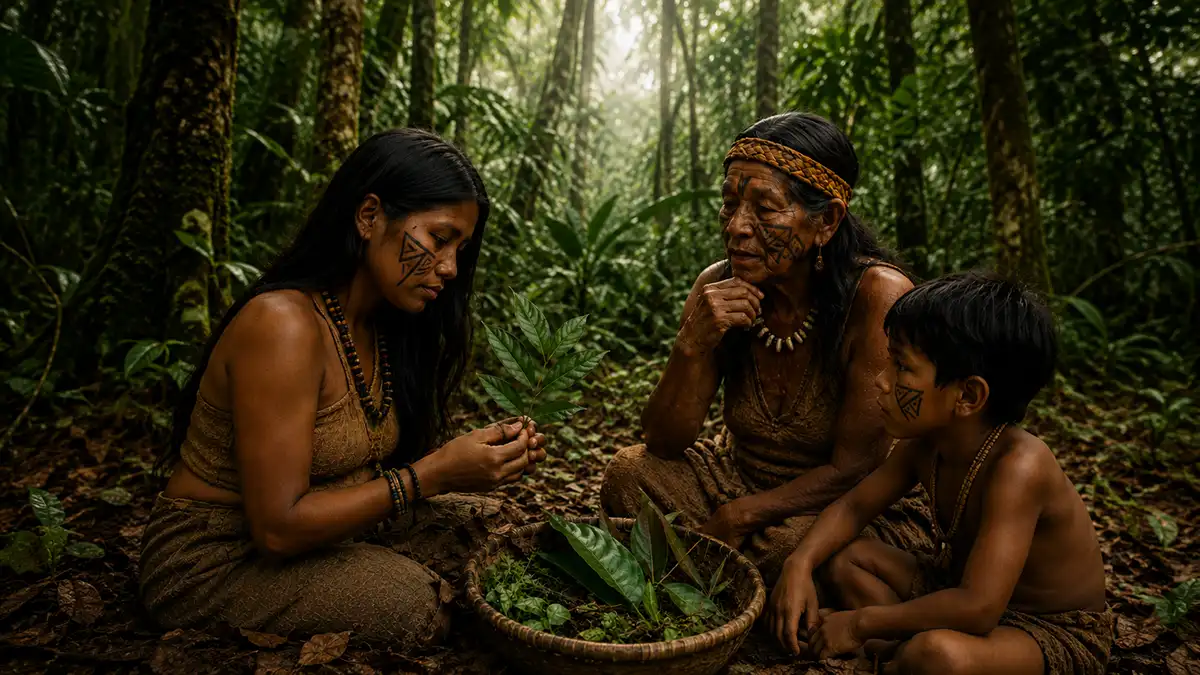
A forest has many ways of disappearing. Trees can be cut. Rivers can be polluted. Species can vanish from a territory. But a forest can also become quieter in another way: the words used to describe it can disappear.
Across Amazonia, Indigenous languages hold far more than names for trees, vines, fruits and medicinal plants. They carry generations of observations about where plants grow, when they flower, how they are recognized, what animals interact with them, which materials people use and what relationships communities maintain with particular species.
When a language becomes endangered, some of this knowledge can become endangered with it.
A major study published in Nature in July 2026 assembled tens of thousands of reports describing how Amazonian societies use native plants. Among 76,390 literature reports involving native Amazonian plant species, 57% were associated with 156 Indigenous languages.
More than half of those languages were classified as threatened in the principal linguistic dataset used by the researchers. The study estimated that if threatened Indigenous languages represented in its analysis disappeared, the documented network of Amazonian plant knowledge could shrink by approximately 26%.
That number is striking. But the deeper lesson is even more important.
A language is not simply a different set of words describing the same world. Sometimes language carries a different way of noticing the world.
A Plant Does Not Have Only One Name
Imagine two people standing beside the same tree.
One may know its scientific name. Another may know a commercial name. Someone else may recognize it primarily as useful timber.
An Indigenous specialist may know a name connected with habitat, season, animals, history, traditional use or another cultural relationship.
All are looking at the same organism.
But they are not necessarily seeing the same network of relationships.
This is why the loss of an Indigenous language cannot be understood simply as replacing one vocabulary with another.
Language can carry:
- Relationships between species;
- Habitat information;
- Seasonal observations;
- Harvesting knowledge;
- Traditional classifications;
- Stories and memory;
- Geographic knowledge;
- Food traditions;
- Plant-use knowledge;
- Relationships between people and territory.
Words can become containers for accumulated observation.
What Did the 2026 Nature Study Find?
The study The Forest of Knowledge Under Global Change examined Amazonian biodiversity, plant use, climate change and Indigenous-language vulnerability.
Researchers assembled a database containing 90,536 reports from 700 references and identified 5,796 native Amazonian plant species used by people.
The literature included information from 243 Indigenous cultures speaking 156 living languages.
Approximately 55% of those languages were classified as threatened using Ethnologue.
Among 76,390 reports concerning native Amazonian plants:
- 57% came from 156 Indigenous languages;
- More than half of those languages were threatened;
- Loss of threatened languages was projected to reduce the documented Amazonian knowledge network by approximately 26%.
The authors describe this estimate as conservative because other linguistic databases classify an even larger proportion of Amazonian Indigenous languages as threatened.
Language Is Part of the Amazon’s Biodiversity Story
Conservation normally measures biological diversity through species, habitats and ecosystems.
But Amazonia also contains extraordinary cultural and linguistic diversity.
A forest species may have different names and meanings among different peoples.
One community may know it primarily as food. Another may work with its fibers. Another may hold medicinal knowledge concerning it. Another may associate the same species with stories or ceremonial life.
This intersection between biological and cultural diversity is often called biocultural diversity.
Protecting one without the other can leave the conservation story incomplete.
Indigenous Languages Are Living Ecological Archives
An archive normally suggests books, documents or digital files.
But languages can also function as living ecological archives.
Knowledge may exist in:
- Plant names;
- Place names;
- Songs;
- Stories;
- Conversations;
- Classification systems;
- Oral histories;
- Daily work;
- Intergenerational teaching.
A traditional place name, for example, may communicate information about a plant, animal, river, soil or seasonal condition.
If the language disappears, the landscape may remain physically visible while some of its cultural information becomes harder to read.
The map remains, but part of its legend is gone.
Why Plant Knowledge Is Difficult to Translate Completely
Translation is essential, but ecological knowledge does not always move perfectly between languages.
Scientific botany organizes plants primarily through taxonomic systems such as genus and species.
Traditional systems may classify plants according to combinations of appearance, taste, habitat, behavior, use, animal relationships or cultural meaning.
A single word may therefore represent a category for which Portuguese or English has no exact equivalent.
Translation can preserve part of the knowledge.
But preserving a living knowledge system requires more than translating a vocabulary list.
The Same Plant Can Carry Different Knowledge in Different Cultures
One of the most striking findings in the 2026 research was that approximately 74% of documented plant services were associated with only one culture.
Traditional plant knowledge is therefore not simply duplicated throughout Amazonia.
Different peoples can know different things about the same species.
This is why expressions such as “Amazonian tribal knowledge” can be misleading.
Amazonia contains hundreds of peoples and knowledge systems.
Whenever possible, specific knowledge should be connected with the specific people who hold it.
Some Unique Plant Knowledge Is Already Linguistically Vulnerable
Around 60% of culturally unique plant services identified by the researchers were associated exclusively with languages considered threatened under the Ethnologue classification.
Imagine that a community holds unique knowledge surrounding a plant.
The plant survives.
The forest survives.
But the language gradually stops being spoken.
Over time, the relationship connecting word, plant and accumulated knowledge may become fragmented.
Biological survival alone has not preserved the entire heritage.
How Does a Language Become Endangered?
Languages rarely disappear because communities collectively decide they no longer matter.
Language loss can emerge through forces such as:
- Colonization;
- Forced assimilation;
- Displacement;
- Discrimination;
- Loss of territory;
- Migration;
- Economic pressure;
- Dominant-language education;
- Stigma surrounding Indigenous identity.
Young people may grow up in environments where Portuguese or Spanish dominates school, media and employment.
If younger generations have fewer opportunities to speak their ancestral language, transmission can weaken.
Territory, Language and Knowledge Are Connected
Consider how ecological knowledge is often learned.
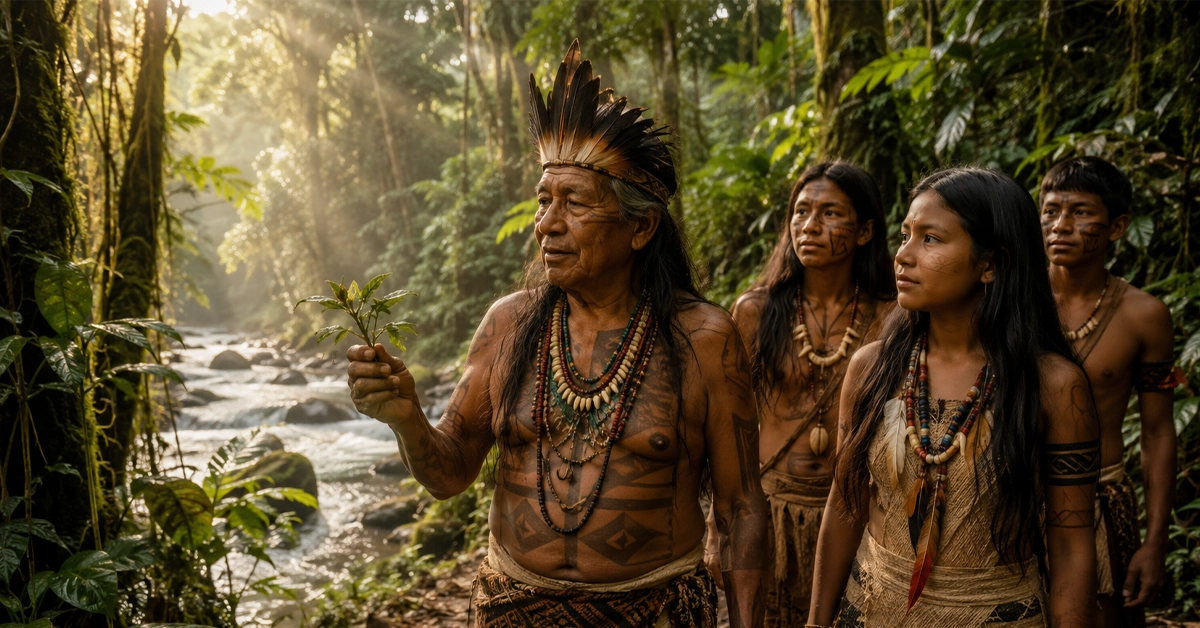
A child walks through the forest with an elder.
Someone points toward a plant and says its name.
They compare it with another species.
They discuss where it grows or remember a story.
The lesson is happening simultaneously in language and landscape.
Remove the landscape and ecological vocabulary loses part of its everyday context.
Remove the language and some systems through which relationships with that landscape are understood may weaken.
Remove both, and the loss can accelerate dramatically.
Plant Knowledge Is Learned Through Participation
Much traditional ecological knowledge is learned by doing.
- Walking;
- Watching;
- Listening;
- Planting;
- Preparing food;
- Making objects;
- Observing seasons;
- Watching animals;
- Listening to specialists and elders.
Language accompanies these activities.
Knowledge becomes connected with texture, smell, weather, landscape and memory.
Written documentation can preserve information, but it cannot reproduce the entire learning experience.
Why Dictionaries Alone Cannot Save Ecological Knowledge
Dictionaries, audio recordings and archives are extraordinarily useful.
But a language remains alive through use.
People must be able to speak it at home, teach it, create new expressions, tell stories, make jokes and adapt it to changing realities.
The same is true of ecological knowledge.
A database can preserve the name of a plant.
Living knowledge continues when people recognize that plant, discuss it, teach others and continue observing it.
Language preservation should therefore support speakers—not merely words.
Language Loss Can Affect Amazon Medicinal Plant Knowledge
The connection is especially important for Amazon medicinal plants.
Traditional medicinal knowledge may include much more than a plant name and a supposed benefit.
- Exact identification;
- The relevant plant part;
- Seasonality;
- Preparation traditions;
- Restrictions;
- Specialist roles;
- Cultural meanings;
- Situations in which a plant is not traditionally used.
Reducing this complexity to “Plant X is good for Y” can distort both culture and health information.
Language helps preserve nuance.
Losing Language Can Also Mean Losing Safety Knowledge
Traditional knowledge is not only about what people use.
It can also include what people avoid.
Communities may hold knowledge concerning:
- Plants that should not be confused;
- Materials requiring specialist preparation;
- Traditionally avoided combinations;
- Age or life-stage restrictions;
- Seasonal harvesting limits;
- Knowledge that is culturally restricted.
These details rarely fit into commercial lists of plant benefits.
But they may be among the most important parts of the knowledge system.
The Problem With Turning Oral Knowledge Into Commercial Claims
Global interest in Amazonian plants can create a troubling chain.
A community knows a plant.
A researcher documents the knowledge.
A scientific paper publishes it.
A commercial website discovers the paper.
The company then writes:
“Amazonian tribes have used this plant for centuries…”
Along the way, the specific people, language, context, restrictions and knowledge holders may disappear.
Documentation should not become a pipeline for cultural extraction.
When Knowledge Is Published, Who Owns It?
Open scientific knowledge can benefit research and conservation.
But traditional knowledge may involve collective cultural rights.
Responsible research should ask:
- Who originally shared the knowledge?
- Was informed consent obtained?
- Can the information be used commercially?
- Does the community receive recognition?
- Is some knowledge restricted?
- Who benefits from future commercial applications?
These questions do not weaken science.
They can create better and more equitable scientific relationships.
Indigenous Languages Should Not Be Protected Only Because They Are Useful
There is an important ethical distinction.
Indigenous languages do not deserve survival merely because they might contain useful medicinal knowledge.
Languages carry:
- Identity;
- Family relationships;
- History;
- Humor;
- Poetry;
- Music;
- Philosophy;
- Memory;
- Political thought;
- Everyday life.
Ecological knowledge is an extraordinary part of this story.
It is not the only reason the language matters.
The Amazon Does Not Speak One Indigenous Language
There is no single “Amazonian language.”
Amazonia contains extraordinary linguistic diversity.
Different peoples living relatively close to one another may speak languages with very different histories.
The same plant can therefore carry different names, classifications, stories and uses.
Responsible educational writing should identify specific peoples whenever reliable attribution is available rather than collapsing everyone into the vague category of “Amazonian tribes.”
Language Revitalization Is Also Conservation
If languages carry ecological knowledge, language revitalization can become part of environmental conservation.
Indigenous-Language Education
Children need opportunities to learn and speak their languages while participating fully in contemporary society.
Intergenerational Teaching
Programs connecting elders and young people can support both language and ecological knowledge.
Community Media
Radio, podcasts, video and digital media can create new spaces in which languages remain active.
Community-Controlled Archives
Communities should retain authority over recordings, dictionaries and sensitive ecological information.
Indigenous-Language Place Names
Traditional place names can preserve cultural and ecological relationships with territory.
Indigenous Research Leadership
Indigenous linguists, botanists, educators and researchers should help lead work involving their own languages and knowledge.
Technology Can Help—but It Cannot Replace Speakers
Digital tools offer new possibilities for language preservation.
Audio archives can preserve pronunciation. Mobile tools can support language learning. Digital maps can connect Indigenous place names with territories.
But technology cannot create the social conditions that make a language alive.
A language survives because children hear it, families speak it, communities value it and people continue creating with it.
The goal should not be perfect digital museums of languages that have stopped being lived.
The goal should be helping languages remain part of the future.
Climate Change Makes Language Protection Even More Important
The same 2026 Nature study projected substantial local losses of useful Amazonian plant species under future climate scenarios.
Plant knowledge can therefore face pressure from two directions.
Plants May Disappear Locally
Climate conditions may make particular territories less suitable for species traditionally used by communities.
Languages May Decline
Knowledge about those plants may become less widely transmitted when Indigenous languages lose speakers.
These pressures can reinforce one another.
This is why the threat is biocultural rather than simply biological or linguistic.
Conservation Needs to Protect Relationships
Traditional conservation often focuses on things:
- Save the species;
- Save the seed;
- Save the forest;
- Save the recording.
A relationship-based approach asks different questions.
- Can people continue interacting with the species?
- Can elders continue teaching younger generations?
- Can plant names still be spoken in the forest?
- Can communities remain on their territories?
- Can new ecological knowledge continue developing?
Conservation becomes not only preservation, but continuity.
What Businesses Working With Amazonian Plants Can Learn
Companies working with Indigenous knowledge or Amazonian botanicals have responsibilities within this story.
- Identify the people connected with specific knowledge when appropriate.
- Avoid vague references to generic “tribal wisdom.”
- Name the language when relevant and authorized.
- Do not exaggerate traditional claims.
- Distinguish traditional use from scientific evidence.
- Respect culturally restricted knowledge.
- Create transparent relationships with communities.
- Ensure communities benefit from commercial activity.
- Represent Indigenous people as contemporary knowledge holders.
- Support relationships rather than merely extracting stories and ingredients.
A beautiful story about ancestral knowledge becomes hollow if the knowledge holders disappear from it.
What Readers and Consumers Can Do
You can:
- Follow Indigenous writers and organizations;
- Learn the names of specific Indigenous peoples;
- Support Indigenous-language cultural projects;
- Question vague “tribal” marketing;
- Support businesses with transparent relationships;
- Learn about Indigenous territorial rights;
- Share Indigenous voices rather than speaking over them;
- Understand language preservation as part of ecological conservation.
From a Forest of Plants to a Forest of Meanings
A botanical inventory can tell us which species grow in a region.
It cannot tell us everything those species mean.
That requires people.
Language connects the visible forest with layers of memory and accumulated observation.
A plant name may point toward a landscape.
A phrase may encode how a species behaves.
A story may preserve seasonal knowledge.
A conversation between an elder and a young person may transmit something no database fully captures.
The Amazon then stops appearing as a warehouse of biodiversity.
It becomes a landscape filled with meanings.
Conclusion: When an Indigenous Language Disappears, Part of the Forest Can Become Unreadable
The relationship between Indigenous languages Amazon communities and plant knowledge reveals something fundamental about conservation.
Biological diversity and cultural diversity are not separate stories.
A forest species can survive while knowledge about it disappears.
A language can survive inside an archive while the territory that gave meaning to its ecological vocabulary is destroyed.
A medicinal plant can become globally popular while the people who named, observed and understood it receive little recognition.
The 2026 Nature study provides a powerful warning.
More than half of the Indigenous languages represented in its primary linguistic analysis were considered threatened, and researchers estimated that their disappearance could remove approximately 26% of the documented Amazonian plant-knowledge network they analyzed.
The same study found that around 74% of documented plant services were associated with only one culture.
Traditional knowledge is therefore not endlessly duplicated.
Some relationships are unique.
If they disappear, there may be no copy elsewhere.
Protecting Indigenous languages means protecting more than vocabulary.
It means protecting people, territory, memory, teaching, identity and the possibility for future generations to continue developing relationships with the living world.
The forest can survive on a map while becoming culturally quieter.
True conservation asks whether the people who know the forest can continue naming it, teaching it, questioning it and learning from it in their own languages.
Because when a language remains alive, the forest is not only remembered.
It can continue being read.
Frequently Asked Questions About Indigenous Languages and Amazonian Plant Knowledge
Why are Indigenous languages important to the Amazon?
Indigenous languages carry cultural identity, history, ecological knowledge, plant names, place names and relationships with territory. They are important in their own right and also contribute to the transmission of knowledge about Amazonian biodiversity.
How many Indigenous languages were included in the 2026 Amazon plant study?
The 2026 Nature study included information associated with 156 living Indigenous languages represented in the ethnobotanical literature analyzed by the researchers.
How many Indigenous languages in the study were threatened?
Approximately 55% of the living Indigenous languages represented were classified as threatened using Ethnologue. The authors note that Glottolog considers an even larger proportion threatened.
How much plant knowledge could disappear if threatened languages are lost?
The researchers estimated that losing threatened Indigenous languages could reduce the documented Amazonian plant-knowledge network examined in their study by approximately 26%.
Are Indigenous languages important only because they contain plant knowledge?
No. Indigenous languages have intrinsic cultural value and carry identity, relationships, history, philosophy, humor, art and community life. Ecological knowledge is one important dimension.
Can plant knowledge simply be translated into Portuguese or English?
Some information can be translated, but translation may not preserve every cultural category, relationship, place-based meaning or ecological distinction encoded in the original language.
What is biocultural diversity?
Biocultural diversity describes the interconnected diversity of biological life, cultures, languages and systems of knowledge.
Does every Indigenous culture use plants in the same way?
No. Different Indigenous peoples may have different names, uses, classifications and relationships with the same species. The 2026 study found that approximately 74% of documented plant services were associated with only one culture.
Can dictionaries save endangered Indigenous languages?
Dictionaries and archives can help, but living languages require speakers, families, education, community use and opportunities for intergenerational transmission.
How can language protection support biodiversity conservation?
Language preservation can help maintain place names, ecological observations, species knowledge and intergenerational relationships with territory. Conservation is strengthened when biological and cultural diversity are protected together.
Sources and Further Reading
Cámara-Leret, R., Roehrdanz, P. R. & Bascompte, J. The Forest of Knowledge Under Global Change. Nature 655, 1212–1216 (2026).
- Nature Portfolio research and commentary on Amazonian biocultural heritage, plant knowledge and language vulnerability.
- Ethnologue and Glottolog language-vitality classifications as discussed in the Nature study.
Continue Exploring the Living Knowledge of the Forest
Explore more stories about Amazonian plants, Indigenous languages, traditional knowledge, biodiversity and the relationships that connect cultural continuity with forest conservation.
At Queen of the Forest, we believe appreciation must begin with listening—and that knowledge deserves attribution, reciprocity and respect for the people and territories that keep it alive.