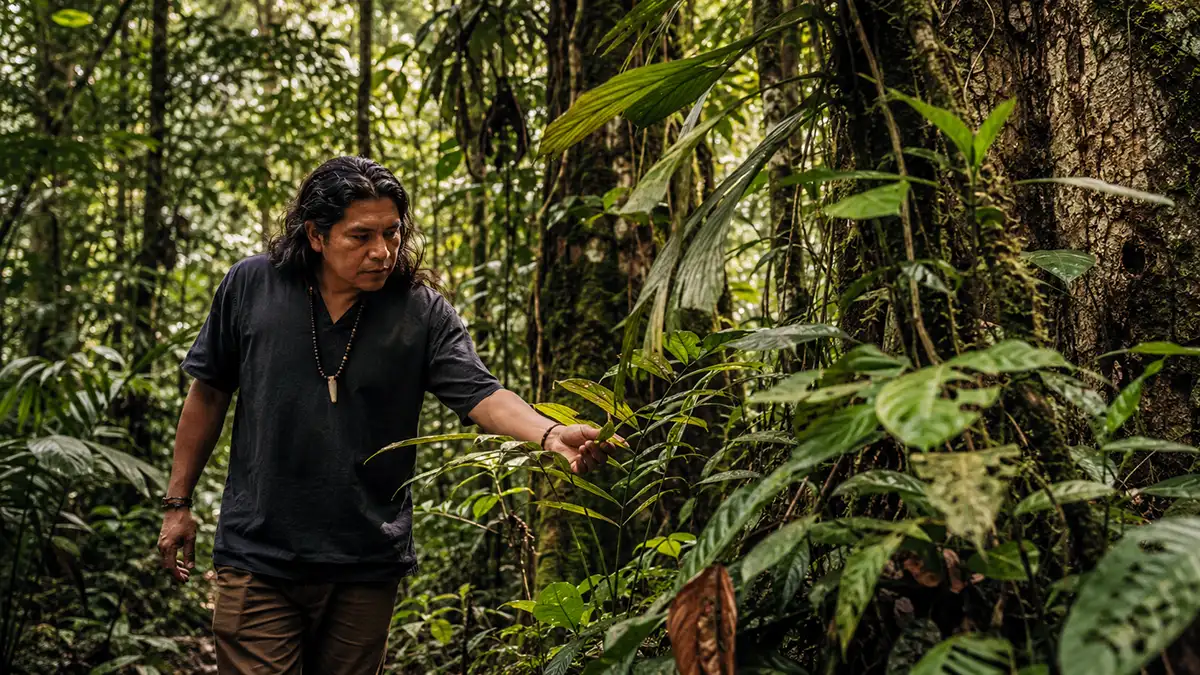
The Amazon rainforest is often described through extraordinary numbers: millions of species, immense rivers, enormous stores of carbon and a forest stretching across several countries. But there is another way to understand the Amazon. It is a forest of knowledge.
For thousands of years, Indigenous peoples and other local communities have learned which trees provide food, which palms yield useful fibers, which fruits arrive in particular seasons, which plants are associated with traditional systems of care and which species belong to stories, technologies and relationships that cannot be understood by looking at the plant alone.
Among these relationships are thousands involving Amazon medicinal plants.
A major study published in Nature in July 2026 attempted something unprecedented: connecting the extraordinary biological diversity of Amazonian plants with cultural knowledge surrounding their uses—and asking what may happen to both as the climate changes.
Researchers compiled 90,536 reports from 700 references published between 1504 and 2023. They identified at least 5,796 plant species used by Amazonian societies. Of these, 3,862 species had documented medicinal uses.
The study then looked toward the future. Its models suggest that by 2060–2080, Indigenous cultures could experience local losses averaging roughly 28% to 34% of the useful plant species currently associated with their territories, depending on the climate scenario.
But the disappearance of a plant from a territory does not necessarily mean losing only a species.
It can mean losing a relationship.
A Living Library Hidden in the Forest
Imagine entering a library containing thousands of books.
Now imagine that the books do not sit on shelves.
Some grow beside rivers. Some emerge in seasonally flooded forests. Some produce fruit only during particular months. Some are vines climbing into the canopy. Others may seem ordinary to someone walking past them but carry names, stories or practical knowledge in languages spoken by relatively few people.
This is one way to understand traditional ecological knowledge.
A forest can contain information distributed across living organisms, landscapes and human memory.
A plant may carry several kinds of knowledge simultaneously:
- Where it grows;
- When it flowers;
- Which animals interact with it;
- Which soils support it;
- Which part has traditionally been used;
- How material is harvested;
- Which preparation belongs to a particular context;
- Which uses are appropriate or inappropriate;
- Which stories accompany it;
- What its name means;
- How one generation teaches the next to recognize it.
None of this information exists completely within the plant itself.
Knowledge lives in the relationship between people, plants, language and place.
How Many Amazon Medicinal Plants Are Known?
The 2026 Nature study significantly expands our picture of human relationships with Amazonian flora.
Researchers identified 5,796 utilized plant species belonging to 195 families and 1,284 genera.
Medicinal knowledge was especially prominent.
- 3,862 species were associated with medicinal uses;
- 33,245 reports involved medicinal uses;
- Compared with 1,804 food species and 12,333 food-use reports.
This does not mean that 3,862 plants have been clinically proven to treat medical conditions.
The database documents reported human uses from ethnobotanical, historical and related literature. Traditional use and clinically demonstrated efficacy are not the same thing.
Instead, these numbers reveal the extraordinary depth of accumulated botanical knowledge in the Amazon.
They also show how much remains unknown. The researchers note that documentation has not reached saturation and that approximately half of Amazonian Indigenous groups are missing from the literature they reviewed.
Indigenous Knowledge Is Central to the Story
Indigenous cultures in the research database reported thousands of utilized species and represented more than half of the ethnobotanical reports analyzed.
This matters because Amazonian biodiversity is sometimes discussed as though people and forest exist separately.
They do not.
People have lived in Amazonia for thousands of years. Communities have observed, selected, cultivated, transported, protected and managed useful plants over generations.
The Amazon should therefore not be understood only as wilderness.
In many places it is also a cultural landscape.
Why Amazon Medicinal Plants Are Especially Vulnerable
Researchers created thousands of species-distribution models to examine how Amazonian plants might respond to climatic conditions projected for 2060–2080.
Across most scenarios, plants used by people were projected to experience greater geographical range contractions than non-utilized species.
Species associated with medicinal use were among the categories particularly affected.
This matters because a plant does not need to become globally extinct for a community to lose access to it.
It needs only to disappear from the territory where that community lives.
A species might continue growing hundreds of kilometers away while becoming absent from the cultural landscape where particular knowledge surrounding it developed.
What Happens When a Medicinal Plant Disappears Locally?
Imagine that a particular tree has been known within a community for generations.
An elder knows where it grows. Another person understands its seasons. A specialist knows a traditional preparation. The plant has a name in the local language. Young people learn to identify it while walking through the forest.
Now imagine that climate conditions gradually move the species away from that territory.
Practical Knowledge Becomes Harder to Transmit
People learn plants partly through direct experience. A photograph cannot fully replace walking through the forest with someone who knows where a plant grows.
Traditional Healthcare Options Can Narrow
Where local systems of care include forest plants, reduced access can narrow the resources available to specialists.
Language Can Lose Vocabulary
Plant names may carry information about appearance, habitat, use and relationships. If the plant becomes absent, the language surrounding it may also become less frequently practiced.
Cultural Practices Can Change
Plants may participate in foods, crafts, ceremonies, tools, construction and community stories.
Ecological Relationships Disappear Too
Pollinators, birds, mammals, fungi and other organisms can also depend upon the species.
Climate Change Could Remove Around One-Third of Useful Plants Locally
The researchers examined three climate pathways and projected average local losses among utilized plants of approximately:
- 28% under SSP1–2.6;
- 30% under SSP3–7.0;
- 34% under SSP5–8.5.
Associated plant services were projected to decline locally by approximately 18% to 23%.
These are modeled projections, not guaranteed outcomes.
But they demonstrate an important principle:
Climate change may alter not only how much forest survives, but which forest survives in particular places.
Climate Change Is Not the Only Threat
Climate change interacts with numerous pressures already affecting Amazonian ecosystems.
- Deforestation;
- Fire;
- Mining;
- Habitat fragmentation;
- Pollution;
- Land invasion;
- Extreme weather events.
A plant population weakened by drought may also face fire. A fragmented forest may offer fewer pathways through which species can shift their ranges. Mining may contaminate rivers and surrounding ecosystems.
The future of Amazon medicinal plants cannot therefore be separated from the future of the forest itself.
The Second Crisis: Indigenous Languages
Plants are not the only living systems under pressure.
Languages are too.
The study incorporated records associated with 156 living Indigenous languages, more than half of which were categorized as threatened within the linguistic dataset used by the researchers.
The authors estimate that the disappearance of threatened Indigenous languages could reduce their documented Amazonian knowledge pool by approximately 26%.
Biodiversity and Linguistic Diversity Are Connected
Conservation is often divided into separate disciplines.
Biologists protect species. Linguists study languages. Anthropologists study culture.
The forest does not obey those divisions.
Plant knowledge connects them.
When a language disappears, botanical vocabulary and ecological observations may disappear with it.
When a plant disappears, opportunities to practice and transmit that knowledge may also decline.
When territory is lost, both can be weakened simultaneously.
Some Knowledge Exists in Only One Culture
One of the study’s most striking findings is that approximately 74% of documented plant services were associated with only one culture.
That means another community using the same plant may not hold the same knowledge.
There may be no duplicate copy.
If every culture held identical versions of every tradition, knowledge loss might be easier to reverse.
The research suggests something very different.
Much of the library appears to be locally unique.
Why Simply Documenting Everything Is Not the Answer
Documentation can help protect threatened knowledge.
Community archives, dictionaries, recordings and botanical collections can support language and cultural revitalization.
But documentation raises important questions.
Who Owns the Knowledge?
Knowledge may belong collectively to families, specialists or entire communities.
Should Everything Be Published?
No. Some knowledge may be sacred, private, specialist or culturally restricted.
Who Controls the Archive?
Community-controlled archives can offer very different protections from databases located outside the territory.
Who Benefits?
If traditional knowledge eventually helps create profitable products, the knowledge holders should not disappear from the economic story.
Amazon Medicinal Plants Are Not Just Ingredients
Modern wellness markets frequently reduce complex forest relationships into short benefit lists.
One bark becomes good for skin.
One leaf becomes good for calm.
One resin becomes good for inflammation.
This may be convenient for marketing, but it can erase context.
An Amazonian medicinal plant may be connected with territory, language, seasonal harvesting, specialists, restrictions, family history and ecological knowledge.
Remove those relationships and what remains is an ingredient.
The ingredient may have value.
But it is not the entire knowledge system.
Traditional Knowledge and Modern Science Do Not Need to Become the Same Thing
Scientific research can investigate chemistry, genetics, pharmacology, toxicity, ecological distribution and climate vulnerability.
Traditional knowledge may ask different questions.
- Where does this species grow?
- When does it flower?
- How should it be harvested?
- Who taught this preparation?
- When should it not be used?
- Which relationships accompany it?
Neither knowledge system needs to pretend to be the other.
Traditional use should not automatically be described as clinical proof.
Scientific identification of a molecule should not be mistaken for discovery of the entire meaning of a plant.
Protecting Medicinal Plants Means Protecting Territory
If plant knowledge depends partly on continued relationships with living landscapes, then protecting territory becomes essential.
Territory allows:
- Elders to teach younger generations;
- Languages to remain connected with living species;
- Plants to continue interacting with animals and soils;
- Community harvesting practices to continue;
- Indigenous management systems to remain active;
- Knowledge to evolve rather than become a historical artifact.
This is why biodiversity conservation and Indigenous territorial rights cannot easily be separated.
Conservation Must Become Biocultural
Protecting biological and cultural diversity together is often described as biocultural conservation.
Instead of asking only:
How many hectares were protected?
we also ask:
Can the people who know this forest continue living with it?
Instead of asking only whether a species survived, we ask whether the relationship surrounding it survived.
Instead of asking whether knowledge was archived, we ask whether future generations can continue practicing it.
What Could Meaningful Protection Look Like?
Protect Primary Forests
Intact tropical forests protect habitats, water cycles, carbon and the plant communities on which local knowledge depends.
Support Indigenous Territorial Rights
Communities require secure territories in which cultural and ecological relationships can continue.
Strengthen Indigenous Languages
Language revitalization can also be understood as part of environmental conservation.
Support Community-Led Research
Indigenous researchers and specialists should participate as leaders and decision-makers in research concerning their biodiversity and knowledge.
Create Community-Controlled Archives
Communities should help determine what is documented, who can access it and how information may be used.
Build Fair Sociobioeconomies
Forest-based economies can create value while maintaining biodiversity, strengthening culture and supporting standing forests.
Respect the Right Not to Commercialize
Not every plant, preparation, ceremony or tradition needs to become a product.
What This Means for People Who Buy Amazonian Products
Consumers also participate in these relationships.
Useful questions include:
- Who produced this?
- Is the plant correctly identified?
- Where did the material come from?
- Was it harvested sustainably?
- Is a particular Indigenous people named?
- Was that name used with permission?
- Does the producer benefit economically?
- Are traditional claims distinguished from scientific evidence?
- Does the business maintain long-term relationships?
- Is Indigenous culture treated respectfully rather than as branding?
From Extraction to Reciprocity
For centuries, much of the wider world’s relationship with the Amazon has followed a pattern of extraction.
Something valuable is discovered.
It is removed.
Rubber. Timber. Gold. Oil. Plants. Knowledge.
Then much of the value accumulates somewhere else.
Reciprocity proposes another question:
Instead of asking only what the forest can give us, what allows the forest and its people to continue?
The Amazon Is More Than a Pharmacy
The Amazon is sometimes called the world’s pharmacy because of the extraordinary number of biologically active compounds that may occur within its flora.
But a pharmacy exists primarily to provide products for humans.
A forest does not.
The Amazon is a living network of plants, animals, fungi, rivers, soils, microorganisms and human communities.
The value of an unknown tree does not depend on whether scientists someday discover a useful molecule inside it.
The forest is not valuable because it might contain the next pharmaceutical discovery.
It is valuable because it is alive.
A Library That Is Still Being Written
Despite centuries of scientific documentation, the 2026 study found that knowledge about utilized Amazonian plants remains incomplete.
Many species remain undocumented, and many Indigenous peoples remain poorly represented in the literature.
The library is therefore not simply unfinished.
It is still being written.
Young people continue learning. Languages evolve. Communities adapt. Plants shift. New observations emerge.
Traditional knowledge is not merely information inherited unchanged from the past.
It is living knowledge.
When an Amazonian Plant Disappears, What Else Goes With It?
The emerging science surrounding Amazon medicinal plants gives us a different way to understand biodiversity loss.
A plant disappearing from a territory can mean the loss of:
- A species from a local ecosystem;
- A source of food or useful material;
- A traditional medicinal relationship;
- Vocabulary within an Indigenous language;
- Knowledge held by specialists;
- Opportunities for intergenerational teaching;
- Cultural practices;
- Ecological relationships still poorly understood.
The 2026 Nature research suggests that Amazonian cultures could experience local losses of approximately 28% to 34% of useful plant species under different climate scenarios by 2060–2080.
The same study indicates that threatened Indigenous-language loss could independently remove approximately 26% of the documented knowledge pool analyzed by the researchers.
Together, these risks reveal why biodiversity and culture cannot be protected separately.
The Amazon is more than a collection of species.
It is a network of relationships.
Plants are connected with people. Knowledge is connected with language. Language is connected with territory. Territory is connected with climate.
Protecting Amazon medicinal plants therefore means far more than preserving botanical specimens.
It means helping keep alive the forests, communities, languages and relationships through which generations have learned how to recognize them.
When we protect that network, we are not simply saving a library from the past.
We are protecting the possibility that the forest can continue teaching into the future.
Frequently Asked Questions About Amazon Medicinal Plants
How many medicinal plants are used in the Amazon?
A 2026 study published in Nature documented 3,862 Amazonian plant species associated with medicinal uses. Scientific documentation remains incomplete, so other traditionally used species may remain undocumented.
How many useful Amazonian plant species are known?
The study identified at least 5,796 plant species used by Amazonian societies across medicinal, food and numerous other categories.
Are all Amazon medicinal plants scientifically proven medicines?
No. Traditional or documented use does not automatically mean a plant has been proven safe or effective through clinical trials. Traditional knowledge, laboratory evidence and human clinical evidence should be distinguished clearly.
How does climate change threaten Amazon medicinal plants?
Changes in temperature and rainfall can alter the geographical areas where plants can survive. Researchers project substantial local range losses for many useful Amazonian plants between 2060 and 2080.
Could Amazonian communities lose one-third of useful plants?
The 2026 study projected average local losses of approximately 28% to 34% of utilized species among Indigenous cultures depending on the climate scenario. These figures are model projections rather than guaranteed outcomes.
Why are Indigenous languages important for plant conservation?
Languages carry plant names, ecological observations, preparation knowledge, stories and cultural meanings. The disappearance of a language can therefore result in the loss of unique botanical knowledge.
What is biocultural diversity?
Biocultural diversity describes the interconnected diversity of biological life, cultures, languages and systems of knowledge.
Can documenting Indigenous knowledge protect it?
Documentation can support cultural continuity, but communities should retain authority over what is recorded, who can access it and whether some knowledge should remain private.
Why do Indigenous territories matter for medicinal plants?
Territories allow plants, community practices, languages and intergenerational teaching to continue together. Protecting a plant while losing the cultural landscape surrounding it may still result in knowledge loss.
How can consumers support responsible Amazonian trade?
Consumers can ask about botanical identification, sustainability, sourcing, Indigenous consent, producer compensation and whether traditional claims are communicated responsibly.
Sources and Further Reading
- Cámara-Leret, R., Roehrdanz, P. R. & Bascompte, J. The forest of knowledge under global change. Nature, 2026.
- Nature Portfolio — Amazon culture and knowledge at risk from plant losses, July 2026.
- Reyes-García, V. Regenerating people–nature relationships to counter biocultural erosion in the Amazon. Nature, 2026.
- Science Panel for the Amazon — Amazon Assessment Report 2025.
Continue Exploring the Living Knowledge of the Forest
Discover more stories about Amazon medicinal plants, Indigenous knowledge, forest ecology, traditional systems of care and the relationships connecting cultural survival with biodiversity conservation.
At Queen of the Forest, we believe appreciation should lead toward understanding—and that understanding carries responsibilities of attribution, transparency, reciprocity and respect for the communities and ecosystems that keep forest knowledge alive.