The Fire That Does Not Burn: The Inner Flame in Ancestral Rituals
The Fire Beyond Destruction
Fire is often feared.
It consumes.
It transforms.
It leaves nothing exactly as it was before.
Yet across ancestral cultures, fire has never been understood solely as an element of destruction. In the forest, in the mountains, in deserts and plains, fire has long been revered as a sacred intelligence — one that does not merely burn, but reveals.
There is a fire that destroys, yes.
But there is also a fire that illuminates.
This is the fire carried into ritual.
The fire lit in silence.
The fire that does not harm the body, but reshapes the spirit.
In a time when humanity carries deep wounds — personal, collective, historical — the ancestral understanding of fire offers a powerful teaching: pain does not have to consume us; it can refine us.
Fire as a Living Presence
For ancestral peoples, fire is not an object. It is a presence.
It breathes.
It moves.
It responds.
To sit before a sacred fire is not to dominate it, but to enter into relationship. Fire listens. Fire mirrors. Fire teaches through movement and heat, through light and shadow.
In rituals across cultures, fire is treated with respect because it represents the principle of transformation itself. What enters the flame does not disappear — it changes form. Smoke rises. Ash remains. Heat spreads.
Nothing is lost. Everything is transformed.
This understanding lies at the heart of fire-based ceremonies: life does not end — it evolves.
The Symbolism of the Inner Flame
Beyond the physical flame exists the inner fire — the force that animates consciousness, courage, and will.
Ancestral traditions speak of this inner flame as the seat of vitality. When it burns too intensely, it can become rage, anxiety, or restlessness. When it weakens, it becomes apathy, sadness, or disconnection.
Ritual fire exists to rebalance this inner flame, not to suppress it.
The sacred fire does not extinguish pain.
It gives pain a place to transform.
This is why fire rituals are often invoked during times of grief, transition, or initiation. Fire does not erase experience — it integrates it.
Fire as a Container for Pain
Pain seeks movement.
Unexpressed pain stagnates.
In ancestral ceremonies, fire serves as a container where pain can be safely released. Offerings are made not to get rid of suffering, but to acknowledge it. To give it form. To let it move.
Words spoken into the fire dissolve into smoke.
Tears evaporate in its warmth.
Heavy emotions loosen under its steady presence.
The fire does not judge what is offered. It receives everything equally — fear, anger, sorrow, gratitude. This impartiality is what makes it sacred.
Through fire, pain is not denied. It is honored — and then transformed.
Ancestral Ceremonies and the Language of Flame
Across ancestral cultures, fire rituals appear with striking consistency. Though forms differ, the essence remains the same.
Fire marks transitions: birth, adulthood, death.
Fire seals commitments and prayers.
Fire opens ceremonial space.
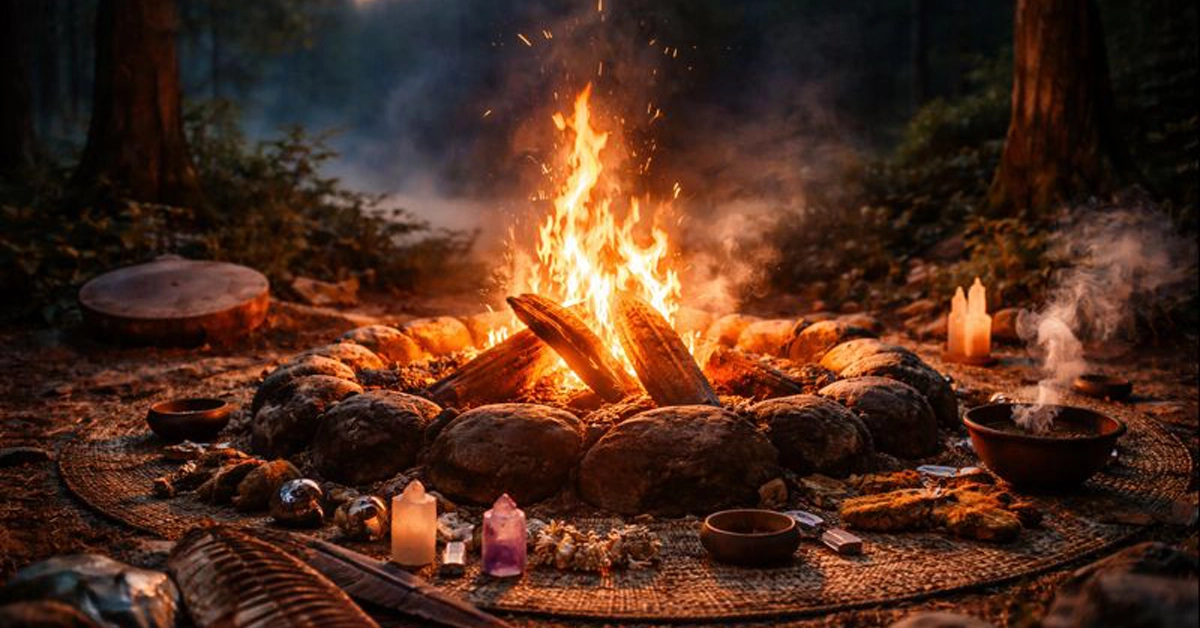
In the forest, fire is often lit at night — when the world quiets and perception deepens. The flame becomes the center around which stories are told, songs are sung, and intentions are clarified.
Fire teaches through observation. Its constant movement reminds us that stability does not mean rigidity. Its warmth reminds us that transformation can be gentle.
In ritual space, fire becomes a teacher without words.
Transformation Without Violence
Modern narratives often frame transformation as struggle — something that must be forced through effort or conflict. Ancestral fire tells a different story.
Transformation does not require violence.
It requires presence.
The sacred flame does not rush. It does not explode unless provoked. Left undisturbed, it burns steadily, patiently converting matter into light and warmth.
This is the model offered to the human spirit.
Change does not demand self-destruction.
Growth does not require burning everything down.
Healing does not need chaos.
Fire, when honored, transforms without aggression.
The Alchemy of Suffering
Alchemy is not only a mystical tradition — it is a lived process.
Fire is the alchemist’s tool because it reveals essence. It separates what is essential from what is not. It purifies by exposure, not by elimination.
In spiritual terms, suffering is raw material. Fire refines it.
When pain is brought into conscious awareness — symbolized by offering it to the flame — it begins to shift. Meaning emerges. Strength forms. Wisdom condenses.
This is why those who have faced fire often carry depth. Not because they avoided pain, but because they allowed it to transform them.
Fire and the Courage to Feel
Fire rituals demand courage — not because fire is dangerous, but because feeling is.
To sit with fire is to sit with intensity. The flame mirrors inner states. It reflects agitation, calm, resistance, surrender.
There is no hiding before fire.
Yet in this exposure lies liberation. Fire teaches that intensity is not something to fear. When held with awareness, it becomes clarity. When met with respect, it becomes strength.
Fire does not numb emotion.
It sharpens it — and then steadies it.
The Sacred Role of Heat and Light
Fire offers two gifts: heat and light.
Heat softens what has hardened. Emotional rigidity loosens under warmth. Defenses relax. The body becomes receptive.
Light reveals what was hidden. Shadows become visible. Patterns emerge. Truth surfaces.
Together, heat and light create the conditions for insight. Not intellectual understanding, but embodied knowing.
This is why fire rituals often precede important decisions. Fire clears confusion not by analysis, but by illumination.
Carrying the Flame Forward
Sacred fire rituals do not end when the flame is extinguished. Their purpose is to ignite something within.
The inner flame carried forward is steadier. More conscious. Less reactive.
After fire, words are chosen more carefully.
Actions become more intentional.
Life feels less chaotic.
This is the true gift of ancestral fire: not spectacle, but alignment.
Fire as Collective Medicine
Fire has always gathered people. Around flames, communities form. Stories pass. Memory is preserved.
In collective ritual, fire holds shared grief and shared hope. It becomes a witness to history. A keeper of continuity.
In times of fragmentation, returning to fire restores a sense of belonging. It reminds us that transformation is not a solitary act. It is communal.
The flame burns for everyone present.
When the Fire Grows Quiet
Eventually, every fire softens. Embers glow. Silence returns.
This moment is as sacred as the ignition. It teaches restraint. Integration. Respect for cycles.
Transformation does not require constant intensity. After the fire, there is rest. Reflection. Assimilation.
The flame teaches when to act — and when to be still.
Conclusion — Becoming Fire Without Burning
The fire that does not burn is not a contradiction.
It is a teaching.
It reminds us that transformation does not have to destroy us. That pain can become strength. That intensity can coexist with gentleness.
Ancestral rituals understood this deeply. They did not fear fire — they learned from it.
In honoring the sacred flame, we learn to honor our own inner fire. To tend it carefully. To let it illuminate rather than consume.
And when life demands change — as it always does — we remember that within us burns a flame capable of transforming everything it touches…
without leaving us in ashes.
Continue exploring
All stories
The medicines of the forest