When the Forest Falls Silent: The Spiritual Power of Retreat
When Silence Becomes a Teacher
There are moments when the forest does not sing.
No birds announcing the dawn.
No insects vibrating the air.
No leaves trembling in the wind.
To the untrained eye, it may seem empty.
To those who listen deeply, it is full.
In the modern world, silence has become uncomfortable. We fill every gap with sound, every pause with distraction, every empty moment with noise. Productivity is praised, acceleration is rewarded, and rest is often treated as weakness. Yet beneath the collective exhaustion of our time lies a forgotten truth: silence is not absence — it is presence in its purest form.
For the forest, silence is not a mistake. It is a phase.
A season.
A necessary return inward.
This is the wisdom the forest offers when it grows quiet: retreat is not retreating from life — it is returning to its source.
The Forgotten Language of Silence
Before words, there was listening.
Before rituals, there was stillness.
Before teaching, there was presence.
Indigenous wisdom has always understood that silence is not something to be created — it is something to be entered. The forest does not force silence. It invites it. And those who accept the invitation begin to perceive a different rhythm, one that does not belong to clocks or calendars, but to cycles of breath, light, and rest.
Silence is the space where perception sharpens.
Where intuition awakens.
Where the body remembers how to regulate itself.
In many ancestral traditions, silence is not imposed as discipline. It is approached as medicine. A way to recalibrate the nervous system, to soften the mind, and to allow the spirit to settle back into the body.
The forest teaches silence the same way it teaches everything else: gently, patiently, without explanation.
Collective Fatigue and the Call to Slow Down
We are living in an era of chronic stimulation. Screens glow day and night. Information never stops flowing. Even rest has been optimized, tracked, measured, and monetized.
The result is not productivity — it is fatigue.
Not just physical exhaustion, but spiritual tiredness. A weariness that no amount of sleep alone seems to resolve. A subtle sense that something essential has been lost, even when life appears full.
This is why the idea of retreat resonates so deeply right now. Not as escape, but as relief. Not as abandonment, but as repair.
The forest responds to this exhaustion with a quiet answer:
You do not need to keep going to be worthy.
You are allowed to pause.
Silence gives permission. Permission to stop performing. Permission to stop explaining. Permission to simply be.
Inner Winter: The Sacred Season of Recollection
In nature, not all seasons bloom. Some withdraw. Some shed. Some go underground.
Winter is not failure — it is preparation.
The concept of inner winter exists in many ancestral understandings of time. It refers to periods when energy naturally turns inward, when visibility decreases, when growth happens beneath the surface rather than above it.
Modern culture resists this. We are taught to be consistent, visible, productive at all times. But the forest does not operate this way. It honors cycles of dormancy just as much as cycles of abundance.
Inner winter is the season of silence.
Of rest without guilt.
Of listening without responding.
It is the phase where the soul reorganizes itself.
Those who honor inner winter often emerge clearer, stronger, and more aligned — not because they pushed through exhaustion, but because they allowed themselves to stop.
Rest as Spiritual Medicine
Rest is often misunderstood as inactivity. In truth, it is integration.
When the body rests, the nervous system recalibrates.
When the mind rests, perception widens.
When the spirit rests, intuition returns.
In forest-based wisdom, rest is not separate from healing. It is healing.
Silence allows the subtle layers of being to realign. Emotions settle. Thoughts slow. The constant inner commentary softens. What remains is a grounded sense of presence — a feeling of being exactly where one needs to be.
This kind of rest cannot be forced. It arises naturally when the environment supports it. This is why the forest has always been a place of renewal. Its rhythm encourages the body to remember how to downshift.
The forest does not rush you back into action.
It holds you until you are ready.
The Ritual of Silence
Silence itself can be a ritual.
Not an absence of sound, but a deliberate act of listening. A conscious stepping back from stimulation. A choice to sit without consuming, producing, or reacting.
In many traditions, periods of silence are observed before important transitions — before ceremonies, before decisions, before healing work. Silence clears the internal space so that what truly matters can be heard.
A silence ritual does not require complexity. It requires sincerity.
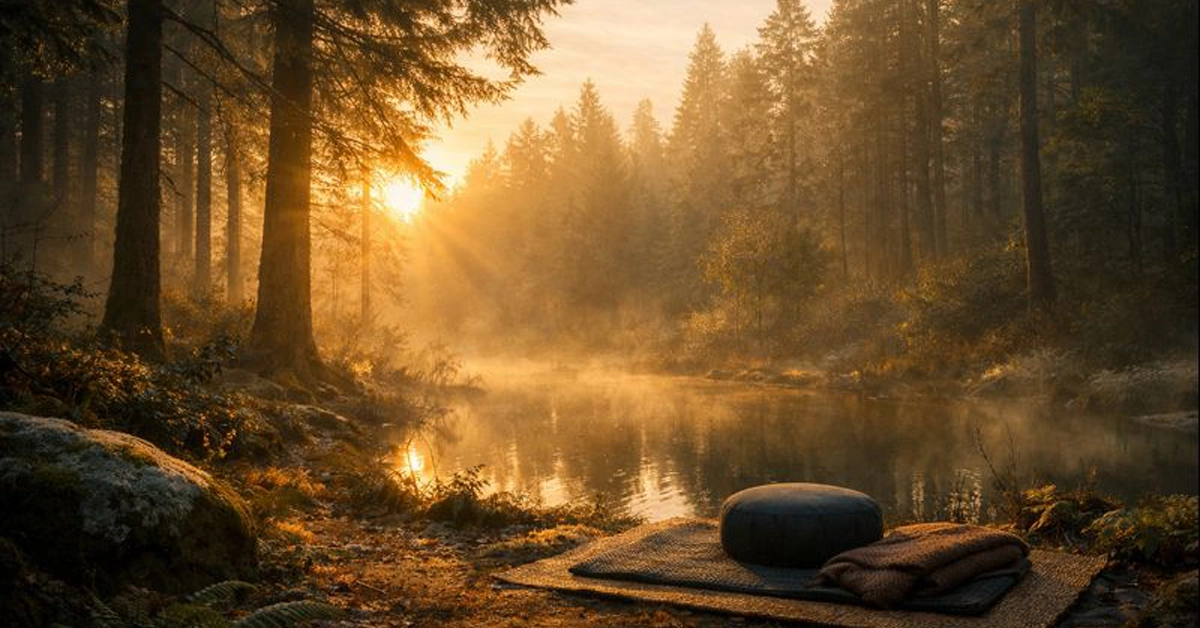
It may look like sitting alone at dawn.
Walking slowly without music or conversation.
Breathing with the rhythm of the body.
Allowing thoughts to pass without chasing them.
In silence, the mind stops demanding answers.
The body stops bracing.
The spirit begins to speak — quietly, but clearly.
Forest Wisdom and Inner Stillness
Stillness is not stagnation. It is balance.
The forest appears still at times, yet beneath the surface, roots exchange nutrients, fungi communicate across vast networks, and life reorganizes itself invisibly.
Human beings are no different.
Inner stillness allows deeper processes to unfold. Old emotions surface and dissolve. Unresolved tensions release. Creative insight emerges without effort.
This is why silence can feel uncomfortable at first. It removes distraction and reveals what has been waiting underneath. But the forest teaches that this discomfort is not something to avoid — it is a threshold.
On the other side of stillness lies clarity.
Letting the Mind Unwind
The modern mind is trained to grasp, analyze, and interpret. Silence interrupts this habit. Without external input, the mind initially searches for stimulation. When none is found, it begins to soften.
Thoughts slow.
Mental loops loosen.
Awareness widens.
This unwinding is not passive. It is deeply restorative.
As the mind quiets, the body follows. Breathing deepens. Muscles relax. The heart rate stabilizes. The entire system shifts from survival mode into regulation.
This is why silence feels different from distraction. Distraction numbs. Silence heals.
Permission to Pause
Perhaps the most radical gift of silence is permission.
Permission to stop striving.
Permission to not know.
Permission to rest without justification.
The forest does not ask for explanations. It does not measure worth by output. It does not reward speed.
In its quiet moments, the forest whispers a simple truth:
You are enough, even when you are still.
This permission is especially powerful in a world that equates movement with value. Silence reminds us that presence itself has worth.
The Return from Silence
Silence is not meant to last forever. Neither is action.
Just as the forest eventually sings again, those who retreat eventually return. But they return changed. Softer. Clearer. More rooted.
After silence, words carry weight.
After stillness, movement becomes intentional.
After rest, energy flows naturally.
This is the paradox of retreat: stepping back allows us to step forward more fully.
The forest teaches this rhythm effortlessly. It knows when to withdraw and when to bloom. When to be quiet and when to express itself.
When we align with this rhythm, life feels less forced and more true.
Listening to the Quiet
When the forest falls silent, it is not sleeping.
It is listening.
Listening to the soil.
To the roots.
To the subtle shifts that guide the next cycle of growth.
In a world that constantly demands more, silence offers a different invitation: to return to what is essential.
To rest without guilt.
To pause without fear.
To listen without needing answers.
The forest does not hurry the seed underground. It trusts the process. And so can we.
In silence, we remember who we are beneath the noise.
In stillness, we rediscover our natural rhythm.
In retreat, we find the strength to continue — not from force, but from alignment.
Sometimes, the most powerful medicine is simply to stop…
and listen.
Continue exploring
All stories
The medicines of the forest