The Rain as Blessing: The Baptism of the Forest
When the Sky Begins to Cry
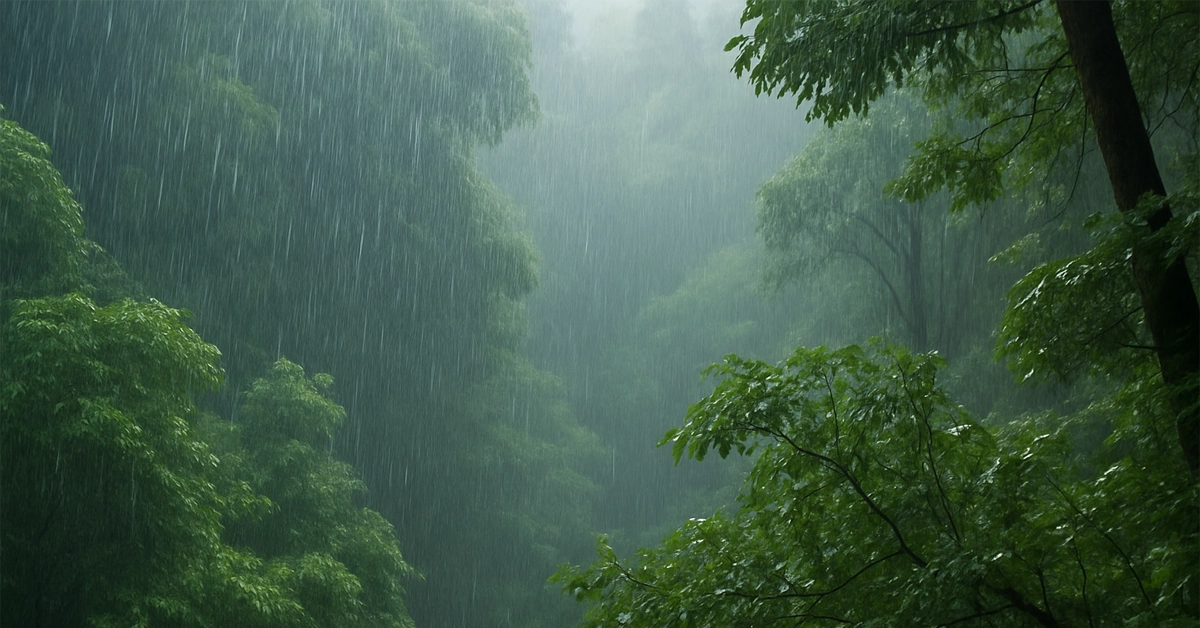
When the first drops fall upon the canopy, a sacred rhythm awakens.
The forest trembles—not in fear, but in recognition. The leaves bow; the rivers sing louder; the air fills with a fragrance that only rain can bring: the scent of life remembering itself.
For the peoples of the forest, rain is not merely a meteorological event. It is a visitation.
A spirit descending from the heavens to cleanse, renew, and bless the Earth.
To them, rain is not water—it is memory made liquid, a song of gratitude from the sky to the soil.
In every droplet lives a story: of seeds waiting to awaken, of roots stretching toward the heart of the planet, of rivers carrying messages to the ocean.
To walk under the rain, then, is to participate in a sacred ceremony—a baptism not imposed by doctrine but offered freely by the Earth herself.
The Sacred Language of Water
Water is the great mediator between worlds.
It flows through our veins as it flows through rivers, connecting body and Earth, spirit and sky. Indigenous traditions around the world recognize water as the first medicine—the mother of all elements, the fluid from which all life is born.
In Amazonian spirituality, water is not simply an element of survival. It is an intelligence, a consciousness that listens, absorbs, and transmits. When shamans speak to the rivers, when they sing to the rain, they are not performing metaphors—they are conversing with living beings.
The forest peoples say that rain is the voice of the great sky-spirit responding to the prayers of the plants. It is the visible expression of the invisible dialogue between Earth and Heaven.
Just as the forest breathes out, the sky breathes in—and when balance is achieved, the rain falls as the exhalation of the cosmos.
In this understanding, every rainfall is a reminder of reciprocity: the eternal exchange that keeps the world alive.
To receive the rain consciously is to be reminded of this covenant.
Rain as Purification: The Ceremony of Letting Go
When the sky opens and the water falls, the forest enters a state of purification.
Dust is washed from the leaves. Old branches collapse to feed the soil. Streams that once murmured in dryness roar again with vitality.
The same happens within us.
Rain is a teacher of release. It shows us how to surrender without fear.
To let go of what we no longer need, to cleanse the heaviness we have carried too long.
It reminds us that purification is not destruction—it is renewal.
In many Amazonian rituals, initiates or healers expose themselves to the rain before entering ceremony.
They allow the sky to cleanse their bodies and minds, letting the water wash away doubts, sorrows, and stagnant energies.
This act is called “the baptism of the forest.”
No sacred words are required. The rain itself performs the prayer.
Each drop becomes a blessing, each gust of wind a spirit whispering: “Be clean, be new, begin again.”
The shamans say that when we open ourselves to rain without resistance, the spirits of the water see us—and through that recognition, healing begins.
The Emotional Alchemy of Rain
For those attuned to the subtle realms, the rain awakens something ancient inside.
It brings memories not only of personal experiences but of humanity’s collective past—times when people lived closer to nature, when every storm was an event, and every rainbow a promise.
Rain carries the frequency of tears, but not of sorrow alone.
It is the divine art of transmutation—of turning sadness into renewal, fatigue into calm, stagnation into movement.
In this sense, crying and raining are the same act at different scales.
The sky cries for the world, the heart cries for the soul. Both release what has been held too tightly. Both make space for the return of light.
When one walks through the forest after a heavy rain, the entire ecosystem seems to sigh.
The soil breathes again. The frogs chant their gratitude. The birds stretch their wings in the new humidity.
This is the alchemy of the rain: transformation through surrender.
It reminds us that cleansing does not always come from effort—it often comes from allowing ourselves to dissolve.
Ceremonies of the Rain: When the Forest Prays
In various Indigenous cultures of the Amazon, there are rituals dedicated to the rain, both as an invocation and as a thanksgiving.
1. The Dance of Renewal
During long dry periods, tribes sometimes gather to sing and dance to call the rain.
The songs are not pleas of desperation but offerings of gratitude in advance, expressions of faith that the balance will be restored.
They paint their bodies with jenipapo and urucum, symbols of the union between the red of the Earth and the blue of the sky.
Their steps mimic the falling of drops, their hands move like clouds gathering.
When the rain finally comes, they do not run for shelter—they celebrate in the open, laughing as children reborn from the womb of the forest.
2. The River Blessing
Another common practice is the ritual bath in the river during or after rain.
Participants immerse themselves completely, letting the current carry away all energetic residues.
Plants like capim santo, alecrim do mato, or breu branco may be added to the bath for cleansing and protection.
This ritual is performed not only for the body but for the soul—to restore harmony after illness, conflict, or loss.
The rain intensifies the river’s power, as if the sky were adding its own medicine to the water below.
3. The Rain Prayer of the Pajés
Shamans often use rainwater collected directly from storms for healing and blessings.
This water, they say, contains the pure vibration of the celestial realms.
It is used to anoint the forehead and heart, to purify ceremonial tools, or to consecrate new medicines such as rapéh and sananga.
Rainwater is seen as unfiltered wisdom—a direct transmission from the sky.
The Rain Within: Inner Waters and Emotional Cleansing
The outer rain reflects the inner waters that flow through us.
Just as rivers can become stagnant, our emotions can too.
The Indigenous view teaches that we must keep our inner waters moving, through prayer, music, tears, or ceremony.
When someone in the tribe becomes emotionally heavy or withdrawn, the healers often encourage them to “let it rain inside.”
That means allowing the emotions to fall—without judgment, without control—until the soul feels clean again.
In modern language, we might call it emotional release or catharsis. In the forest, it is seen simply as natural balance.
The relationship between internal and external rain is also reflected in dreams.
To dream of rain is considered auspicious—it signifies the arrival of renewal, blessings, and fertility.
But heavy storms in dreams may symbolize the cleansing before transformation—the necessary thunder that precedes peace.
We are water beings, after all.
Our tears are rain in miniature.
When we cry consciously, we echo the sky’s own wisdom: that nothing should be held forever.
Rain and the Elemental Balance
The Indigenous cosmologies often describe the world as an interplay between the four elements—Earth, Water, Fire, and Air—plus a fifth essence, Spirit.
Rain is the marriage of Air and Water, a union of movement and emotion.
It falls upon the Earth, feeding Fire through the rebirth of life.
In this sense, rain is the expression of elemental harmony.
Too much sun without rain, and the land burns.
Too much rain without sun, and the land floods.
Balance is not stillness—it is a dance.
The forest knows this dance perfectly.
She welcomes the dry days as rest, and the rainy days as rebirth.
Human beings, however, often forget this rhythm, seeking only the sunshine of pleasure and growth, avoiding the storms of change.
But the medicine of rain teaches us otherwise: that sometimes our evolution requires storms; that without the tempest, the air cannot clear, and the light cannot return pure.
Rain as the Voice of the Divine Feminine
In many ancestral teachings, water is associated with the feminine principle—fluid, receptive, nurturing, intuitive.
The rain, therefore, is seen as the voice of the Great Mother.
Her touch is gentle yet powerful, soft yet unstoppable.
The Indigenous midwives of the Amazon say that when a child is born during rain, the mother receives special blessings, for her labor was accompanied by the Earth’s own birthing.
In the same way, when a new project, love, or phase of life begins under rain, it is said to carry the blessing of fertility and renewal.
The rain also symbolizes forgiveness.
Just as it falls on all without discrimination—on the leaf and the stone, on the hut and the palace—it teaches the unconditional love of the Divine Feminine.
It does not choose where to fall. It gives equally, infinitely, humbly.
When Rain Meets Fire: The Alchemy of Opposites
There is a moment of profound symbolism when rain meets fire—when the sky’s tears fall upon the sacred flame.
In ceremonies, this is often seen as a sign of balance, not contradiction.
The fire represents the masculine principle: transformation, will, illumination.
The rain embodies the feminine: purification, softness, emotion.
When they meet, steam rises—a bridge between worlds, a visible prayer ascending.
This union mirrors the human condition itself: our need to reconcile opposites within—strength and tenderness, reason and feeling, control and surrender.
The rain upon fire whispers the ultimate teaching: that healing arises not from victory of one force over another, but from their harmony.
Modern Souls, Ancient Rains
In today’s cities, rain is often seen as inconvenience—a delay, a disruption of plans.
But to the ancient ones, rain was an invitation to pause, to listen, to remember.
We have grown so distant from the language of the elements that we forget they still speak.
Yet, the rain continues its patient work, washing streets and spirits alike, whispering through the hum of modern noise:
“You belong to something vast. You are made of what falls from the sky.”
Many spiritual seekers are rediscovering the beauty of simple rain rituals:
lighting candles by the window, meditating to the sound of falling drops, collecting rainwater for sacred baths, or simply walking barefoot on wet Earth.
Each act reconnects us to the ancient rhythm of the forest—where purification is not an act of effort but of presence.
To listen to rain is to listen to God breathing.
The Forest After the Rain: A Vision of Renewal
After a long storm, the forest shines as if reborn.
Sunlight pierces the mist, forming rainbows between the trees.
Birds return to sing songs of joy, and insects begin their invisible labor anew.
The scent of breu and wet wood fills the air like incense offered by the Earth.
This is the baptism completed—the forest, the soil, and the spirits cleansed.
It is said that in those moments, if one listens closely, the forest whispers its secrets: not in words, but in vibrations.
The message is always the same: “Everything begins again.”
Humans who live in harmony with the forest understand that this is the rhythm of existence itself—
Birth, growth, decay, renewal.
The rain does not erase; it transforms.
It brings continuity to the eternal circle of life.
Becoming Rain
In the end, the lesson of the rain is simple yet infinite.
To be like water—to flow, to cleanse, to adapt, to give.
To allow ourselves to fall, to merge, to disappear into the greater ocean of being.
When we understand this, every storm becomes a blessing.
Every tear becomes holy.
Every moment of surrender becomes a doorway to renewal.
The forest has no fear of rain; she knows it is her baptism.
And so, too, must we learn to bless the moments when life washes over us unexpectedly, when our certainties dissolve like dust in the downpour.
Because somewhere beyond the clouds, a greater harmony is at work—
The sky remembering the Earth.
The Earth remembering the sky.
And within that sacred exchange,
we, too, are remembered.
Continue exploring
All stories
The medicines of the forest