The Song of the Macaws: Living Voices of the Forest in the Traditions of Indigenous Peoples
Voices that Paint the Sky
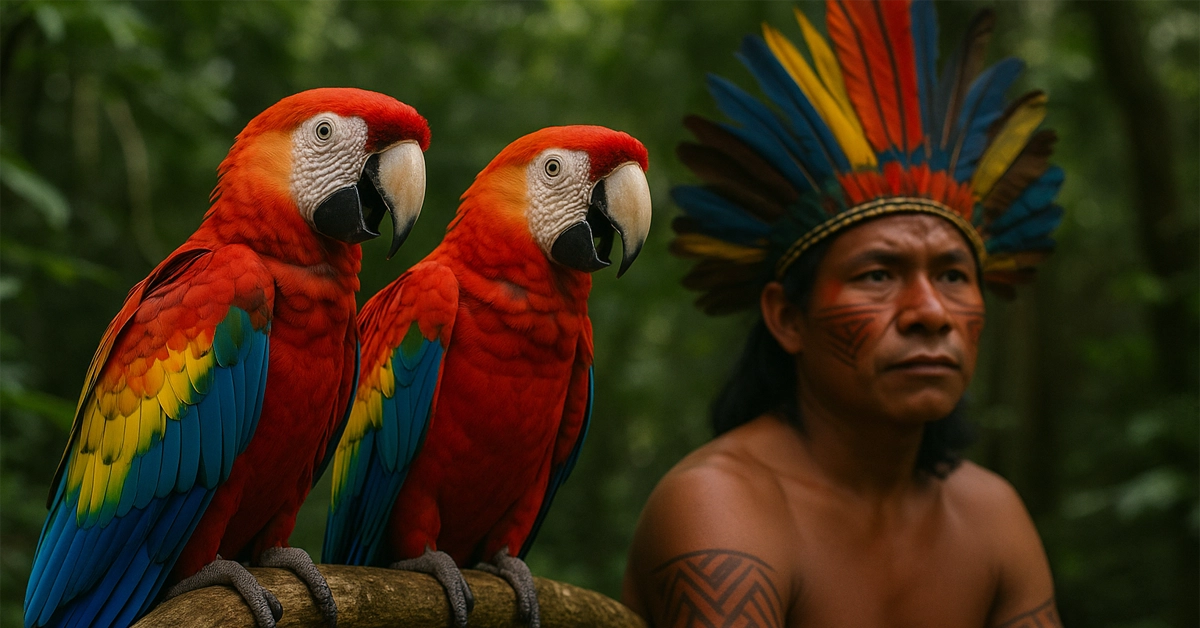
When the sun rises in the heart of the Amazon, before the forest has fully awakened, a sound cuts through the green silence: the cry of the macaws. Echoing among ancient trees, their call is both piercing and majestic, as if the forest itself were announcing the continuity of life. For Indigenous peoples, this sound is not just natural noise — it is a sacred language, a message that crosses the visible and invisible worlds.
Macaws, with their red, blue, yellow, and green feathers, are living paintings of the cosmos. They carry in their wings the mysteries of primordial colors, and in their calls, Indigenous peoples hear signs of prophecy, protection, joy, or warning. The song of the macaw is, therefore, a bridge between human beings and the spirits of the forest.
The Symbolism of the Macaw in Indigenous Cosmologies
Guardians of the Heights
In many Indigenous traditions, the macaw is considered the guardian of the space between Earth and Sky. Its high flight represents the link with the spiritual world, carrying messages from shamans and communities to the spirits that dwell in the higher realms. When it sings, it is not only to communicate with its flock but also to reaffirm this cosmic bridge.
Colors as Spiritual Language
The feathers of the macaw are seen as fragments of primordial light. Peoples such as the Kayapó and the Yawanawá associate each color with an element or force of nature: red with fire and the blood of life, blue with water and the spirit of the sky, yellow with the sun and vital energy, green with the forest and its abundance. Thus, when the macaw calls, it is as if all the forces of creation manifested in a single voice.
The Macaw as Messenger
Among the Huni Kuin, it is believed that the song of the macaw announces change. It may be a warning of rain, the arrival of hunters, or even the presence of a spirit approaching. Its voice is listened to carefully and translated not merely as sound but as message. For shamans, it is a natural oracle — an echo that reveals the invisible rhythm of the forest.
The Presence of the Macaw in Daily Life
Companions of Rituals
The cry of the macaws often accompanies ceremonies. During sacred songs — known as huni meka or icaros — the voice of the macaw in the background is received as spiritual confirmation. It is as if the forest itself were responding, participating in the ritual.
Inspiration for Human Songs
Several peoples reproduce in their chants and instruments the sounds of the macaws. Flutes, maracas, and voices imitate their piercing calls — not as mimicry, but as a way of harmonizing with the bird’s spirit. To sing like the macaw is to open one’s throat to echo both heaven and earth.
Protectors of the Malocas
In some villages, when macaws perch near malocas (traditional communal houses) and cry out, they are seen as spiritual protectors. Their presence symbolizes that the community is aligned with the forest. Many believe that macaws choose where to sing, and therefore their visit is never meaningless.
The Song as Omen and Medicine
Guidance for Hunting and Agriculture
For hunters and farmers, the cry of the macaw may serve as guidance. Some ethnic groups say that if a macaw calls at dawn in a certain direction, it signals abundance ahead; if it cries in a sharper, repetitive tone, it may be warning of scarcity or danger nearby.
The Medicine of Sound
The sound of the macaw is also used symbolically in healing. Shamans describe its sharp call as breaking through blockages, expelling dense energies, and awakening the body to new vitality. Just as its cry cuts across the sky, its vibration is believed to travel through the human body, cleansing and energizing.
Myths and Legends of the Macaws
The Woman Who Became a Macaw
Among Pano-speaking peoples, there is a tale of a young woman who, in refusing the violence of invading warriors, was transformed by the spirits into a macaw so she could fly free and never be captured again. Her cry remains to this day a symbol of freedom and resistance.
The Macaws and the Sun
Another legend says that macaws were the first birds to carry the colors of the sun in their feathers. When the Creator painted the world with the rainbow, he blew upon the macaws, giving them the gift of singing to keep alive the memory of creation.
The Cry that Dispels Darkness
Some traditions believe that the call of the macaws drives away spirits of darkness. Thus, when flocks of macaws cross the sky in loud voices, the community feels protected — as if celestial warriors were sweeping away the shadows.
Threats to the Macaw and Its Song
Deforestation and Silence
The voice of the macaws is under threat. Deforestation and wildlife trafficking drastically reduce their populations. Where the forest once echoed with their cries, silence now reigns. For Indigenous peoples, this is not merely the loss of a bird, but the loss of a portion of the forest’s sacred language.
Indigenous Resistance
Many Indigenous communities rise against these threats. For them, protecting macaws is not only an environmental issue but also a spiritual one: without the macaws, the forest loses its music, and the people lose a channel of communication with the sacred.
The Song that Endures
The cry of the macaws is more than sound. It is a cosmic melody that has crossed centuries and cultures, uniting peoples, spirits, and nature. For Indigenous peoples, each call is memory, warning, protection, and prayer.
When we hear a macaw sing, we are invited to listen not only with our ears but with our hearts. For within its song echoes the voice of the forest — a voice asking for care, reverence, and continuity.
If humanity can learn to hear as Indigenous peoples hear, perhaps we can save not only the macaws but also the entire symphony of life that vibrates in the Amazon.
Continue exploring
All stories
The medicines of the forest