Night Flowers of the Amazon: Beauty That Awakens in the Dark
Plants that bloom only at night and their connection with dreams and spiritual visions
The Secret Garden of the Night
When the sun sets over the endless canopy of the Amazon, the forest seems to enter a different realm. The heat of the day softens, the voices of birds fade, and the nocturnal choir of frogs, insects, and night hunters begins. Yet, beyond these sounds, another mystery unfolds—flowers that wait until the night to reveal their beauty.
These night-blooming plants are guardians of the hidden hours, messengers of the moon, and keepers of silence. For Indigenous peoples and spiritual seekers, they are not simply biological wonders but carriers of meaning, allies in dreams, and companions in vision. Their fragrance, timing, and symbolism weave a tapestry of wisdom that connects humanity to the unseen dimensions of existence.
In this article, we will journey into the mystical world of Amazonian nocturnal flowers, exploring their natural characteristics, spiritual symbolism, and the way they have inspired myths, rituals, and dreams.
The Mystery of Night-Blooming Flowers
Nature’s Hidden Rhythm
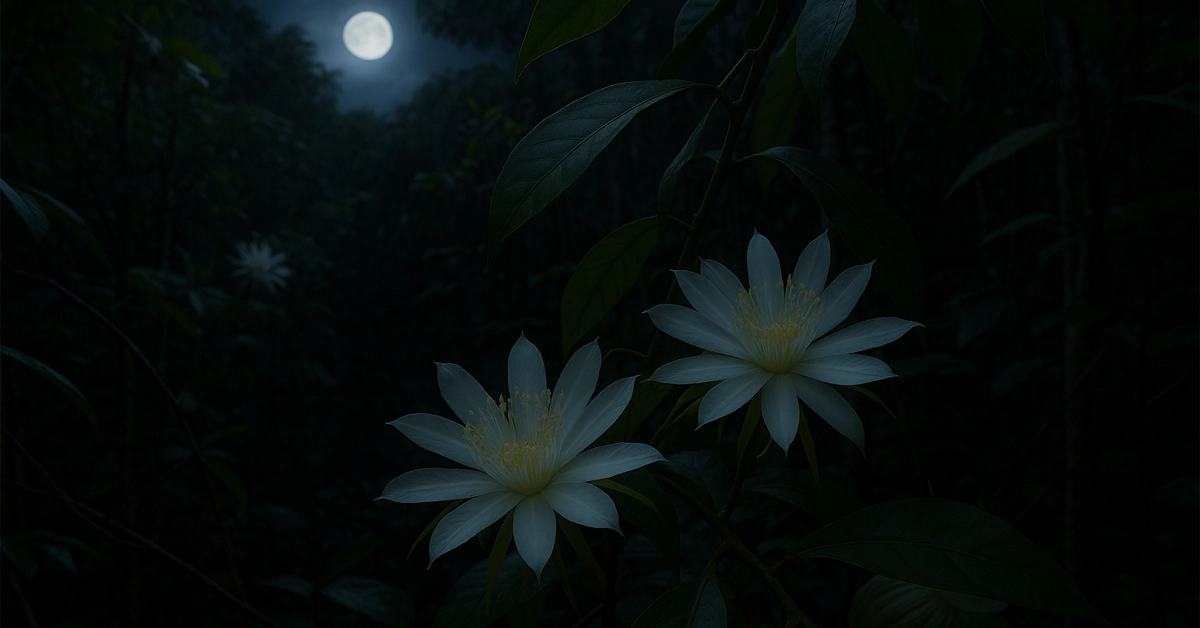
Unlike the flamboyant orchids or the bright heliconias that flaunt their colors during the day, certain Amazonian species choose to bloom under the veil of darkness. Their blossoms are often pale—white, cream, or faintly yellow—glowing under moonlight like spirits rising from the forest floor.
The reason is both ecological and symbolic. Scientifically, many of these flowers are pollinated by nocturnal beings—moths, bats, or night insects. Their pale colors make them visible in the dark, and their strong fragrance serves as a guide. Spiritually, this nocturnal timing has been interpreted as a sign of humility and mystery. The forest teaches that not all beauty must be seen in the open sun—some treasures reveal themselves only in silence and shadow.
Examples from the Amazon
- Moonflower (Ipomoea alba): Known as dama-da-noite in Portuguese, this vine opens its large white blossoms only at dusk, filling the air with a sweet fragrance that lasts until dawn.
- Night-Blooming Cactus (Selenicereus species): With flowers as big as plates, they bloom for just one night, reminding us of impermanence and the fleeting nature of beauty.
- Amazon Water Lily (Victoria amazonica): While it opens first at dusk, its bloom evolves over the course of the night, changing color as it is pollinated by beetles sheltered inside.
The Moon as Midwife of Blossoms
In Indigenous cosmologies, the moon is more than a celestial body—it is a grandmother, a guide, and a regulator of cycles. Just as it influences tides and menstruation, it also governs the mysterious blooming of certain plants.
Night-blooming flowers are often seen as daughters of the moon. Their rhythm of opening aligns with lunar phases, and their presence during ceremonies is considered an omen of fertility, dreams, or spiritual insight. Shamans often speak of these flowers as teaching plants—not through ingestion but through their timing, fragrance, and visions they inspire.
Dreams and the Fragrance of the Night
The Scent as a Spiritual Channel
Unlike daytime flowers, many night blossoms emit powerful fragrances that can travel far through the forest. For Indigenous people, smell is not just a physical sense but a spiritual one—a bridge to memory and the unseen. The fragrance of a flower opening at night is often interpreted as a message from spirits, inviting the dreamer into dialogue.
Flowers in Dream Culture
In some traditions, sleeping near a blooming moonflower is said to enhance dreams, bringing clarity or symbolic visions. Shamans sometimes place certain night blossoms in ceremonial spaces, allowing their scent to permeate the environment, guiding participants into altered states of awareness.
Symbolism of the Hidden and the Ephemeral
Impermanence and the One-Night Bloom
The fact that many of these flowers bloom for only a single night carries deep symbolic meaning. They remind humans of the fleeting nature of beauty, love, and even life itself. In shamanic storytelling, the one-night flower represents opportunities—moments that must be seized, for they may never return.
The Gift of the Unseen
To encounter these blossoms requires patience and awareness. You cannot simply stumble upon them in daylight; you must be willing to walk into the forest at night, guided by intuition and respect. This makes them metaphors for hidden wisdom—treasures that reveal themselves only when one dares to enter the mystery.
Flowers as Allies in Ceremony
Ritual Uses
While most night-blooming flowers are not ingested, they are used in symbolic ways:
- Decoration of altars: Their glow under moonlight brings a sense of purity and mystery.
- Fragrance in healing rituals: Shamans may use the flowers’ scent to cleanse the energy of participants.
- Vision quests: Placing these flowers near the resting place of seekers is believed to open dream channels.
Spiritual Synesthesia
During ceremonies with sacred medicines such as rapéh, ayahuasca, or sananga, the presence of night flowers adds another layer of sensory dialogue. The combination of plant medicine with fragrance and moonlight creates a multi-dimensional environment where participants feel surrounded by spirit allies.
Myths of the Night Flowers
Across Amazonian tribes, myths tell of flowers that bloom in darkness as the embodied spirits of ancestors or as lovers who chose the night to hide their passion.
- The Spirit Bride: A legend speaks of a woman who fell in love with the moon. Unable to unite with him, she transformed into a flower that opens only when he appears.
- The Ancestor’s Lamp: Some believe that the glowing petals of night flowers are the lamps of spirits walking the forest, ensuring that their descendants are never left in total darkness.
These myths teach that night flowers are not passive plants but living beings with stories, emotions, and wisdom to share.
The Spiritual Ecology of Darkness
Night-blooming flowers remind us of the importance of darkness as a teacher. In modern culture, darkness is often feared or rejected, associated with the unknown. Yet in the forest, darkness is fertile, healing, and sacred.
These blossoms show that the night is not empty but full of revelations. Just as dreams arise when the conscious mind rests, so too does hidden beauty emerge when the sun departs. For Indigenous spirituality, this teaches balance: honoring both light and shadow, day and night, consciousness and unconsciousness.
Messages for Modern Seekers
In a world saturated with artificial light, speed, and constant exposure, night-blooming flowers invite us to slow down and rediscover subtlety. They remind us:
- To value what is hidden rather than always seeking the spotlight.
- To appreciate fleeting moments instead of trying to possess them.
- To trust the unseen rhythms of life, knowing that not all beauty is revealed on demand.
For those on spiritual paths, these flowers are allies in cultivating patience, presence, and reverence for mystery.
Blossoms of the Invisible
The night flowers of the Amazon are more than botanical curiosities. They are symbols of impermanence, whispers of the moon, and guides into the world of dreams. Their beauty awakens not for the eyes of the many but for those who dare to step into the forest at night, attentive and humble.
In a time when humanity often fears darkness, these blossoms invite us to reclaim it as sacred. They remind us that even in shadow, beauty blooms, fragrance rises, and visions unfold. To honor them is to honor the hidden dimensions of life itself.
Continue exploring
All stories
The medicines of the forest