Visionary Art: When the Forest Paints Through Us
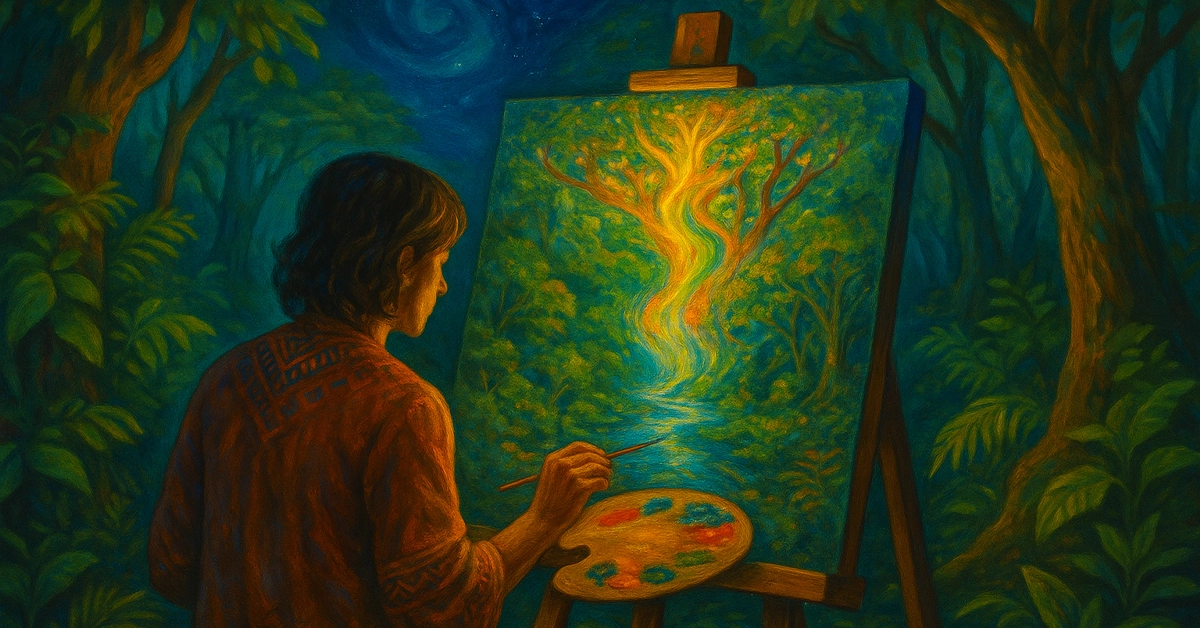
The spiritual power of art inspired by sacred medicines
When the Invisible Becomes Color
There are moments in ceremony — moments beyond language, beyond thought — when the forest opens her eye and shows you who you are.
You see shapes that dance like prayers.
You see beings made of light.
You see the pulse of the Earth in geometries.
And you understand, not with your mind, but with your soul.
And then — if you are an artist — you return.
To paper, to canvas, to wall, to skin.
And the forest paints through you.
This is visionary art.
Not invented. Not imagined. But received.
It is the bridge between the seen and the unseen.
It is the map of the spirit world translated into human form.
It is the way the jungle leaves messages for humanity —
in color, in texture, in vibration.
What Is Visionary Art?
Visionary art is more than aesthetics.
It is a spiritual transmission.
It arises from altered states of consciousness — whether through dreams, deep meditation, sacred medicines, or divine inspiration.
It is often:
- multi-dimensional,
- filled with sacred geometry,
- alive with color and pattern,
- and overflowing with symbols from myth, ancestry, and nature.
But visionary art is not limited to any style or form.
It is defined not by technique, but by origin.
It comes from an encounter.
A vision.
A remembering.
A communion with something beyond the veil.
Art as a Path of Healing
For many artists who work with sacred medicines like rapéh, Sananga, or Ayahuasca, painting becomes a form of integration and healing.
The act of translating a vision into form helps to:
- process what was seen,
- make the invisible visible,
- ground the ineffable in the physical world.
Some describe it as “downloading light.” Others call it soul-mapping.
But in all cases, it is a sacred task.
Creating visionary art is ceremonial.
And observing it can also be transformative.
To gaze upon a work born from deep spiritual realms is to remember something ancient within you.
A whisper of the forest.
A song of the stars.
When the Forest Uses Human Hands
Indigenous artists, especially those who have been raised within ceremonial traditions, often speak of the art “coming through” them.
They describe:
- being guided by ancestral spirits,
- receiving visions during ceremony,
- or having dreams in which an image is revealed.
These visions may take the form of:
- intricate beadwork,
- feather headdresses,
- painted ceramics,
- body painting,
- or murals created to protect and bless sacred spaces.
In many Indigenous traditions, art is not separate from spirituality.
To paint is to pray.
To carve is to honor.
To weave is to transmit wisdom.
The forest does not distinguish between artist and healer.
In her view, they are one and the same.
The Medicine of Pattern and Color
Those who have participated in sacred plant ceremonies know that the patterns seen during visions are more than decoration.
They are language.
Often referred to as “icaros visuais” or visual songs, these patterns carry codes of:
- healing,
- protection,
- and guidance.
In Shipibo-Konibo traditions, for example, the sacred geometric designs known as kené represent the vibration of specific healing songs sung by shamans during ceremony.
Each design is a map of energy — a visual prayer that aligns the body, spirit, and cosmos.
To look at a Shipibo painting is to hear a silent icaro.
To wear a kené pattern is to carry protection from the forest.
Famous Visionary Artists Inspired by the Forest
While the visionary art tradition is ancient and rooted in Indigenous cultures, it has also inspired countless contemporary artists from around the world who have worked with sacred medicines.
Here are just a few notable names:
Pablo Amaringo (Peru)
A former Ayahuasquero turned painter, Pablo Amaringo was one of the first artists to widely depict his Ayahuasca visions through art. His works are filled with:
- Amazonian spirits,
- healing plants,
- celestial beings,
- and sacred temples.
His legacy helped birth an entire movement of medicine-inspired painting.
Anderson Debernardi (Peru)
A student of Amaringo, Anderson creates richly detailed artworks that serve as visual journeys into the world of Ayahuasca. His paintings often reflect themes of:
- nature’s intelligence,
- human awakening,
- and multi-dimensional reality.
Mauro Reátegui Perez (Peru)
Known for blending ancestral Shipibo imagery with luminous color palettes, Mauro’s work is deeply connected to the sacred geometry seen in ceremony.
Martina Hoffmann & Robert Venosa (International)
Though not Indigenous, both artists are central figures in the Western visionary art movement. Inspired by sacred plant journeys and Eastern mysticism, their work carries a cosmic, meditative quality.
Each of these artists, in their own way, lets Spirit move through the brush.
When the Art Speaks to the Soul
There is a reason why people cry in front of visionary paintings.
Why they feel healed, seen, or called.
It’s because these images bypass the intellect and speak directly to the soul.
They are reminders.
Of our origin.
Of the forest.
Of the realms we forgot.
A single painting, when born from a true vision, can open the heart in ways a thousand words cannot.
It can awaken memories of:
- other lives,
- ancestral paths,
- or the purpose we’ve buried beneath routine.
Visionary Art as Collective Medicine
In a world that has lost its center, visionary art brings back the sacred.
It reminds us that:
- life is mysterious,
- spirit is real,
- beauty is medicine.
And just like sacred songs or ceremonial prayers, these images carry frequencies.
They are not passive — they do something.
Some offer protection.
Some activate inner gifts.
Some calm the nervous system.
Some awaken long-forgotten dreams.
This is why more and more healing spaces — temples, retreats, yoga centers, and homes — are adorned with this art.
It doesn’t just decorate.
It transmits.
The Role of the Artist as Channel
The visionary artist is not merely creative.
They are a channel.
And with that role comes responsibility.
To stay clear.
To listen deeply.
To honor what is shown.
Just like the healer or the ceremonial guide, the artist must maintain:
- personal integrity,
- energetic hygiene,
- and humility.
Because the visions are not owned.
They are gifted —
to be shared with those who are ready to receive.
Sacred Art Beyond the Canvas
Visionary expression is not limited to paintings.
It can take the form of:
- tattoos,
- textiles,
- sculptures,
- digital art,
- murals,
- or even sound and movement.
Some forest traditions use body paint before ceremony, inscribing sacred symbols on the skin to activate and protect.
Others weave spirit patterns into fabric or jewelry, each bead and thread holding prayer.
In this way, art becomes portable magic — a way to carry ceremony into daily life.
Creating Your Own Visionary Art
You don’t have to be a professional painter to engage in visionary art.
Anyone who has walked a path of healing, ceremony, or spiritual awakening can create from a place of vision.
Here are some gentle invitations:
- ✍️ Keep a sketchbook next to your altar or after ceremony
- Paint or draw what you see in meditation or dreams
- Create art not to impress, but to express
- Let spirit guide your hand — surrender control
- Use natural materials or offerings from the forest if available
- ️ Treat your creative space as sacred
The point is not perfection.
The point is connection.
When Spirit Paints Through the Human Heart
There is a current running through the universe.
A rhythm. A light. A song.
Some call it God. Some call it Forest. Some call it Vision.
When it enters an artist’s heart, and they say “yes” —
colors move.
images form.
and something holy emerges.
Visionary art is not just art.
It is a prayer in color.
A bridge between the world we see and the world that sustains us.
May we honor those who carry these visions.
May we listen with our eyes.
And may we allow the forest —
when she chooses —
to paint through us.
Continue exploring
All stories
The medicines of the forest