When Rapéh Teaches: The Silent Lessons Only the Forest Can Give
A contemplative journey into the medicine that speaks without words
There are medicines that arrive like thunder—loud, overwhelming, impossible to ignore. And there are others that whisper, entering gently, almost unnoticed, until you suddenly realize that something inside you has shifted forever. Rapéh is one of those medicines. It does not shout. It does not demand. It does not try to impress. Instead, it speaks in the oldest language of the forest: silence.
For those who walk the spiritual path with sincerity, rapéh eventually becomes more than a snuff, more than a ritual, more than a tool for grounding or focusing. It becomes a teacher. A subtle, patient, uncompromising teacher whose classroom is your own body and whose blackboard is your own breath. Rapéh is a mirror, a compass, a cleansing wind, a quiet presence that reminds you of truths you have forgotten.
People often describe rapéh by its physical sensations—the pressure in the head, the heat rising in the chest, the tears that come, the sudden clarity that seems to sharpen the senses. But these descriptions are merely the surface, the doorway. The real teachings happen in the silence between breaths, in the space that opens inside once the medicine settles in the body. It is there, in that space, that rapéh begins its work.
The forest has always taught through silence. You can sit for hours beneath a canopy of leaves, listening to the river, the insects, the distant call of birds, and realize that the forest is not quiet at all. It is full of movement, full of sound—but none of it is noise. Every sound has purpose. Every rhythm carries meaning. Rapéh brings that same quality into the human being. It clears the noise inside us—the anxious spirals of thought, the clutter of emotion, the static of worries—and leaves only what is essential. It leaves the inner landscape in the same state as a forest at dawn: awake, alive, but profoundly still.
This is why so many seekers say that rapéh helps them remember who they are. Not because it gives new information but because it removes what is not true. Rapéh does not add; it subtracts. It does not decorate; it reveals. It does not entertain; it confronts. The medicine does not create clarity—it uncovers it, like clearing leaves from a path that was already there. This is why rapéh can feel both gentle and powerful at the same time. It is a simple medicine that opens complex doors.
One of the most mysterious aspects of rapéh is the way it teaches without speaking. When you receive the medicine and sit with it, there is no narrative, no voice, no story being told. Yet something begins to communicate. Something begins to align. It is a communication that bypasses intellect. Instead of asking What does this mean?, the experience invites you to feel, to breathe, to notice. For people who are constantly seeking answers, rapéh teaches a different kind of knowing—the knowing that arises not from the mind but from presence.
The forest, after all, never rushed to explain itself. Trees never justified their growth. Rivers never apologized for changing their course. The Earth lives in a state of being rather than a state of explanation. Rapéh slowly brings humans back into that same way of existing. It returns us to a state where presence is enough, where silence is rich, where clarity does not need words.
But this does not mean rapéh is always gentle. Sometimes the medicine arrives like a sudden gust of wind blowing through a room full of dust. Old emotions rise. Tears come unexpectedly. Memories appear from places we never visit on purpose. The medicine brings these things not to punish but to clean. Rapéh’s understanding of healing is the same as the forest’s: to heal something, you must first make it visible. A wound covered by leaves will continue to rot. Rapéh uncovers the leaves.
This is why many people receive insights during rapéh that they were not actively seeking—insights about relationships, purpose, fear, behavior, truth. The medicine does not give answers; it reveals the places where answers already exist but were buried under avoidance or distraction. Rapéh teaches the heart to be brave enough to see itself. And once you see, you cannot unsee.
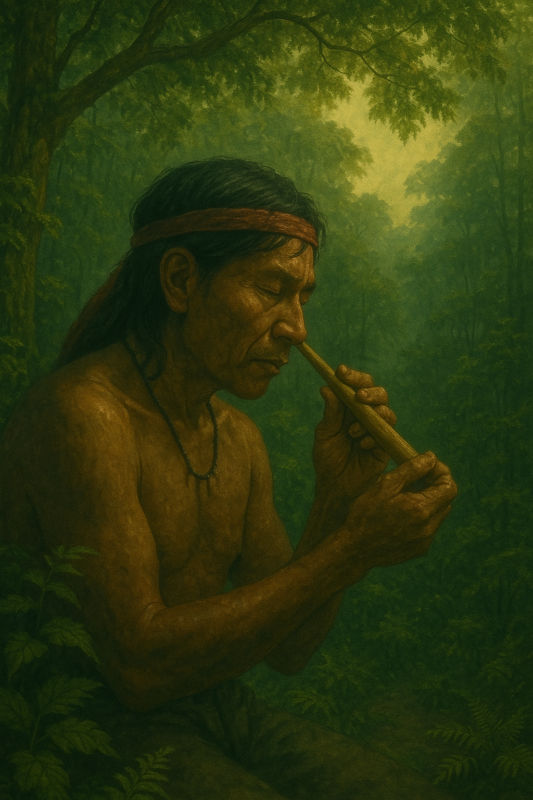
There is also the teaching of humility. When you bring rapéh to your nose, whether with a kuripé or through the hands of someone offering with a tepi, there is a gesture of surrender. You cannot control what the medicine will show you. You cannot predict how your body will respond. You cannot choose which emotions will rise or which illusions will break. Rapéh asks you to trust—not blindly, but consciously. It asks you to open a small doorway inside yourself and allow the wind of the forest to enter.
In a world where people are taught to protect themselves, defend themselves, and hide their vulnerability, rapéh asks for the opposite. It asks for honesty. It asks for truth. It asks for the courage to sit with yourself without running away. This is why rapéh is not for spectators. It is for participants. It is for those who want to be transformed.
And transformation, in the eyes of the forest, is not a dramatic event. It is a shift in alignment. A recalibration. A returning. Rapéh teaches that transformation does not happen in the spectacular moments of life but in the small, quiet ones. In the way you breathe. In the way you listen. In the way you respond to your own thoughts. It teaches you to notice the subtle—the tiny adjustments that change the entire direction of your inner compass.
Another silent lesson rapéh gives is the understanding of protection. Not protection as a shield, but as clarity. When the mind is clear, when the breath is steady, when the emotions are not tangled, you naturally become protected. Confusion is porous; clarity is strong. Rapéh teaches that protection is not something you wear—it is something you become. When your energy is aligned, nothing chaotic can enter easily. When your heart is calm, no storm can break it.
Perhaps one of the greatest lessons comes in the moments after the medicine settles, when the mind becomes so quiet that you can finally hear yourself. Not your fears, not your doubts, not your expectations—yourself. There is a voice inside every human that speaks softly, a voice that is often drowned out by the noise of the world. Rapéh clears the space so that this voice can be heard again. It is the voice that knows the path. It is the voice that knows the truth. It is the voice that the forest has been trying to awaken all along.
For those who walk with rapéh over many years, the relationship becomes intimate. The medicine becomes a companion, a friend who always tells the truth, even when the truth is uncomfortable. It is a friend who never lies, never flatters, never manipulates. Rapéh teaches integrity—not as a moral concept but as a state of being whole. To be in integrity is simply to be aligned with your deepest truth. Rapéh guides people back to that alignment again and again.
What makes rapéh so deeply transformative is that it does not teach through force. It teaches through presence. It teaches through stillness. It teaches through the kind of clarity that can only be found when everything unnecessary has fallen away. In this sense, rapéh does not change you; it reminds you. It reminds you of the forest inside you—the part that is ancient, wise, patient, and rooted in something larger than your individual story.
If you listen closely, you realize that rapéh’s greatest teaching is this: You already know.
You already know what you need to heal.
You already know what you must release.
You already know what is true and what is illusion.
You already know the path.
But you forget.
Rapéh helps you remember.
In the end, rapéh is not a medicine of visions or extraordinary experiences. It is a medicine of truth. A medicine that guides you back into your body, back into your breath, back into your heart. A medicine that teaches you the ancient way of the forest: to be present, to be aware, to be humble, to be real.
The forest does not speak in sentences. Neither does rapéh. The forest speaks through wind, through leaves, through silence, through the movement of animals and the heartbeat of the Earth. Rapéh speaks the same way—through sensation, through breath, through subtle shifts in perception. Its teachings are not made of words but of awakenings.
And so, the lesson is simple and eternal: sit, breathe, listen.
When rapéh teaches, it teaches everything the forest has ever known.
Continue exploring
All stories
The medicines of the forest