Rapéh and the Breath: The Portal Between Body and Spirit

There is a quiet intelligence within the breath that most people overlook. It is always there, moving gently in the background, sustaining life without asking for attention. And yet, the moment we become aware of it, everything begins to shift. The breath is no longer just a biological function. It becomes a doorway.
In many traditions of the forest, breath is not seen as something mechanical, but as something sacred. It is the meeting point between the physical body and the unseen layers of experience. Through the breath, intention travels. Through the breath, presence deepens. Through the breath, the mind can either scatter or return home.
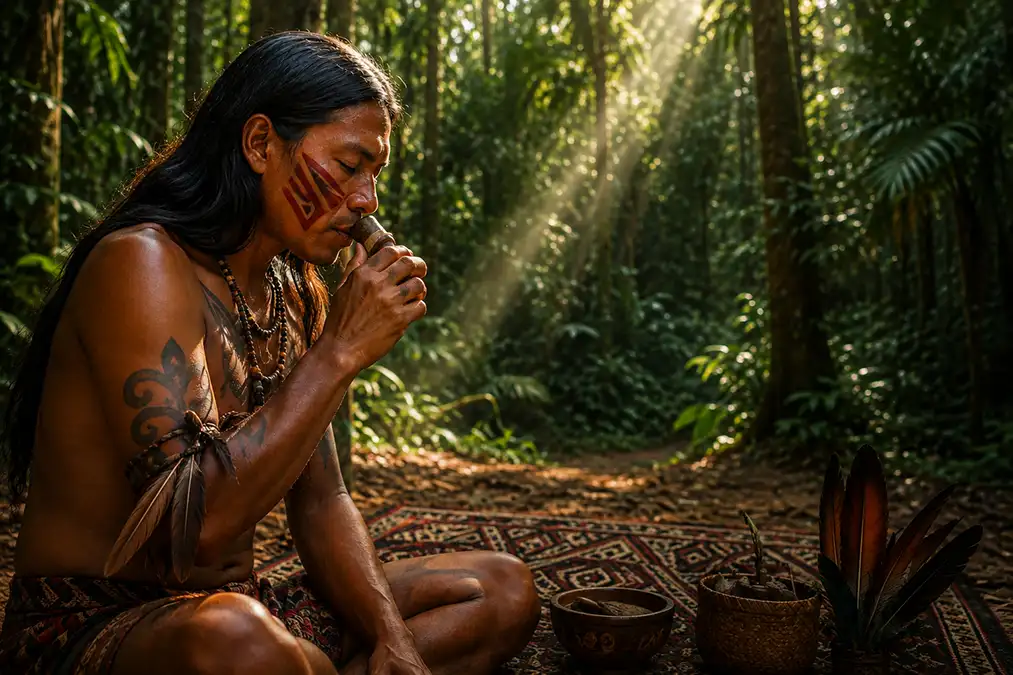
This is where rapéh reveals its true nature. Not as a substance to be consumed, but as a force that meets you at the level of your breath. The experience begins the moment the breath becomes conscious. What was automatic becomes intentional. What was unconscious becomes visible. And in that simple shift, the entire system begins to reorganize.
The connection between hapeh breathing and the nervous system is immediate and undeniable. The breath acts as a bridge, directly influencing how the body responds to the world. When breathing is shallow, the body remains in a subtle state of alertness. Thoughts move quickly, emotions react easily, and attention becomes fragmented. But when the breath deepens and slows, something else emerges. The body begins to regulate. The mind softens. A sense of grounded presence returns.
Rapéh, when approached with awareness, amplifies this natural intelligence of the breath. It does not override the body; it brings attention to it. It highlights the patterns that were already there. It reveals tension, resistance, and also openness. It creates a moment where the usual rhythm is interrupted just enough for something new to emerge.
This is why sacred breath rituals have existed for so long across different cultures. The breath has always been understood as a key. Not a concept, but an experience. Something that can be felt directly, without interpretation. In the presence of the forest, this becomes even more apparent. The air itself carries a different quality. Rich, alive, dense with life, it invites a different kind of breathing. Slower, deeper, more attuned.
When rapéh enters this space, it does not act alone. It interacts with this environment, with the body, and most importantly, with the breath. The moment of application is not passive. It is an exchange. A meeting between intention and presence. The breath becomes the vehicle through which this meeting happens.
And what follows is not just sensation, but awareness.
The inhale becomes sharper, more defined. The exhale becomes a release, not only of air but of accumulated tension. There may be moments of stillness, pauses where the system recalibrates. These pauses are not empty. They are full of information. They are moments where the body and mind align, even if only briefly.
This is one of the most overlooked rapé benefits. Not the intensity, not the sensation, but the clarity that follows. A clarity that does not come from adding something new, but from removing what was clouding perception. The breath becomes the anchor in this process. It holds the experience in place, allowing it to unfold rather than dissipate.
There is a practical simplicity to this, but it requires attention. Before engaging with rapéh, bringing awareness to the breath changes everything. Slowing it slightly, feeling it fully, allowing the body to settle. This prepares the system, not by force, but by invitation. It creates a space where the experience can be received rather than resisted.
Afterward, the breath becomes even more important. It becomes the place where integration happens. Where the intensity settles into understanding. Where the nervous system returns to balance. Without this, the experience remains incomplete, like a conversation that was started but never finished.
This is where many people miss the depth of what is available. They focus on the moment itself, but not on what the moment reveals. And what it reveals is often simple, almost obvious, but deeply transformative. That presence is always available. That clarity is not something to be chased, but something to be uncovered. That the breath is always there, waiting to be felt.
The forest itself reflects this truth constantly. There is no rush in its rhythm. Everything moves in cycles, in patterns of expansion and contraction, of activity and rest. The wind moves through the trees like a breath. The rivers flow with a steady pulse. Even the stillness is alive.
When we align with this, even for a moment, something changes inside us. The fragmentation begins to dissolve. The sense of separation softens. The body, the mind, and the environment begin to feel like part of the same movement.
This is not something abstract. It is something that can be felt directly, through the breath.
Rapéh, in this context, is not the center. It is a support. A tool that can help bring attention back to what is already present. It does not create connection; it reveals it. It does not force awareness; it invites it.
And always, it returns to the same place.
The inhale.
The exhale.
The space in between.
This space is often overlooked, but it holds something essential. It is a moment of stillness, a moment where nothing is happening and everything is possible. A moment where the body is not yet moving and the mind is not yet reacting. In this space, there is a kind of clarity that does not depend on thought.
When this becomes familiar, the experience of breath changes completely. It is no longer something that happens in the background. It becomes a constant reference point. A way to return, again and again, to presence.
And in that presence, something deeper becomes available.
A sense of alignment.
A sense of connection.
A sense that the boundary between body and spirit is not as fixed as it seems.
Because the breath moves through both.
It touches the physical and the subtle at the same time. It carries sensation, but also awareness. It is both grounding and expansive. And when it is felt fully, it becomes clear that it is not just supporting life.
It is guiding it.
The invitation here is simple, but powerful. To bring attention back to the breath. Not as a technique, but as a relationship. To feel it, to follow it, to allow it to reveal what is already present.
To approach tools like rapéh not as solutions, but as companions in this process.
And to remember that the doorway is always here.
Not somewhere else.
Not in the future.
But in this breath.
And the next.
And the one after that.
Always available.
Always waiting.
Always leading back to the same place.
Presence.
Continue exploring
All stories
The medicines of the forest