

The Language of Birds: How Their Songs Speak to the Guardians of the Forest
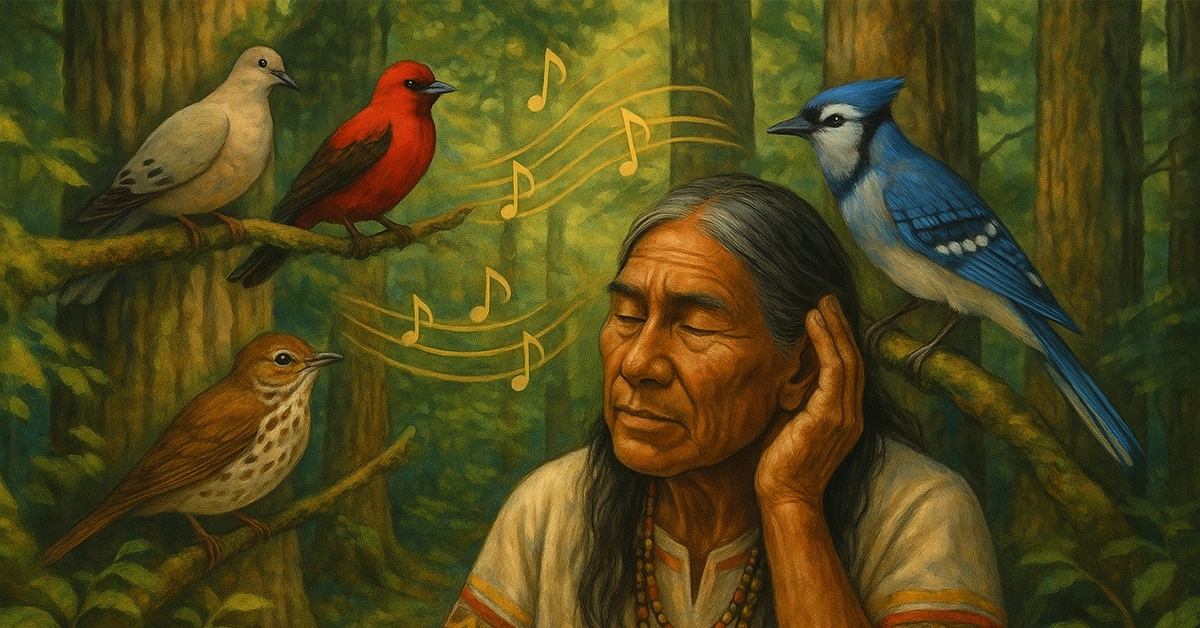
Spiritual Messages in Birdsong and What the Elders Hear in the Wind
When Wings Carry Words
Before the written word, before even spoken language, there was song. And in the living temples of the forest, the birds were the first singers.
Their melodies echo through the trees at dawn and dusk, marking not only the rhythm of the day, but the arrival of messages. To Indigenous peoples across the world—especially those in deep communion with the rainforest—birdsong is more than sound. It is communication.
For the elders, bird calls are not random. They are signals, prophecies, and signs from the invisible world. They tell us when visitors are coming, when spirits are near, when rain is about to fall, or when a ceremony is truly aligned.
In this article, we explore how the language of birds is heard, interpreted, and honored among Indigenous forest guardians. Through their ears, we begin to understand the world not as a place of chaos—but as a living web of voices, each with a sacred role.
Birds as Spirit Messengers
In Indigenous cosmology, birds are considered spiritual beings with specific missions.
Each species has its own vibration, purpose, and message. Some birds are seen as protectors, others as announcers, and some are bringers of healing or transition. Their arrival, direction, tone, and timing are all part of the message.
Just as humans speak different languages, so do birds. But the forest dwellers know: the key is not to “translate” the birds—but to feel them.
Some common meanings include:
- A bird singing at sunrise: Blessing and renewal
- A sudden loud call at night: A warning or presence approaching
- A repetitive call near the house: Spirits calling for attention or alignment
- An unfamiliar bird singing after a prayer: Confirmation from the invisible world
For the shaman, the bird’s voice is often a sign from the spirits themselves—a way the unseen world chooses to speak out loud.
The Bird’s Role in Ceremonial Time
During ceremonies, the appearance or sound of a bird can carry powerful spiritual weight.
There are stories from Amazonian tribes of rituals interrupted or redirected based on a bird’s call. If a certain bird sings during the opening prayer, the shaman may change the course of the ceremony or deliver a different chant.
In some lineages, when a hawk flies overhead at the peak of a ritual, it is seen as the confirmation of the work being accepted by higher spirits.
Birdsong is also used to mark time. Before watches and phones, the people of the forest knew when to begin or end an offering based on the birds’ rhythm.
- The uru bird may mark twilight
- The inhambu signals mid-morning
- The bacurau sings after dusk, indicating that the spirits of the night are awakening
The birds, in this way, are not spectators of sacred time. They are participants.
️ Songs of the Wind: A Map of Spirit Movement
The forest is full of invisible currents. Not only the wind that stirs the leaves, but the movements of energy, the crossing of spirits, the pulse of prayer.
Birds are particularly sensitive to these currents. When the energetic field changes, so does the way they sing.
An elder from the Yawanawa once explained that before a spirit arrives, the birds change their rhythm. It may be a pause, a collective silence, or a sudden burst of calls. “They feel what we cannot see,” he said, “and if you listen, they will tell you everything.”
This sensitivity is especially useful for those who guard sacred lands. When spirits—both benevolent and disruptive—approach a ceremonial space or healing house, the birds are the first to know.
Their voices become a natural alarm system, not one of fear, but of awareness.
️ The Birds That Carry Blessings
Not all birds bring warnings. Some are known as bearers of light and good fortune. Their songs are celebrated as blessings, especially when heard in key moments of prayer or offering.
Examples include:
1. Beija-flor (Hummingbird)
- Small and swift, its appearance is considered a kiss from the divine.
- Its silent wings remind us that speed and stillness can coexist.
- Often associated with love, sweetness, and beauty in the heart.
2. Arara (Macaw)
- Colorful and loud, macaws are keepers of ancestral memory.
- Their call is said to awaken clarity and strength.
- Appearing during rituals may signal the presence of elders or guides.
3. Coruja (Owl)
- Though feared in some traditions, owls are seen as deep seers.
- Their nighttime song often marks the arrival of hidden wisdom.
- They bring messages from the shadows, dreams, and inner vision.
How the Elders Listen: The Art of Deep Hearing
To truly understand the language of birds, one must listen differently.
Modern ears are often trained to filter sound—to ignore what’s not immediately relevant. But in the forest, listening is not passive. It’s a sacred skill, a way of relating to life.
Elders teach that one must listen with:
- The whole body — feeling the vibration
- An open heart — allowing intuition to translate
- Without analysis — letting the meaning arise naturally
Sometimes, it’s not about the bird at all—it’s about what happens in your spirit when you hear it.
One Kaxinawá grandmother said:
“When the bird sings, it’s not just the bird. It’s your own soul remembering how to speak.”
Bird Dreams and Visions
Birds also visit in dreams and meditative states. When they do, their meanings are deeply symbolic.
- A bird flying out of your chest may indicate liberation of suppressed truth.
- A bird feeding you may mean a message or blessing is being delivered.
- A wounded bird may reveal a broken connection to spirit or community.
These are not random symbols. They are living messages, woven into the psyche by the forest itself.
Some healers even receive their spiritual name after a bird visitation, forever linked to that species as a spirit guide.
The Feather as a Spiritual Tool
Because of their sacred link, bird feathers are considered holy.
They are used in:
- Prayer fans to direct energy and carry intentions
- Sacred altars as offerings of flight and communication
- Healing rituals to brush away heavy energy from the body
- Ceremonial dress as a sign of alignment with the spirit world
Each feather carries the spirit of the bird it came from, and must be treated with great respect. They are never taken casually, but often gifted by nature in perfect timing.
To hold a feather is to hold a piece of sky.
The Modern Silence: Why Birdsong Matters Now
As cities grow and machines drown out the subtle sounds of nature, birdsong is disappearing from daily life.
This is not just an ecological loss—it’s a spiritual one.
Without the birds, we lose the real-time messages of the Earth. We lose the mirror that reflects the energetic state of the land, of the people, and of the spirit world.
Listening to birds is not about nostalgia—it’s about rebuilding a bridge between the human and the non-human. It’s about remembering that we are not separate from nature—we are a voice among many.
And when we listen to the birds, we remember how to sing.
️ A World That Still Speaks
The birds do not ask for followers. They do not seek praise. They simply sing the truth of the moment.
If we listen, they will remind us:
- To be present
- To honor the unseen
- To speak only what is needed
- To sing not for performance, but for connection
In the great web of the forest, each voice matters.
May we listen more. May we remember the language we once knew.
May the birds keep singing — and may we learn, once again, how to hear.
Continue exploring
All stories
The medicines of the forest