Herbal Baths and Smudging: Purification Rituals of the Forest

Ancestral wisdom on cleansing body and spirit with sacred plants
Throughout the Amazon and many Indigenous cultures around the world, purification is not just an act of hygiene — it is a spiritual preparation. Whether for a ceremony, a transition in life, or a healing process, the body and spirit are seen as one integrated field of energy. What affects the spirit manifests in the body. What is felt in the body echoes through the soul. In this understanding, the forest becomes more than a setting — it becomes a pharmacy, a sanctuary, and a teacher.
Among the most cherished practices for cleansing and harmonizing are herbal baths and smudging rituals. These are not mere traditions of the past; they are living practices still widely used today by shamans, elders, and communities that continue to walk in deep relationship with nature. These rituals offer an opportunity to reconnect, to reset, and to release what is no longer needed — emotionally, energetically, or spiritually.
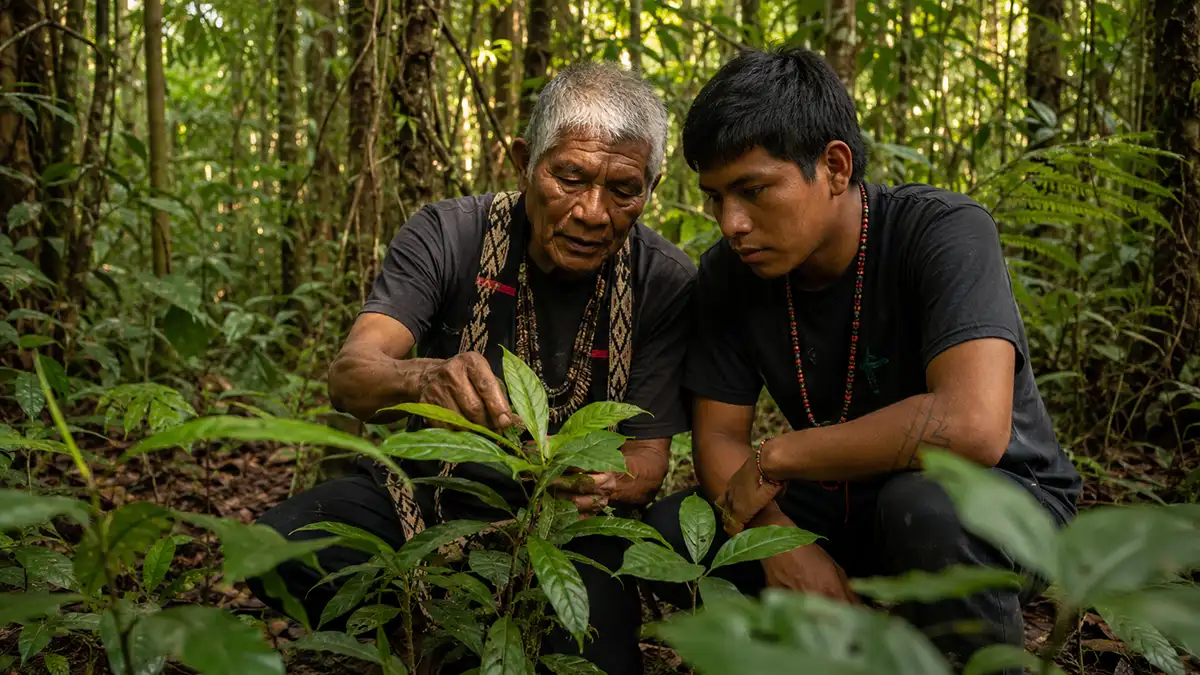
Herbal baths, often referred to as banhos de ervas in Portuguese-speaking communities, involve the intentional infusion of plants in water to cleanse not just the skin, but the energetic body. The process is both practical and ceremonial. First, the plants are selected with purpose. Each plant carries its own spirit, its own vibration, and its own function. Some are cooling and calming, like mint or lavender. Others are protective and clearing, like rue, rosemary, or guiné. Some plants open the heart, others awaken the mind. The person preparing the bath speaks to the plants, sometimes singing or praying, asking for their assistance. The leaves are often macerated or boiled gently, and the water becomes a sacred brew — one to be poured slowly over the body, often from the neck down, in silence or in prayer.
In many traditions, these baths are taken during specific moon phases or after certain ceremonies. A person may take a bath before a sacred ritual to prepare their energy field, or afterward to release the excess and close the energetic portal. Children may receive baths to calm their sleep or protect them from unwanted energies. Healers use baths to cleanse themselves after attending to others. In all cases, the bath is more than a blend of herbs — it is a ritual of relationship between human and plant spirit.
Closely related are the smudging practices, or defumações. This is the art of using smoke to purify a space, an object, or a person. Commonly used plants for smudging include palo santo, white sage (used in North America), copal resin, breu-branco from the Amazon, and dried herbs like rosemary or bay leaves. In Amazonian traditions, native incenses such as cipó embira or cascas de árvores (tree barks) are burned on hot coals or embers. The smoke is fanned gently with a feather or hand around the person’s body or throughout a house. The purpose is to clear stagnation, repel heavy or intrusive energies, and invite harmony.
Smudging is often performed at thresholds — the beginning of a ceremony, the opening of a new home, the change of a cycle, or the return from a difficult journey. The smoke is believed to be the vehicle that carries prayers to the spirit world. It is also a messenger: the way the smoke moves, its thickness or thinness, the scent it leaves, can be interpreted as signs by the one performing the ritual. Elders often speak of the smoke as a bridge between dimensions — it speaks where words cannot, it cleans where hands cannot reach.
One important aspect to consider is that both these practices, though ancient and sacred, are also simple and deeply adaptable. They do not require exotic ingredients or complex preparations. What matters most is intention. Even in an urban environment, one can cultivate a small collection of plants on a balcony, prepare a tea with fresh herbs, or burn a bundle of native leaves in a bowl of sand or clay. The power is not in the ritual’s grandeur but in its authenticity. In a world increasingly saturated with noise, screens, and artificiality, these small acts of care return us to what is essential: presence, breath, connection.
Those who integrate herbal baths and smudging into their modern lives often report subtle but profound shifts. A sense of grounding after a day of stress. A feeling of renewal after grief. The clarity to move forward after confusion. Even without deep knowledge of plant spirits, these rituals open a doorway to something deeper than words — a return to the rhythm of nature.
Importantly, Indigenous wisdom reminds us that we should not use these rituals as tools of control or superstition, but as invitations to relationship and reverence. When we treat the plants with respect, when we ask for permission and listen to their guidance, they respond. These are not passive materials — they are alive. They are not there to be consumed, but to co-create with us.
As the world turns its eyes more and more to ancestral practices for healing and balance, it is crucial to honor the roots of these traditions. If we take without giving back, if we adopt without listening, we risk reducing sacred medicine to aesthetic performance. But when we walk with humility, when we remember that the forest speaks through its leaves and its smoke, we step back into the circle — not as masters, but as relatives.
Bringing these rituals into urban life doesn’t require a forest — only a willingness to slow down, to feel, and to connect with the sacred within the ordinary. Preparing a simple bath with rosemary, lavender, and basil, and pouring it over oneself with a quiet prayer can shift the entire course of a day. Lighting a piece of local resin and smudging a corner of your home while setting an intention can change the way a space feels — not just physically, but energetically.
There is wisdom in the plants that cannot be translated fully into language. It must be felt. And when we open ourselves to that feeling, the baths become not just cleansing — they become communion. The smoke becomes not just a scent — it becomes a signal. We are remembering. We are returning. And we are not alone.
Continue exploring
All stories
The medicines of the forest