Hapeh: When Silence Enters the Body
The medicine that does not speak loudly, yet gently brings everything back into alignment
There are moments in life when words lose their usefulness. Not because they are wrong, but because they are insufficient. In a world saturated with explanations, opinions, notifications, and noise, silence becomes a rare and almost forgotten language. Yet silence is not empty. It is full. It carries weight, presence, and an intelligence that cannot be rushed. Hapé belongs to this language. It does not arrive to convince, entertain, or impress. It arrives quietly, asking the body to listen before the mind tries to understand.
For those who encounter hapé with openness, it quickly becomes clear that this medicine is not about visions, spectacle, or escape. It is about returning. Returning to the breath, to the spine, to the weight of the body sitting on the earth. It is a medicine of alignment, not expansion outward but gathering inward. Where modern life fragments attention, hapé gently calls the pieces back home.
Silence, in this context, is not the absence of sound. It is the absence of resistance. When hapé enters the body, there is often an immediate interruption of internal chatter. Thoughts may still arise, but they no longer dominate. The mind pauses, not by force, but by recognition. Something deeper has taken the lead. This is why many people describe hapé not as something that does something to them, but as something that restores what was already there.
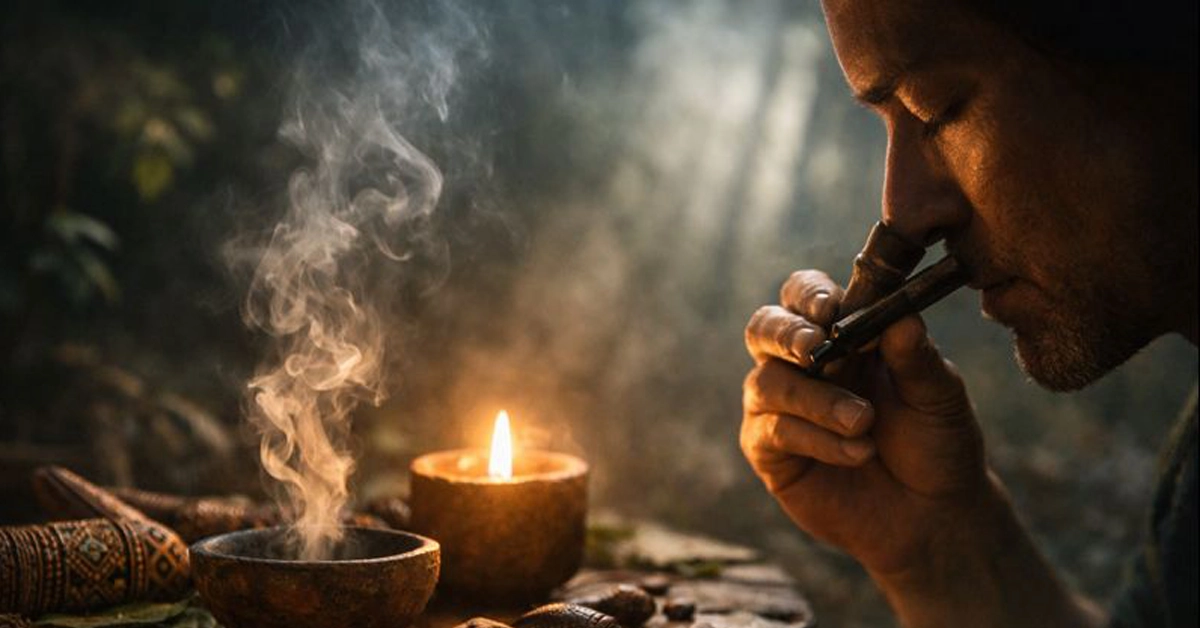
Breath plays a central role in this encounter. Not as a technique to be mastered, but as a bridge between the visible and the invisible. The moment hapé is received, the breath naturally deepens. It moves lower, fuller, closer to the belly and the base of the spine. This shift alone can reorganize the nervous system. It signals safety. It tells the body that it can stop bracing, stop anticipating, stop holding unnecessary tension. In this way, hapé does not impose silence; it creates the conditions for silence to emerge on its own.
Many traditions speak of alignment as something mystical or abstract, but hapé teaches alignment in a very physical way. The body straightens. The posture adjusts almost automatically. The head bows slightly, not in submission, but in humility. There is a recognition that something larger than personal preference is present. This alignment is not about discipline; it is about coherence. When breath, body, and attention move in the same direction, the inner noise has no place to hide.
What makes hapé unique among sacred medicines is precisely this lack of drama. It does not seduce with beauty or overwhelm with intensity. Instead, it strips away excess. It removes what is unnecessary so that what remains can be felt more clearly. For some, this feels grounding. For others, confronting. Silence has a way of revealing what we avoid when we stay busy. Yet even this revelation is not aggressive. Hapé does not push; it waits.
Conscious use is essential, not because hapé is fragile, but because the human mind often seeks to turn every experience into consumption. Used consciously, hapé becomes a ritual of listening rather than doing. It invites slowness. It asks to be met with intention, not expectation. When approached this way, it naturally teaches moderation. One does not feel the urge to repeat it compulsively. Silence, once felt, is self-sustaining.
In many Indigenous traditions, hapé is associated with clarity rather than ecstasy. It clears the path so that perception can sharpen. Emotions settle. Decisions that felt confusing suddenly feel simple, not because answers appear, but because unnecessary questions fall away. This is the organizing quality of the medicine. It does not add meaning; it removes distortion.
Modern language often struggles to describe this state because it is neither excitement nor relaxation in the conventional sense. It is presence. A quiet, alert presence that feels rooted rather than elevated. In this state, the body becomes a place rather than an object. One inhabits oneself more fully. This is perhaps why hapé is so closely linked to grounding practices. It brings awareness downward, into the legs, the hips, the earth beneath.
Silence also changes how time is perceived. Minutes stretch. The urgency to move on dissolves. This temporal shift is subtle but profound. It allows integration to happen organically. Nothing needs to be processed intellectually. The body does the work quietly, the way a forest regenerates after rain, without announcing each step.
Another essential aspect of hapé is its relationship with respect. It does not respond well to distraction. Using hapé while multitasking or seeking entertainment tends to dull its effect. This is not punishment; it is feedback. The medicine reflects the quality of attention it is given. When met with reverence, it responds with depth. When rushed, it remains on the surface.
This reflective quality is why many people describe hapé as a mirror. Not a mirror that shows images, but one that reflects states of being. If one arrives agitated, that agitation becomes visible. If one arrives sincere, sincerity deepens. Silence amplifies what is already present. In this sense, hapé is not something external entering the body; it is a conversation between what is taken in and what is already there.
Plants have always communicated in this way. They do not negotiate or persuade. They offer conditions. The human response determines the outcome. Hapé carries this ancient intelligence. It does not belong to modern productivity or spiritual performance. It belongs to cycles, to pauses, to moments when listening is more important than acting.
In a culture that values expression over perception, hapé rebalances the equation. It reminds us that not everything needs to be shared, analyzed, or named. Some experiences gain strength by remaining internal. Silence becomes a container, holding insights gently until they are ready to emerge, if they ever need to.
This is why hapé often pairs naturally with meditation, prayer, or simple stillness. Not because it enhances these practices, but because it aligns with them. It speaks the same language. It supports the transition from mental noise to embodied awareness. Over time, this can reshape how one relates to daily life. Small irritations lose their grip. Reactions soften. Space appears between impulse and response.
Importantly, hapé does not promise transformation. It does not claim to heal or fix. Its gift is more modest and more radical: it restores contact. Contact with breath. Contact with body. Contact with the present moment. From this contact, clarity may arise. Or rest. Or simply a deeper acceptance of what is.
In times of collective uncertainty, this quality becomes especially valuable. When the world feels unstable, practices that anchor rather than stimulate are essential. Hapé does not distract from reality; it brings one closer to it. It strengthens the capacity to remain present without becoming overwhelmed. Silence, here, is not withdrawal. It is resilience.
As with all sacred medicines, integration matters more than intensity. The true work of hapé continues after the immediate effects fade. It shows itself in how one walks, speaks, listens, and pauses. In how one chooses not to react. In how one breathes when no one is watching. The medicine completes itself in the ordinary.
Ultimately, hapé teaches that silence is not something to be achieved, but something to be remembered. It has always been there, beneath the noise. The body knows this. The breath knows this. Hapé simply reminds us. Quietly. Without insisting. Organizing everything from the inside out.
And in that reorganization, something essential becomes clear: when silence enters the body, nothing is missing.
Continue exploring
All stories
The medicines of the forest