The Whispering Roots: The Spiritual Wisdom of Forest Trees

How tree roots carry ancestral knowledge and connect the Earth’s memory with human consciousness
Where Silence Speaks
In the hush of the forest, where the canopy filters sunlight into shimmering gold, and the air smells of moss and earth, there is a language without words. It flows beneath the surface, deep in the roots of trees, whispering stories older than memory.
For many Indigenous traditions and spiritual seekers alike, trees are more than majestic organisms. They are guardians, healers, and living archives of wisdom. And while their trunks may tower above us, it is their roots—hidden, silent, powerful—that connect them to the heart of the Earth and to the memory of all life.
This article invites you to descend into the sacred underworld of forest spirituality, where roots become bridges between dimensions, and trees become teachers of grounding, balance, and ancient presence.
Chapter 1: Trees as Beings, Not Resources
In the Western paradigm, trees are often seen as timber, fuel, or landscape decoration. But in Indigenous cosmologies, trees are beings with spirit, emotion, and memory.
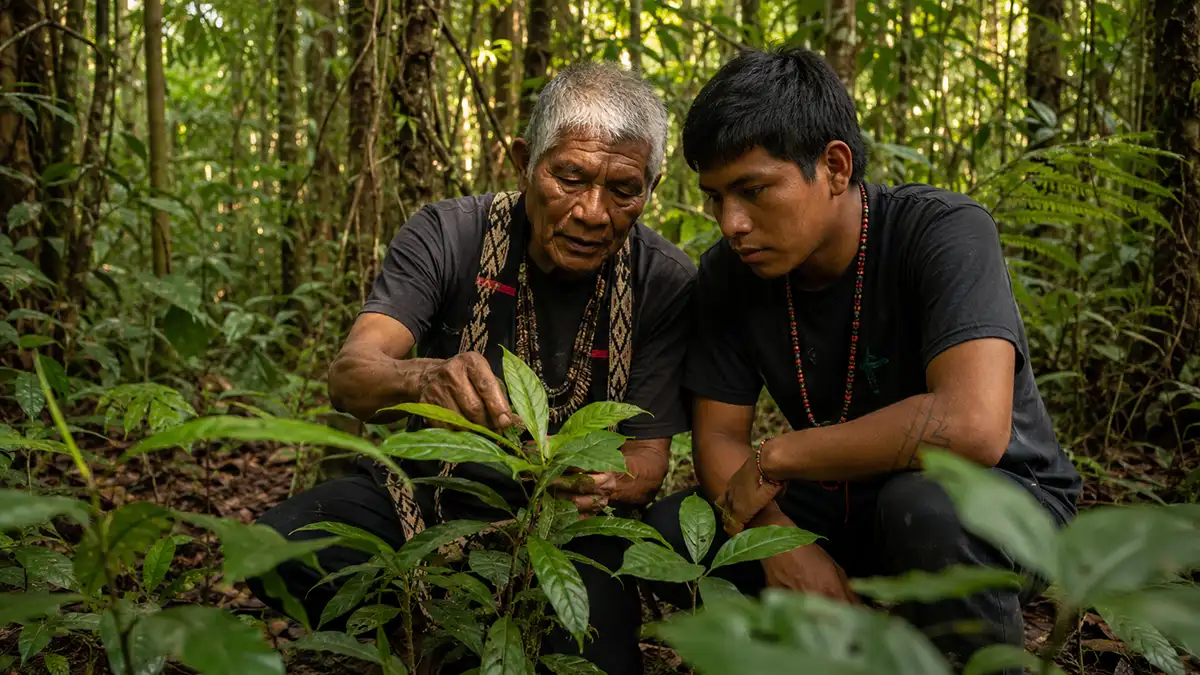
Among the Yawanawá and Huni Kuin peoples of the Amazon, trees are referred to as “avôs” (grandfathers) and “avós” (grandmothers)—elders who hold knowledge. Their sap is medicine. Their bark, protection. Their leaves, breath. The roots? The ancestral lifeline.
Tree spirits are honored in songs, called upon in ceremony, and visited in dreams. Some trees are said to be oracles—they reveal guidance through visions or sound when approached with reverence.
Chapter 2: The Root Network and the Web of Life
Beneath the forest floor lies one of the most astonishing and spiritually symbolic structures on Earth: the mycorrhizal network. This underground web connects tree roots to one another and to fungi in a symbiotic exchange of nutrients and information.
Science calls it the “Wood Wide Web.”
Spirituality calls it memory.
In this network:
- Older trees (mother trees) nourish younger saplings
- Trees warn each other of danger (such as pests or drought)
- Forests share resources communally, not competitively
The implications are profound. Trees do not simply exist. They commune. They nurture. They remember.
When we sit at the base of a tree, we sit atop an invisible library of Earth knowledge.
Chapter 3: Roots as Symbols of Grounding and Presence
In many spiritual practices, to be rooted is to be whole. Rooting is not just physical stability; it is energetic anchoring.
Trees teach us:
- How to stay still in chaos
- How to draw strength from deep sources
- How to be present, regardless of external conditions
Meditation with trees—placing your back to the trunk, your hands on the bark, or even lying face-down at the roots—is a practice used by forest shamans to absorb wisdom and recalibrate the nervous system.
The root chakra in yoga philosophy is the foundation of safety, survival, and connection to the Earth. When we feel scattered, anxious, or disconnected, returning to the roots—literally and energetically—can restore harmony.
Chapter 4: Trees in Ritual and Ceremonial Use
Specific trees play a vital role in traditional healing ceremonies:
- Ayahuasca Vine: Considered a teacher plant, often found entwined around large trees, the vine draws energy from deep roots and canopy light, symbolizing the path between worlds.
- Palo Santo (Bursera graveolens): A tree whose fallen branches are used in smudging and blessing rituals. The smoke is believed to carry prayers to the heavens.
- Samaúma (Ceiba pentandra): Known as the “Queen of the Forest,” the Samaúma is a towering being whose deep roots and wide crown represent cosmic balance. Some shamans say its roots hold the songs of the jungle.
In Afro-Brazilian Candomblé, trees are the dwelling places of orixás (deities), and offerings are made to them with the utmost respect.
Each species has a specific vibration, medicine, and message.
Chapter 5: Listening to the Roots
To receive the wisdom of the roots, one must first learn to listen.
Silence is the language of trees. They speak in frequency, in intuition, in felt sense. Some techniques for attuning to tree wisdom include:
- Tree Meditation: Sit with your spine against a tree. Breathe. Feel the slow pulse of the Earth rise through you.
- Dreamwork: Many medicine people dream with trees before harvesting bark or making decoctions. Keep a journal of tree symbols or forests in your dreams.
- Walking Barefoot in the Forest: This practice, sometimes called earthing, recharges the body’s electrical system and attunes you to the subtle messages of the land.
- Offerings and Dialogue: Bring water, song, or tobacco. Ask permission. Say thank you. You might receive guidance in unexpected ways.
The roots do not respond to force. They open to presence.
Chapter 6: Trees as Timekeepers and Memory Holders
Some trees live for hundreds—even thousands—of years. In their rings are encoded droughts, floods, solar flares, and atmospheric changes. But in their energetic field is stored something else: collective emotional memory.
Certain forest groves are known as “places of power.” People report spontaneous weeping, visions, or ancestral dreams when entering these zones. These may be places where Indigenous ceremonies were held for generations, or where a particular tree became a vessel for spirit.
The same way a crystal records energy, a tree can record presence. Imagine sitting beneath a being that has watched entire civilizations rise and fall. What might it teach you about your brief moment here?
Chapter 7: The Forest as Healer and Mirror
Forests are not escapes. They are teachers. They show us what we have forgotten in the noise of urban life:
- To breathe deeply
- To move slowly
- To listen before acting
- To support each other, as the trees do
The Japanese practice of shinrin-yoku, or forest bathing, is now scientifically proven to reduce stress, lower cortisol levels, and enhance immune response. But Indigenous cultures have known this all along.
The forest heals because it mirrors a deeper order. An intelligence beyond words.
Chapter 8: Protecting the Tree Elders
To honor the spiritual role of trees is also to protect them.
Deforestation not only erodes biodiversity—it silences voices. It cuts off memory. It rips pages from the book of life.
Supporting reforestation, Indigenous land rights, and sacred ecology projects is a spiritual act. It is not enough to receive wisdom from the roots. We must also defend their right to grow.
As we protect the trees, we protect ourselves.
Becoming Rooted in Spirit
In a world spinning faster by the day, the invitation of the trees is simple:
Come down. Breathe slow. Sink your roots into what is real.
The whispering roots do not shout. They wait.
They wait for the still ones, the listeners, the walkers of the quiet path.
They will share their songs with those who kneel, those who remember, those who return.
So next time you pass a tree, pause. Place your hand on its bark. Feel its pulse.
And know that somewhere in the silence beneath your feet, the Earth is remembering you too.
Continue exploring
All stories
The medicines of the forest