The Mystery of the Serpent: Guardian of the Forest’s Wisdom
The symbolism of the serpent in Indigenous cultures and its presence in spiritual visions
The Call of Silence
Deep in the forest, where the sunlight dances through the leaves and the earth pulses with the rhythm of creation, there lives a symbol that transcends continents, cultures, and time: the serpent.
It does not shout. It whispers.
It does not impose. It invites.
Invites transformation, listening, and a descent into the unseen.
For many forest-dwelling peoples, the serpent is not just an animal.
It is a spirit.
A guardian.
A living path between the physical and the spiritual realms.
Far beyond the visions provoked by Ayahuasca, the serpent appears in dreams, chants, dances, and stories passed down beside the fire. Its winding body represents life in spiral form — healing, power, and the eternal return.
The Serpent in Indigenous Traditions
In Amazonian traditions, the serpent is the silent teacher.
For the Huni Kuin, it is Nane Putxa, the spirit who lives in deep waters and guides healers in their journey.
Among the Yawanawá, it appears as the Sacred Anaconda, guardian of medicine and the spiritual gates.
It slides between worlds, knows the secrets of the roots, knows where the healing plants grow, and where the wounded spirits lie.
Unlike the Western lens that ties the serpent to sin or betrayal — like in the Judeo-Christian Eden — Indigenous traditions recognize it as a being of wisdom. An ally of the shaman. A protector of ancient knowledge. A messenger between Earth and sky.
A Body in Spiral: The Movement of Life
Watch a serpent glide across the forest floor. It does not move in straight lines like an arrow.
It dances.
It weaves.
It embraces the journey.
This spiral motion reflects the wisdom of nature:
- The vines that spiral around trees
- The whirlpools in the rivers
- The unfolding of leaves and petals
- Even the structure of DNA
The serpent teaches that true wisdom is not linear — it is layered.
It requires time.
It demands surrender.
It invites us to spiral inward, toward self-awareness.
The Serpent as Guardian of Ancestral Knowledge
Imagine a vast living library where each leaf, each root, each sound holds a story. Who is the librarian?
The serpent.
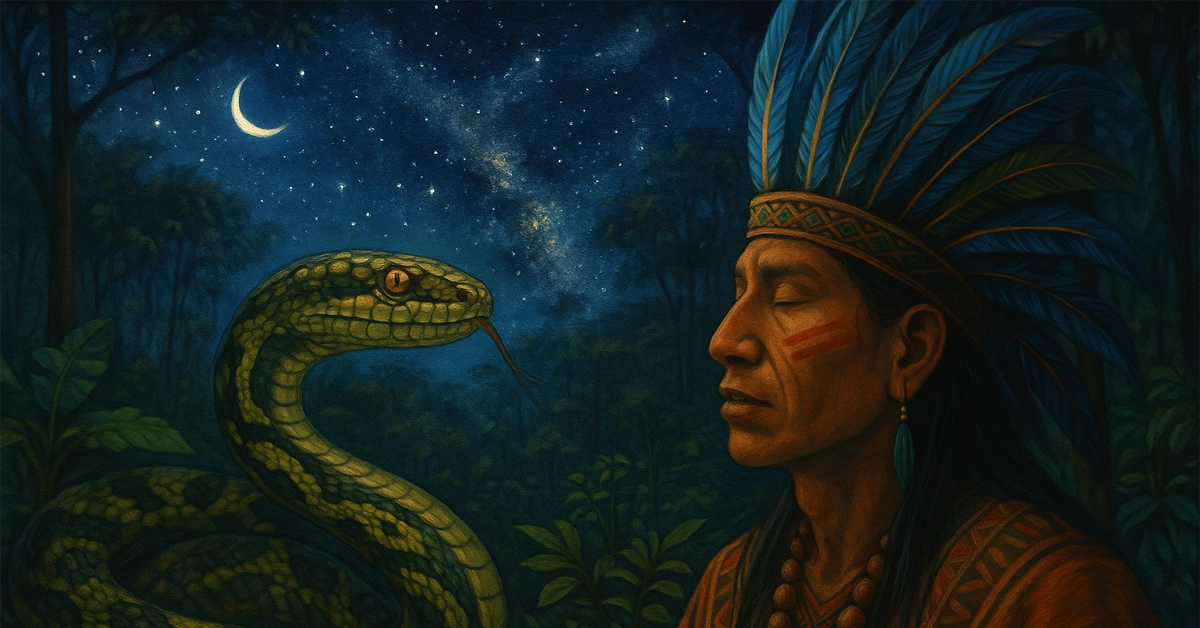
In the visions and prayers of forest peoples, the serpent often coils at the feet of healers, guarding sacred knowledge and protecting those who carry it.
It does not share its secrets easily.
One must approach it with humility, silence, and deep respect.
Ancestral knowledge is not bought or sold.
It is earned — through reverence, connection, and integrity.
To learn from the serpent is to listen to what is not spoken, to see what is hidden, and to remember what was never forgotten.
Kundalini Energy: The Inner Serpent
In Indian tradition, there is also a serpent — one that dwells at the base of the spine, coiled and sleeping.
She is Kundalini, the primal spiritual energy waiting to awaken.
When stirred, she rises along the energetic spine, activating centers of awareness, purifying inner blocks, and revealing our inner power.
The connection between Kundalini and the forest serpent is clear:
Both are hidden forces within.
Both are feminine, intuitive, alchemical.
Both awaken with reverence — not force.
To awaken the inner serpent is to embrace the fullness of life — its darkness, its light, and all the mystery in between.
The Serpent in Plant Spirit Visions
Although Ayahuasca is not our focus here, we cannot deny its link to the serpent archetype.
Many report seeing luminous, radiant serpents during ceremonies — sometimes terrifying, sometimes soothing — always teaching.
They do not speak in words, yet they convey deep understanding.
They do not heal directly, but point to the root of the pain.
These visions are not hallucinations.
They are manifestations of forest consciousness — nature itself taking shape to guide the human spirit back into balance.
Yet serpents appear outside of ceremony, too —
In dreams, meditations, and even physical encounters.
They can serve as guides, omens, or invitations to change.
The Fear of the Serpent: A Mirror of Our Shadow
Why do we fear the serpent so deeply?
Because it reveals what we hide.
It lives in the dark, moist, unseen places.
It sheds its skin.
It dies and is reborn in plain sight.
And that transformation is powerful.
And power — real, unfiltered power — can be terrifying.
The serpent does not seek worship.
It seeks presence.
It invites us to face ourselves honestly, to let go of what must die, and to be reborn with courage.
It is not the danger.
It is the doorway.
Mythical Serpents of the Forest
Throughout Indigenous mythologies, serpents appear as central, powerful figures:
- Boiúna (or Cobra Grande): A mighty river serpent of the Amazon, embodying the forces of nature and the spirit of the waters.
- Yacumama: “Mother of the Waters,” revered as protector of springs and aquatic beings.
- Amaru: In the Andes, a feathered serpent that connects the heavens, earth, and underworld — symbol of higher consciousness and evolution.
These are not just myths.
They are symbolic teachings, encoded in story form, to protect nature, honor the cycles of life, and pass on sacred knowledge.
Shedding Skin: A Rite of Passage and Healing
One of the most powerful images in spiritual life is the serpent shedding its skin.
It reminds us that we, too, must let go.
Of fears.
Of outdated beliefs.
Of old wounds.
Healing in the forest comes in layers.
The serpent invites us to peel them back — one at a time.
Without rushing.
With surrender.
With each layer we release, we come closer to our essence.
Not to perfection, but to truth.
Walking the Serpent Path in Everyday Life
You don’t need to live in the forest to walk with the serpent.
She may show up:
- In a recurring dream nudging you to transform
- In a calling to retreat, slow down, or seek stillness
- In moments when life demands you “shed your skin”
- In the quiet voice of intuition you keep ignoring
- Or even in a chance encounter that changes everything
The serpent can be your ally.
But like all powerful forces, she requires reverence.
You don’t control her.
You learn from her.
Serpent as Living Wisdom
In the end, the serpent is not just a symbol.
She is a living force.
She is the guardian of truths that cannot be spoken — only felt.
She is the bridge between body and spirit, earth and sky, shadow and light.
To honor the serpent is to remember:
That silence is sacred.
That change is holy.
That the spiral is the true path home.
May we walk gently through the forest and all that lives within it.
May we be worthy of the serpent’s gaze — not as threat, but as teacher.
And may we, upon meeting her, remember that the real power is the one that heals…
And that the deepest wisdom doesn’t shout:
It whispers,
like a serpent dancing
in the womb of the Earth.
Continue exploring
All stories
The medicines of the forest