Flowers of the Amazon: Messengers of Light and Mystery
When the Forest Blossoms
In the heart of the Amazon, beauty is not an ornament — it is a form of intelligence.
Every color, every fragrance, every petal that opens at dawn carries a message.
The forest does not bloom to impress; it blooms to communicate.
Through flowers, the Earth speaks — in light, in fragrance, in silence.
Among the dense canopy and winding rivers, flowers appear like sudden stars in the green universe. They remind us that even in the wildest depths of existence, grace finds its way. They are the forest’s smiles, its prayers, its living poetry.
To the Indigenous peoples of the Amazon, flowers are not mere decorations. They are symbols of creation, renewal, and spirit. Each one holds a story, a medicine, a song. To know them is to read the invisible language of life.
The Queen of the Waters: Vitória-Régia
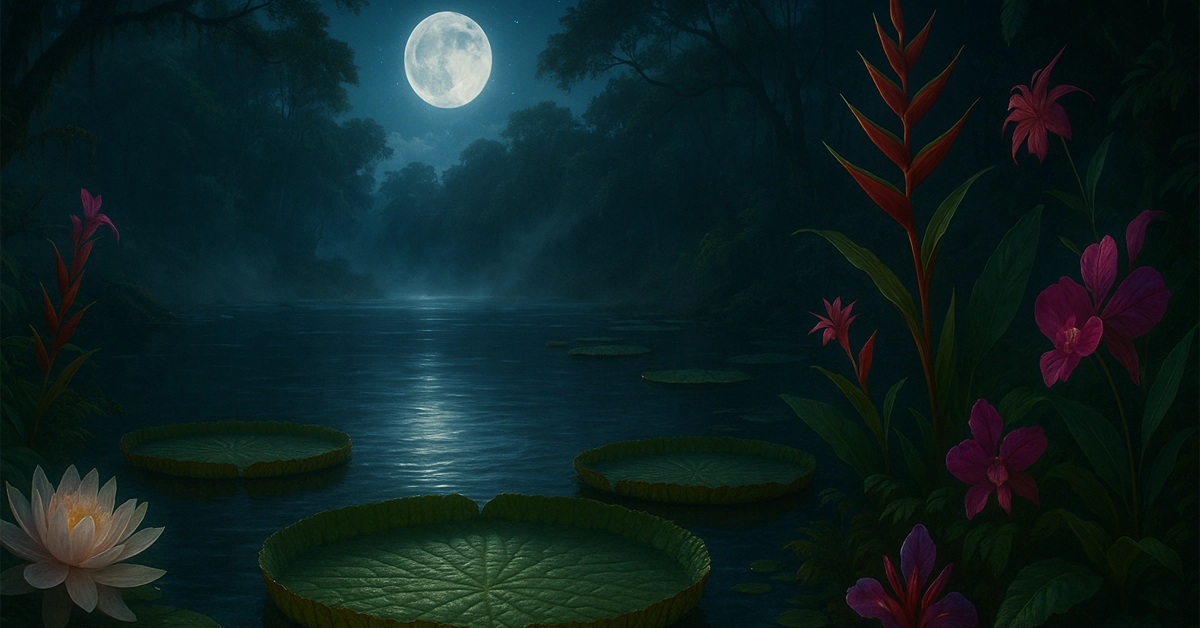
No flower of the Amazon is more legendary than the Vitória-Régia, the great water lily that opens at night on the still waters of the rivers.
Its story, passed from generation to generation, tells of a young woman named Naiá who fell in love with the moon. Every night, she would gaze at its reflection in the water, dreaming of becoming one of the celestial maidens. One night, she reached out to touch it — and disappeared beneath the surface.
Out of compassion, the moon transformed her into a flower that would bloom only under its light: the Vitória-Régia.
When it opens, it is pure white — symbol of innocence and spiritual love. By morning, it turns pink — symbol of awakening and transformation.
Floating upon the mirror of the water, the Vitória-Régia is a living bridge between the Earth and the sky. It teaches that beauty is born of longing, and that love, when pure, becomes light.
Its circular leaves, wide and strong, can hold the weight of a child — just as faith can carry the weight of the heart.
In the forest’s mythology, the Vitória-Régia is the flower of the soul: the one that opens in darkness and reveals its beauty to the moon.
Heliconia: The Flame of the Tropics
Wherever you walk in the rainforest, the Heliconia greets you like a burst of flame among the greens. Its bold colors — red, orange, yellow — seem to ignite the very air around it.
To the Indigenous mind, the Heliconia is the flower of vitality. It represents life force, the sacred fire that moves through all beings. Its upward shape resembles tongues of flame, pointing toward the sun.
Healers use it as a symbol of protection — a reminder that beauty can also be strength. The Heliconia attracts hummingbirds, those tireless messengers of joy, and thus becomes a portal for positive energy and communication between worlds.
In ceremony, some elders place Heliconia petals near the fire or altar, invoking clarity and courage. They say the flower embodies the energy of the sun — fierce yet life-giving — and that to contemplate it is to remember our own inner fire.
Passionflower: The Heart’s Crown
The Passionflower (maracujá flor) is perhaps one of the most intricate flowers in the world. Its tendrils twist like spirals of divine geometry. Its filaments radiate from a central crown. Its scent is subtle but intoxicating — a perfume that speaks of serenity and surrender.
To the forest peoples, this flower represents the heart of patience. Its medicine calms the mind and soothes the spirit, teaching the art of stillness amidst chaos.
In some stories, it is said that this flower was born from the tears of the forest after a storm — a reminder that peace follows every trial.
The Passionflower embodies balance — between activity and rest, between the seen and unseen. Its delicate vines climb toward the light, yet they hold firmly to the Earth.
To meditate with this flower is to learn that surrender is not weakness — it is wisdom. The flower does not force itself to bloom; it simply opens when the time is right.
Orchids of the Forest: The Spirits of Elegance
There are thousands of orchid species in the Amazon — each one more mysterious than the last. They grow on trees, hidden in shadows, suspended in air — like thoughts of the forest dreaming themselves into color.
To Indigenous shamans, orchids are the spirits of subtlety and refinement. They teach sensitivity, presence, and listening. Some tribes believe that orchids are the voices of the forest nymphs — those invisible beings who guard the harmony of nature.
Orchids bloom quietly, often unseen, yet their beauty transforms the space around them. They teach us the art of inner grace — to radiate without shouting, to shine without taking.
Their colors vary from deep violet (the frequency of spiritual transformation) to soft white (the vibration of purity and healing). Each orchid carries its own vibration, and healers sometimes use them as energetic symbols to harmonize the environment.
To gaze upon an orchid is to be reminded of humility: that true beauty does not demand attention — it attracts it naturally.
Bird of Paradise: The Flight of the Spirit
Though native to other tropical regions, the Bird of Paradise flower also thrives in parts of the Amazon basin, where it has taken on local spiritual meanings.
Its shape resembles a bird in flight — wings extended, poised for departure. To the spiritual eye, it represents the soul’s journey toward freedom.
The Bird of Paradise reminds us that beauty can be a form of flight — an ascent from limitation to creativity, from heaviness to joy. Its brilliant orange and blue petals symbolize fire and water united — the sacred marriage of passion and intuition.
In Indigenous teachings, this balance is essential: fire without water consumes, water without fire stagnates. The Bird of Paradise thus becomes a living reminder of harmony — the union of opposites that gives birth to art, healing, and love.
The Hidden Flowers: Miracles of the Understory
Not all flowers of the Amazon are grand or visible. Some bloom quietly beneath the leaves, seen only by those who walk slowly enough to notice.
These hidden blossoms are the secret keepers of the forest — humble, fragrant, unassuming. Their beauty is not meant to impress but to nourish the unseen relationships that sustain life: bees, bats, butterflies, and spirits.
To the people of the forest, these tiny flowers teach humility and service.
They remind us that the most important acts of beauty are often invisible.
They feed the world silently, expecting nothing in return.
In spiritual symbolism, these hidden flowers are the embodiment of the heart’s quiet radiance — the kind that doesn’t need recognition to bloom.
The Ceremony of Blooming
Every flower in the forest follows the rhythm of light, rain, and moon. Their blooming is a ceremony — one that happens not in temples but in time.
Some open only at night, guided by the stars. Others open at dawn, bathed in golden light. Each has its own sacred timing, its own dialogue with the cosmos.
This rhythm teaches us that growth is cyclical — that everything in life has its season. We cannot force awakening; we can only prepare for it.
When a flower opens, the forest rejoices — not in noise, but in vibration. The air changes. The scent spreads like a prayer. The entire ecosystem feels it.
And so do we, if we listen.
Flowers as Medicine
Many Amazonian flowers carry medicinal properties. Their petals, roots, and essences are used to heal body and spirit alike. But beyond chemistry, their greatest medicine is vibrational — the transmission of harmony itself.
When you sit before a flower and truly observe it — its colors, its form, its symmetry — your mind begins to mirror its order. This is the ancient art of florotherapy: to heal by resonance, not by force.
Each flower teaches a different lesson:
- Vitória-Régia – Opens the heart to lunar and feminine wisdom.
- Heliconia – Awakens courage and creative fire.
- Passionflower – Brings peace, rest, and acceptance.
- Orchid – Refines perception and inner beauty.
- Hidden Flowers – Teach humility and quiet strength.
To connect with these energies is to allow beauty itself to become your medicine.
The Language of Color
The colors of the Amazon are not random. They are frequencies — living expressions of the forest’s consciousness.
- Red symbolizes life force and passion.
- Orange ignites creativity and transformation.
- Yellow brings joy and clarity.
- Green restores harmony and healing.
- Blue connects to intuition and peace.
- Violet opens portals to spirit.
- White purifies and elevates.
When the forest blooms, it is the Earth speaking through light. To look upon a flower is to look upon energy made visible — a vibration you can feel with your whole being.
The Feminine Spirit of the Forest
In Indigenous cosmology, flowers are the daughters of the Earth — born from her joy and sensitivity. They represent the feminine side of creation: receptive, nurturing, sensual, and compassionate.
Every flower is an offering — from the Earth to the sky, from the Mother to the Father. Their blooming is a song of love sung in color.
This feminine essence is why flowers are so often used in ceremony — woven into crowns, laid upon altars, or placed upon the water. They carry the vibration of beauty that heals without words.
To work with flowers is to remember the art of gentleness — to heal through tenderness, to bless through beauty.
Messages from the Flowers
When you encounter a flower, it may be speaking to you.
Not in language, but in energy.
- A flower that falls before your feet may be asking you to slow down.
- A bloom that opens suddenly near your home may be reminding you to appreciate the present.
- A wilted petal might whisper about endings and renewal.
The forest speaks constantly through such signs — through flowers, birds, rain, and wind. Those who walk with awareness can hear it.
In ceremony, many shamans receive visions through flowers — the spirits of plants revealing knowledge, healing, and prophecy. The flowers become portals to understanding the great web of life.
Beauty as a Path of Awakening
In a world that worships speed and utility, flowers remind us of something deeper: that beauty itself is a path to awakening.
When we contemplate a flower with full attention, the mind stops. Time dissolves. What remains is pure presence.
That moment of stillness is enlightenment in its simplest form — not a distant goal, but a glimpse of unity. The flower teaches us how to be: rooted, open, radiant, and ephemeral.
The Buddha is often depicted sitting upon a lotus for this reason — not because of doctrine, but because a flower embodies the very essence of awakening: born from the mud, yet untouched by it.
The flowers of the Amazon carry the same message:
Purity is not the absence of struggle, but the grace that grows through it.
The Forest in Bloom Within Us
When we look at a flower, we are seeing ourselves reflected in another form of life.
We too are meant to bloom — to unfold layer by layer, revealing the colors of our soul.
The forest’s flowers remind us that the purpose of beauty is not to decorate the world, but to heal it. Each petal is a prayer for harmony. Each scent is a call to remembrance.
To walk among them is to walk through living temples — places where the Earth herself worships creation.
So when you next encounter a flower, pause. Breathe. Listen.
You may discover that it is not you who is admiring the flower — it is the forest admiring you through its petals.
Because in truth, we are all blossoms of the same garden — born from light, growing through darkness, and destined to open fully before returning to the source.
Continue exploring
All stories
The medicines of the forest