
Forest People
The Colors of the Forest: The Language of Natural Dyes and Body Paints
Oct
When the Forest Paints the Soul
Before there were canvases, there was skin.
Before there were brushes, there were leaves, fingers, and feathers dipped in the living palette of the Earth.
Long before art was confined to galleries, it was danced in ritual — painted upon bodies, stones, and trees under the open sky.
In the Amazon, color is not decoration.
It is identity, protection, and prayer.
Every hue — red, black, yellow, white, blue, green — carries a vibration, a meaning, a presence.
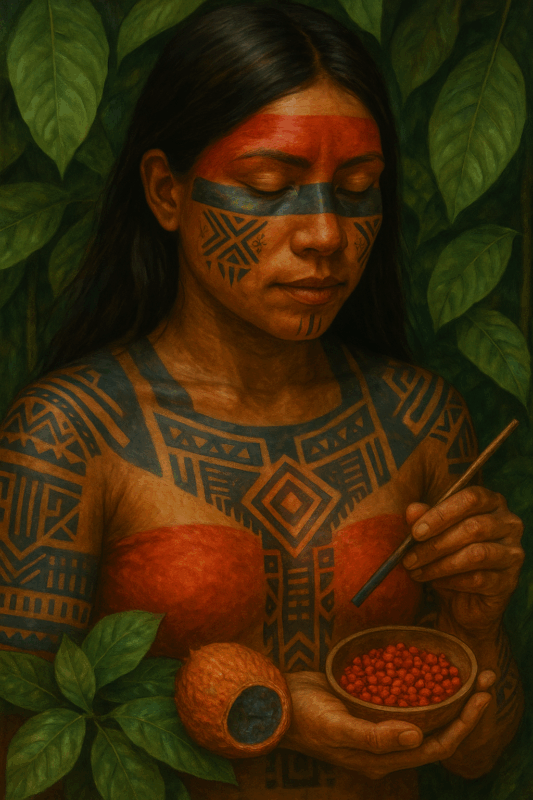
To the Indigenous peoples of the forest, painting the body is not vanity; it is a ceremony.
It is how one speaks to the invisible world.
Through the sacred pigments of urucum, jenipapo, charcoal, clay, and plant ashes, the people of the forest weave symbols on the skin that tell who they are, where they come from, and what spirit they invoke.
Each mark is a word in the forest’s silent language — a reminder that color itself is alive.
The Sacred Origins of Natural Pigments
The use of natural pigments is as ancient as fire.
In the heart of the Amazon, the ancestors discovered that the forest was also a painter — that beneath her bark, seeds, and fruits hid infinite tones of red, black, yellow, and blue.
Urucum: The Red of Life and the Blood of the Sun
Urucum (Bixa orellana), also known as annatto, produces a deep, fiery red pigment from its tiny seeds.
To the peoples of the forest, this is the color of vitality, courage, and sacred fire.
It represents the energy of the Sun — the masculine principle, protection against evil, and the spark of life itself.
Warriors once covered their bodies with urucum before battle, invoking strength and radiance.
Mothers paint their children to guard them from illness and spiritual harm.
Its red is not aggression but affirmation — a reminder of the heart’s flame and the sacred blood that flows through all beings.
Jenipapo: The Blue of Mystery and Spirit
If urucum is the Sun, jenipapo (Genipa americana) is the Moon.
The fruit’s juice, when exposed to air, oxidizes into a deep indigo-blue — a pigment used for centuries to adorn the skin in intricate geometric patterns.
This color represents the night, introspection, the world of dreams, and the invisible spirits that walk beside us.
Many tribes believe that painting with jenipapo invites spiritual protection, connecting the wearer to ancestral wisdom.
Its cool tone soothes the fiery nature of urucum, balancing passion with intuition.
Together, the two colors mirror the cosmic duality of the forest — the dance of day and night, sun and moon, masculine and feminine.
The Body as Sacred Canvas
To paint the body is to awaken it.
The act itself is meditative — each line drawn with intention, each dot a seed of prayer.
The designs painted before ceremonies are not arbitrary; they are maps of energy.
They may represent rivers, constellations, or the pathways of the soul.
They prepare the body to become a vessel of the divine.
In initiation rituals, the patterns can signify one’s lineage, totem animal, or spiritual mission.
During healing ceremonies, the marks channel protection and alignment.
For festivals, they celebrate beauty and belonging — a visible expression of joy and gratitude.
When the paint touches the skin, something ancient awakens.
It is as if the body remembers its original language — the language of vibration, rhythm, and color.
The Language of Colors
Each tone used by the forest peoples carries a symbolic resonance that extends beyond aesthetics.
It speaks to the invisible threads that weave the human soul into the web of creation.
|
Color |
Source |
Meaning |
|
Red |
Urucum, clay, cochineal |
Vitality, life force, protection, courage, fire, the heart. |
|
Black |
Charcoal, ashes, jenipapo (dark phase) |
Mystery, grounding, ancestral power, death and rebirth. |
|
White |
Clay, kaolin, ashes |
Purity, moonlight, spiritual clarity, peace. |
|
Yellow/Gold |
Turmeric, earth minerals |
Wisdom, sunlight, abundance, divine illumination. |
|
Green |
Crushed leaves, chlorophyll |
Fertility, growth, the healing power of the Earth. |
|
Blue |
Jenipapo, rare minerals |
Spirit, dreams, intuition, the world beyond sight. |
These colors are not separate from nature; they are nature — encoded frequencies of light translated into matter.
When applied to the skin, they reconnect the body’s vibration with the forest’s living frequency.
The Ritual of Painting
Before a ceremony begins — whether for healing, celebration, or protection — women and men gather with bowls of pigment, feathers, and small sticks.
Laughter mingles with silence as they prepare each color.
The smell of urucum mixes with the sweetness of jenipapo, and soon a sacred stillness fills the air.
Each person takes turns painting another, for in the forest, one never paints oneself.
It is an act of community — a reminder that our identity is reflected in one another.
As the lines emerge, songs rise: melodies that honor the spirits of the plants from which the dyes were made.
The painters sing to Nixi Pae (the vine of visions), to the Mother of the Colors, to the spirits of water and fire that bless their art.
By the end, every body shines with the geometry of the tribe — each person a walking tapestry of prayer.
To the untrained eye, it is beautiful.
To the initiated, it is divine communication.
Colors as Medicine
The pigments are not only symbolic — they are medicinal.
Urucum is rich in antioxidants and protects the skin from insects and sunlight.
Jenipapo cools inflammation and helps heal minor wounds.
Clay and ash detoxify the pores and regulate body temperature.
The forest never separates beauty from health.
When one paints the body, one also nourishes it.
In this way, art, medicine, and spirituality merge into a single act of harmony.
Even the fragrances — earthy, fruity, smoky — have their own therapeutic effects.
They calm the mind and align the breath with the rhythm of nature.
To wear these colors is to participate in the Earth’s own healing ceremony.
Geometric Codes and Spiritual Patterns
Many Indigenous designs follow geometric patterns — spirals, diamonds, zigzags, concentric circles.
These are not random decorations but sacred codes, echoing the structures of the natural world: snake scales, butterfly wings, the flow of rivers, the web of stars.
Among the Shipibo people, for example, every line represents a song — a vibrational pathway between worlds.
To paint such a pattern is to bring that song into the visible realm.
The kené, as they call these designs, are living prayers that align body and spirit.
In the Huni Kuin tradition, geometric symbols mirror the patterns seen in visions during ceremonies with nixi pae (ayahuasca).
They are messages from the plant spirits — blueprints of harmony and protection.
Thus, the painted body becomes a bridge between dimensions, carrying the codes of healing that sustain the tribe’s relationship with the unseen.
The Feminine Hand of the Painter
In many tribes, it is the women who paint — mothers, sisters, daughters who carry the ancestral knowledge of color.
They mix the pigments with songs, blending laughter and memory.
Their art is not only external; it is the transmission of lineage through the gesture of care.
A mother painting her child’s face before a celebration is not simply adorning—it is blessing.
A lover tracing lines on her partner’s skin is invoking connection and protection.
An elder painting the forehead of a young initiate is passing the flame of identity.
This intimate act reminds the community that art is not separate from affection — that love itself is a sacred pigment.
The Disappearance and Revival of the Ancient Palette
For centuries, colonization attempted to erase these colors.
Missionaries forbade body painting, calling it “pagan.”
Industrial dyes replaced natural pigments.
The forest’s sacred art was nearly silenced.
But traditions, like seeds, never truly die.
In recent decades, Indigenous communities have revived their ancestral aesthetics as a form of cultural sovereignty and spiritual remembrance.
Young artists now learn the old recipes for urucum and jenipapo, mixing them again with water, ash, and song.
Festivals, ceremonies, and even modern fashion now echo these designs — bringing ancient color codes to new generations.
What once was forbidden has become a statement of pride, identity, and connection to the Earth.
Every painted line today is an act of resistance — and a gesture of love for the living memory of the forest.
The Metaphor of Painting the Soul
At a deeper level, the practice of body painting invites us all to ask: What colors paint my spirit?
It is a metaphor for self-expression and transformation.
Just as Indigenous painters prepare the pigments with reverence, we can prepare our emotions with mindfulness.
Each color can become a meditation:
- Red for courage and vitality.
- Blue for peace and intuition.
- Green for healing and compassion.
- Black for grounding and mystery.
- White for clarity and surrender.
We may not use urucum or jenipapo, but we can still wear the essence of their teachings — through the way we live, the words we speak, the energy we radiate.
In this sense, every day becomes a painting — every gesture a brushstroke on the canvas of existence.
Sustainability and Sacred Beauty
Natural pigments also offer a lesson in ecological respect.
They come from renewable sources — fruits, leaves, roots, and stones — and return harmlessly to the soil and water.
Their making involves gratitude, not extraction.
In contrast, synthetic dyes used in modern cosmetics and textiles pollute rivers and poison ecosystems.
Reconnecting with the ancestral palette reminds us that beauty does not have to cost the Earth.
It shows us a path of sacred sustainability — where art and ecology coexist, where color becomes prayer, and where beauty is an offering, not a commodity.
The Eternal Dance of Color and Spirit
The forest paints without fear.
Every morning, she spreads new tones of light across leaves, feathers, and petals.
Every sunset, she erases her own art — only to begin again the next day.
In her rhythm, we learn impermanence.
The Indigenous painters understand this truth: the body paint fades, but the energy remains.
Beauty is not meant to last forever; it is meant to awaken.
Each ceremony, each mark, each pigment is a momentary union of human and nature, matter and spirit.
And when it washes away in the river, the water carries the prayer onward — painting the world anew.
Becoming the Colors of the Forest
In the end, the colors of the forest are not only seen — they are felt.
They live in our blood, our memories, our dreams.
To paint oneself with them is to remember that we, too, are part of the Earth’s living artwork.
The ancestors teach that every being is a color in the divine spectrum — some fiery, some calm, all necessary.
When humanity learns again to live as one palette, balanced in diversity and united in purpose, the Earth will shine in her full brilliance once more.
Until then, may we walk painted by gratitude.
May our hearts glow with urucum, our souls flow with jenipapo, and our lives become canvases of harmony.
Because the forest has always been painting us —
and now, it’s time we remember how to paint with her.
🌿 Enter the Forest
Receive occasional transmissions from the rainforest — sacred medicines, stories, fresh arrivals, and ceremonial wisdom.
No noise — only occasional letters from the forest. Unsubscribe anytime.